

CG Policy · 2025
In this section7 topics
Corporate Governance Policy
Has a Corporate Governance Policy
Yes
Policy Description
1. Corporate Governance Policy
The Board of Directors believes that having a good, transparent, and auditable management system, along with adequate and appropriate checks and balances and internal control systems, coupled with respecting shareholders' rights and equality and being responsible to stakeholders, will be crucial factors in strengthening the organization's resilience and fostering balanced and sustainable long-term growth.
Therefore, the Board of Directors has established a corporate governance policy for all directors, executives, and employees to adhere to as a guideline for their operations, as follows:
1. All directors, executives, and employees are committed to implementing the principles of corporate governance, business ethics, and the code of conduct for directors, executives, and employees in the company's operations.
2. All directors, executives, and employees must perform their duties with responsibility, care, honesty, and integrity, by complying with laws, company regulations, and relevant announcements.
3. Ensure that the company's management structure defines the powers, duties, and responsibilities of the Board of Directors.
4. Ensure that internal control and risk management systems are at an appropriate level, including having accurate and reliable accounting and financial reporting systems.
5. Ensure sufficient, reliable, and timely disclosure of important information, as long as it does not affect the legitimate interests of the company.
6. Recognize and respect the ownership rights of shareholders, and treat shareholders equally.
7. Operate with consideration for responsibility towards shareholders, stakeholders, communities, society, and the environment.
8. Strive for excellence in business operations by committing to customer satisfaction through listening and self-reflection, to continuously enhance management potential and create the best.
9. Instill virtues and ethics, foster good conscience, treat employees fairly, and commit to continuously developing and enhancing personnel capabilities.
10. Combat fraud and corruption, refrain from intellectual property infringement, and respect laws and human rights.
11. Manage conflicts of interest with prudence and reason, prioritizing the company's interests.
2. Principles of Corporate Governance Divided into 5 categories as follows:
1. Rights of Shareholders (Rights of Shareholders)
1.1 The Board of Directors recognizes and respects the ownership rights of shareholders. No actions are taken that violate or infringe upon shareholders' rights. The Board acts to fairly protect the interests of shareholders, as well as to support and encourage all shareholder groups, whether domestic or international, including major shareholders, minority shareholders, or institutional shareholders, to exercise their rights. These include fundamental shareholder rights, the right to adequate and timely access to information, and the right to attend shareholders' meetings to determine operational direction and make decisions on matters with significant impact on the company.
1.2 The Board of Directors provides shareholders with the opportunity to propose meeting agendas and submit questions in advance of the shareholders' meeting, by publishing the criteria for proposing agenda items and submitting questions in advance on the company's website.
1.3 The Board of Directors ensures that information regarding the date, time, venue, and agenda of the meeting is provided, with explanations and reasons for each agenda item included in the notice of meeting, and that the meeting venue is convenient for travel.
1.4 The Board of Directors grants shareholders the right to approve directors' remuneration annually, with established criteria for remuneration of each committee's directors.
1.5 The Board of Directors promotes the use of technology in shareholders' meetings to ensure accuracy and speed, with item-by-item voting, granting shareholders the right to elect directors individually, and using ballot papers, as well as having an independent person verify the vote count.
1.6 The Board of Directors discloses the resolutions of the shareholders' meeting to the public, along with the voting results for each agenda item, on the company's website on the next business day.
1.7 The Board of Directors prepares minutes of the shareholders' meeting, recording the explanation of voting procedures, names of directors, sub-committee members, and executives present and absent, voting results for each agenda item with questions and answers. No additional agenda items not specified in the notice of meeting are added, and the minutes are disclosed to the public on the company's website.
In 2025, the company held its Annual General Meeting of Shareholders on Tuesday, April 29, 2025, at 2:00 PM, at Kingbridge Hall, 4th Floor, Kingbridge Tower, No. 989 Rama 3 Road, Bang Phong Phang Sub-district, Yannawa District, Bangkok, which is convenient for shareholders' travel.
The company grants shareholders rights according to established policies, such as the right to propose agenda items and directors, submit questions in advance, prepare clear meeting invitations sent in advance as required by law, and disclose clear meeting results and voting resolutions. Details are available on the company's website. www.newcity.co.th Topic: Investor Relations/Shareholder Information
Information Disclosure Policy and Promotion of Shareholder Meeting Participation
The company prioritizes the rights of all shareholder groups to attend shareholders' meetings, with the following policies and guidelines:
1. Transparent and Accessible Shareholders' Meetings
o The company organizes shareholders' meetings in a format that allows all shareholder groups to participate, creating an environment conducive to fair access to information and voting.
o Meeting documents and financial reports are prepared and sent to shareholders in advance within the period prescribed by law.
2. Advance and Complete Information Disclosure
o Provide important information regarding agenda items, such as financial statements, proposals for director appointments, and approval of significant matters, with easy-to-understand explanations. o Disseminate information via the company's website and notify the Stock Exchange to enable shareholders to study information in advance and prepare questions.
3. Promote Participation and Voting
o Encourage shareholders to exercise their voting rights either by attending in person or through a proxy / electronic voting (e-Voting) in accordance with legal requirements.
o Provide clear instructions on voting procedures and meeting registration.
4. Equality and Prevention of Bias
o All shareholder groups are given equal opportunities to attend meetings and express opinions.
o The company does not discriminate against or restrict shareholders' rights based on the size of their shareholding.
5. Report on the results of the Shareholders' Meeting
o The company prepares clear Minutes of Meeting and discloses them to all shareholders, and publishes them on the company's website within the legally prescribed timeframe.
2. Equitable Treatment of Shareholders (Equitable Treatment of Shareholders)
2.1 The Board of Directors treats all shareholders fairly and equally, with shares of the same type having equal voting rights, equivalent to one share per one vote.
2.2 The Board of Directors encourages shareholders who cannot attend meetings in person to appoint proxies to attend and vote on their behalf, using a proxy form that allows shareholders to specify their voting direction, and proposes at least one independent director as an option for shareholders to appoint as proxy.
2.3 The Board of Directors provides minority shareholders with the opportunity to nominate individuals for election as directors at the Annual General Meeting of Shareholders.
2.4 The Board of Directors published the notice of the shareholders' meeting on the company's website at least 30 days prior to the meeting date, in both Thai and English.
2.5 The Board of Directors encourages all shareholders to exercise their rights as shareholders by sending notices of shareholders' meetings and supporting documents for advance consideration, with an English version provided for foreign shareholders.
2.6 The Board of Directors establishes a policy to prevent the use of inside information and implements measures to prevent the misuse of inside information for personal gain or the undue benefit of others. This prohibits directors, executives, and employees in departments with access to inside information from trading the company's securities during the 1-month period prior to the public disclosure of financial statements.
2.7 The Board of Directors requires directors and executives to report their interests and those of related persons, manage conflicts of interest with prudence, and comply with the regulations of the Securities and Exchange Commission.
In the past year 2025, the company found no actions violating the conflict of interest policy. During the Board of Directors' meeting, an agenda item was set regarding the reporting of changes in securities holdings by directors and related persons to the company and to the Securities and Exchange Commission. The reporting criteria and methods were communicated, recorded in the Board meeting minutes, and jointly acknowledged.
3. Consideration of the Role of Stakeholders (Role of Stakeholders)
3.1 The Board of Directors recognizes and respects the rights of various stakeholder groups, taking into account their legal rights or agreements with the company, to ensure that these rights are protected and treated fairly and equally. Therefore, policies have been established as guidelines for dealing with each stakeholder group, as well as considering communities, society, and the environment for sustainable development, combating fraud and corruption, refraining from intellectual property infringement, and respecting human rights.
3.2 The Board of Directors supports the preparation of a social responsibility report as part of the annual report.
3.3 The Board of Directors ensures that channels and procedures are available for all stakeholder groups to report or complain about matters that may cause damage to the company, the accuracy of financial reports, or issues of unfair treatment.
3.4 The Board of Directors has established policies or guidelines for protecting employees or whistleblowers in matters that may cause damage to the company or involve unfair treatment.
4. Disclosure and Transparency (Disclosure and Transparency)
4.1 The Board of Directors oversees the accurate, transparent, and timely disclosure of important information in accordance with relevant laws and regulations, including information reported periodically according to accounting cycles and event-driven information that affects shareholders' rights and benefits, as well as other disclosures in line with the principles of good corporate governance of the Stock Exchange of Thailand, as long as it does not affect the legitimate interests of the company. Information is disclosed via the company's website, the Stock Exchange of Thailand's dissemination channels, in both Thai and English, and other channels that allow for widespread and equal access to information.
4.2 The Board of Directors arranges for a department or person responsible for investor relations. Mr. Adul Srimadee is designated as the company's investor relations officer, responsible for providing information and news about the company to investors and interested parties, contactable via the company's website at www.newcity.co.th Topic: Investor Relations Information
In 2019, companies in the Saha Group, in collaboration with the Stock Exchange of Thailand, organized the "Analysts and Investors Meet Saha Group 11th Edition" event on Friday, June 28, 2019, at the Ballroom, Queen Sirikit National Convention Center, within the 23rd Saha Group Fair. This event provided executives from all 13 listed companies with the opportunity to meet analysts, investors, and media to clarify information about their businesses, operations, economic outlook, industry, and significant developments within the group companies, as well as to allow everyone to visit new products and innovations from the group, which garnered significant interest from investors. From 2020 to 2022, the event was canceled due to the COVID-19 pandemic.
5. Responsibilities of The Board (Responsibilities of The Board)
5.1 The Board of Directors defines the structure of the Board of Directors, comprising individuals with diverse knowledge, abilities, and experience, without gender restrictions, and possessing qualifications as prescribed by law. There must be at least 1 non-executive director with experience in the company's business, and independent directors as per the announcement of the Securities and Exchange Commission.
5.2 The Board of Directors defines independent directors to meet at least the criteria set by the Securities and Exchange Commission.
5.3 The Board of Directors appoints sub-committees to help screen important tasks for submission to the Board of Directors.
5.4 The Board of Directors has prepared charters for each committee, defining terms of office and scopes of authority and duties, to clearly delineate roles, responsibilities between the Board of Directors, sub-committees, and management.
5.5 The Board of Directors has a policy requiring directors and executives who hold directorships in other companies to report to the Chairman of the Board and the Chairman of the Audit Committee.
5.6 The Board of Directors ensures the appointment of a Company Secretary to perform duties as required by law and as assigned. The Company Secretary should possess knowledge in law or accounting, or have completed relevant training courses on the duties of a Company Secretary, and continuously undergo training and knowledge development.
5.7 The Board of Directors has established a corporate governance policy, business ethics, and a code of conduct for directors, executives, and employees of the company to adhere to consistently.
5.8 The Board of Directors has defined the company's vision and mission to ensure that directors, executives, and employees share a common direction.
5.9 The Board of Directors has a policy to promote and support the continuous development of knowledge for directors, executives, and employees.
5.10 The Board of Directors sets meeting schedules in advance each year. In considering various agenda items, the interests of shareholders and all relevant parties are fairly taken into account. All directors have independence in expressing their opinions, and directors with a conflict of interest do not have the right to vote on agenda items where they have such an interest.
5.11 The Board of Directors requires directors to attend all Board of Directors meetings, except in cases of necessity.
5.12 The Board of Directors has a policy to encourage senior executives to attend Board of Directors meetings.
5.13 The Board of Directors has a policy to allow non-executive directors to meet among themselves as necessary, without the presence of management, and should inform the Managing Director of the meeting results.
5.14 The Board of Directors has a policy to encourage all directors to access necessary additional information from the Managing Director, Company Secretary, or other assigned executives within the defined policy scope. In necessary cases, the Board of Directors may arrange for independent opinions from consultants or external professionals, with the cost borne by the company.
5.15 The Board of Directors has measures to address conflicts of interest with prudence and reason, and to comply with the regulations of the Securities and Exchange Commission and the Stock Exchange of Thailand.
5.16 The Board of Directors prohibits directors and executives from trading the company's securities during the 1-month period prior to the public disclosure of financial statements.
5.17 The Board of Directors requires directors, executives, as well as their spouses and minor children, to report their holdings and changes in holdings of the company's securities to the Securities and Exchange Commission and to submit a copy to the Company Secretary for reporting to the Board of Directors at the next Board meeting.
5.18 The Board of Directors requires directors and executives to report their interests and those of related persons, according to established criteria.
5.19 The Board of Directors established an internal audit unit as a department within the company, with a reporting line to the Audit Committee.
5.20 The Board of Directors mandates an annual performance evaluation of the Board of Directors.
5.21 The Board of Directors prepares a report on the Board's responsibility for financial reports, which is included in the annual report.
5.22 The Board of Directors oversees and ensures the payment of appropriate remuneration to each committee's directors, based on their authority and responsibilities, and compared to practices in the same business group.
5.23 The Board of Directors establishes a policy for employee succession planning in various roles to facilitate advancement to higher positions.
5.24 The Board of Directors arranges an orientation for directors who are newly appointed to the company.
5.25 The Board of Directors ensures the establishment of internal control and risk management systems.
5.26 The Board of Directors mandates the monitoring and evaluation of corporate governance by establishing a Corporate Governance Committee.
Policy & Practices — Board of Directors
Has Policy & Guidelines for the Board
Yes
Board Guidelines
| Guideline | Detail |
|---|---|
| Nomination of Directors | The Board of Directors recognizes the importance of management in accordance with good corporate governance principles, which will enable the company to grow steadily and sustainably, building confidence among all stakeholders. Therefore, it deems appropriate to appoint a Nomination and Remuneration Committee to perform the duties specified in this charter. Appointment and Qualifications The Board of Directors shall appoint the Nomination and Remuneration Committee, consisting of at least 3 members from the entire Board of Directors, with more than half being independent directors, and the Chairman of the Committee being an independent director. By resolution of the Board of Directors Meeting No. 6/2565 on December 13, 2022, the Nomination and Remuneration Committee was appointed as follows: 1. Mr. Piratchai Prakobsap Chairman 2. Dr. Kaweepong Hirankasi Director 3. Mr. Pipop Chokwatana Director 4. Mrs. Patcharin Treekulkittipan Committee Secretary
Term of Office and Remuneration Members of the Nomination and Remuneration Committee shall hold office for a term equal to that of a director of the company, commencing from the date of appointment. Upon completion of their term, if the Board of Directors has not yet appointed a new committee, the existing Nomination and Remuneration Committee shall continue to perform its duties until a new committee is appointed by the Board of Directors. Should a member of the Nomination and Remuneration Committee vacate office or be unable to complete their term for any reason, the Board of Directors shall appoint a replacement within 3 months from the date of term completion or vacation of office. The replacement shall serve for the remainder of the term of the member they replace. Members who have completed their term may be reappointed. In addition to the expiration of their term, a member of the Nomination and Remuneration Committee shall vacate office upon disqualification, resignation, death, or a resolution by the Board of Directors to remove them from office. The Nomination and Remuneration Committee members shall receive remuneration appropriate to their duties and responsibilities, subject to approval by the Board of Directors and shareholders. Duties and Responsibilities The Nomination and Remuneration Committee has the following duties and responsibilities: (1) Consider and select suitable individuals to be appointed as directors and propose them to the Board of Directors. (2) Verify the background and various information of selected individuals, considering their knowledge, abilities, experience, and diverse professional expertise in accordance with the company's Board Skill Matrix and alignment with business strategies, without restriction based on gender, age, or nationality. (3) Prepare opinions or recommendations for the Board of Directors' consideration. (4) Review, revise, and amend the charter of the Nomination and Remuneration Committee and submit it to the Board of Directors for consideration. (5) Evaluate the performance of the Nomination and Remuneration Committee and prepare performance reports to inform the Board of Directors and disclose to shareholders annually. (6) Consider remuneration for the Board of Directors and sub-committees, based on fair and reasonable criteria, methods, and structures, taking into account performance, company operating results, industry practices, and scope of duties and responsibilities, and propose to the shareholders' meeting for approval. (7) Perform any other duties assigned by the Board of Directors.
Meetings The Nomination and Remuneration Committee must meet at least twice a year. To convene a meeting, the Chairman or a person designated by the Chairman shall send a notice of meeting at least 7 days prior to the meeting date. The Chairman may arrange for the committee meeting to be held via electronic media or may pass a resolution without holding a meeting if approved by the Chairman and all committee members sign their consent to such resolution. A meeting of the Nomination and Remuneration Committee shall constitute a quorum if at least half of the total number of Nomination and Remuneration Committee members are present. If the Chairman of the Nomination and Remuneration Committee is not present at the meeting, the attending Nomination and Remuneration Committee members shall elect one of their members to be the chairman of the meeting. Resolutions of the meeting shall be decided by a majority vote. Each member of the Nomination and Remuneration Committee shall have one vote. In the event of a tie, the chairman of the meeting shall cast an additional vote as a deciding vote. The secretary of the Nomination and Remuneration Committee shall not have the right to vote. Any member of the Nomination and Remuneration Committee who has a personal interest in any matter or any interest in the matter under consideration must inform the meeting and abstain from giving opinions, voting, and leaving the meeting room, unless the meeting, excluding the interested member, unanimously resolves to allow the interested member to participate in clarifying information during the meeting for thorough consideration and decision-making, but without the right to vote or make decisions on that matter. The Nomination and Remuneration Committee has the authority to invite management, relevant parties, or any suitable persons to attend meetings or provide clarifications, as well as the authority to request relevant documents. |
| Determination of Director Remuneration | The Remuneration Committee is responsible for considering the appropriate remuneration budget for directors, proposing it to the Board of Directors for consideration, and then to the shareholders' meeting for approval of the said remuneration budget. The 54th Annual General Meeting of Shareholders for the year 2022, held on April 26, 2022, approved a total remuneration budget for company directors not exceeding 2.4 million Baht per year, with the Remuneration Committee assigned to consider the allocation. Executive remuneration is in accordance with the principles and policies set by the Remuneration Committee, which is determined based on the performance of each executive and paid as: • For serving as a company director - Meeting allowance for serving as Chairman of the Board: 5,000 Baht/meeting, and for each company director: 3,000 Baht/meeting. - Annual remuneration is paid to all company directors. The meeting allowances and committee remuneration are paid within the budget approved by the shareholders' meeting. The Board of Directors serves on the Executive Committee, and the Executive Committee and sub-committees do not receive remuneration other than their regular salaries. • For serving as an Audit Committee member - Meeting allowance for serving as Chairman of the Audit Committee: 4,000 Baht/meeting, and for each Audit Committee member: 3,000 Baht/meeting. - Remuneration for the Chairman of the Audit Committee: 110,000 Baht/year, and for Audit Committee members: 90,000 Baht/year. This is effective from the date of approval by the Annual General Meeting of Shareholders and shall remain in effect until further changes, provided that the remuneration paid does not exceed the amount approved by the Annual General Meeting of Shareholders. |
Policy & Practices — Shareholders and Stakeholders
Has Policy & Guidelines for Shareholders and Stakeholders
Yes
Shareholder & Stakeholder Guidelines
| Guideline | Detail | ||||||||||||||||||||||||||||||||||||||||||||||||||||||||||||||||||||||||||||||||||||||||||||||||||||||||||||||||||||||||||||||||||||||||||||||||||||||||||||||||||||||||||||||||||||||||||||||||||||||||||||||||||||||||||||||||||||||||||||||||||||||||||||||||||||||
|---|---|---|---|---|---|---|---|---|---|---|---|---|---|---|---|---|---|---|---|---|---|---|---|---|---|---|---|---|---|---|---|---|---|---|---|---|---|---|---|---|---|---|---|---|---|---|---|---|---|---|---|---|---|---|---|---|---|---|---|---|---|---|---|---|---|---|---|---|---|---|---|---|---|---|---|---|---|---|---|---|---|---|---|---|---|---|---|---|---|---|---|---|---|---|---|---|---|---|---|---|---|---|---|---|---|---|---|---|---|---|---|---|---|---|---|---|---|---|---|---|---|---|---|---|---|---|---|---|---|---|---|---|---|---|---|---|---|---|---|---|---|---|---|---|---|---|---|---|---|---|---|---|---|---|---|---|---|---|---|---|---|---|---|---|---|---|---|---|---|---|---|---|---|---|---|---|---|---|---|---|---|---|---|---|---|---|---|---|---|---|---|---|---|---|---|---|---|---|---|---|---|---|---|---|---|---|---|---|---|---|---|---|---|---|---|---|---|---|---|---|---|---|---|---|---|---|---|---|---|---|---|---|---|---|---|---|---|---|---|---|---|---|---|---|---|---|---|---|---|---|---|---|---|---|---|---|---|---|---|---|---|---|---|
| Shareholder | The Board of Directors performs its duties with responsibility, prudence, honesty, and integrity to generate continuous and sustainable returns for shareholders, by establishing the following policies and guidelines: 1. Respect ownership rights and treat shareholders equally and fairly. 2. Operate in accordance with good corporate governance principles, which will help build trust and confidence among shareholders, leading to sustainable growth. 3. Continuously develop the company's business for progress and provide appropriate returns to shareholders. 4. Report important information that has or may have an impact on shareholders' rights and benefits, including information reported according to accounting periods and event-based information, in accordance with relevant laws and regulations, without taking any actions that restrict shareholders' rights to access company information. 5. Ensure that the Board of Directors' responsibility statement for financial reports is included in the annual report. 6. Provide opportunities for minority shareholders to propose matters for inclusion in the meeting agenda and/or nominate individuals for consideration as company directors at the Annual General Meeting of Shareholders. 7. Provide opportunities for shareholders to submit questions related to the meeting in advance of the Shareholders' Meeting. 8. Publish the notice of the Shareholders' Meeting on the company's website at least 30 days prior to the meeting date, in both Thai and English, to allow shareholders to be informed and study the information before the meeting. 9. Facilitate shareholders' meetings by ensuring that the date, time, venue, and methods do not hinder shareholders' participation, and by providing opportunities for shareholders who cannot attend in person to appoint proxies to attend and vote on their behalf. 10. Manage conflicts of interest prudently, reasonably, and with full disclosure. 11. Protect the company's interests and safeguard its assets as a prudent person would protect their own assets, eliminating the pursuit of undue benefits, whether directly or indirectly. | ||||||||||||||||||||||||||||||||||||||||||||||||||||||||||||||||||||||||||||||||||||||||||||||||||||||||||||||||||||||||||||||||||||||||||||||||||||||||||||||||||||||||||||||||||||||||||||||||||||||||||||||||||||||||||||||||||||||||||||||||||||||||||||||||||||||
| Employee | The Board of Directors considers employees to be valuable resources and a key factor in the company's success, and has established the following policies and guidelines: 1. Treat employees with respect for human dignity and fundamental labor rights, and refrain from disclosing or transmitting employee information or secrets to external parties or unauthorized persons. 2. Treat employees within the framework of laws and company regulations concerning employment. 3. Promote equality in employment, without discrimination or exclusion based on sex, skin color, race, religion, age, disability, or any other status not directly related to job performance. 4. Support and promote training and knowledge exchange to comprehensively develop the knowledge and abilities of personnel, create career stability, and provide opportunities for advancement according to individual potential. 5. Encourage employees to participate in determining the company's operational direction and development. 6. Provide fair and appropriate compensation based on knowledge, ability, duties, responsibilities, and performance. 7. Provide appropriate welfare and benefits to employees, such as medical care, accident insurance, annual bonuses, retirement gratuities, and various employee assistance funds. 8. Provide opportunities for employees to communicate, make suggestions, and file grievances regarding their work. Such suggestions will be considered, and solutions will be determined to benefit all parties and foster good working relationships. 9. Provide necessary facilities for performing duties, and arrange a working environment that adheres to safety and occupational health principles, in order to promote and enhance the quality of life of employees. 10. Promote the participation of employees at all levels in social responsibility activities. | ||||||||||||||||||||||||||||||||||||||||||||||||||||||||||||||||||||||||||||||||||||||||||||||||||||||||||||||||||||||||||||||||||||||||||||||||||||||||||||||||||||||||||||||||||||||||||||||||||||||||||||||||||||||||||||||||||||||||||||||||||||||||||||||||||||||
| Customer | The Board of Directors recognizes that customer satisfaction and trust are key factors leading to the company's sustainable success, and has established the following policies and guidelines: 1. Operate businesses in manufacturing, distributing products, and providing services that are safe for consumers and environmentally friendly. 3. Conduct business with honesty, integrity, and fairness, and refrain from any actions that infringe upon customer rights. Maintain the confidentiality of customer trade secrets and do not use them for personal gain or for the undue benefit of related parties. 4. Do not solicit, accept, or agree to accept any assets or other dishonest benefits from customers, either directly or indirectly. 5. Adhere to commercial agreements. In cases where compliance is not possible, promptly inform customers in advance to jointly find solutions and prevent damages. 6. Provide communication channels for customers to submit complaints to the company, and ensure that complaints are given due attention and handled fairly. | ||||||||||||||||||||||||||||||||||||||||||||||||||||||||||||||||||||||||||||||||||||||||||||||||||||||||||||||||||||||||||||||||||||||||||||||||||||||||||||||||||||||||||||||||||||||||||||||||||||||||||||||||||||||||||||||||||||||||||||||||||||||||||||||||||||||
| Business competitor | The Company's Board of Directors conducts business under the provisions of the law, establishing policies and guidelines as follows: 1. Conducts business within the framework of fair competition rules, taking into account business ethics and trade competition laws in the various countries where the company operates. 2. Does not damage the reputation of trade competitors. In the past year, there have been no disputes or lawsuits with trade competitors. | ||||||||||||||||||||||||||||||||||||||||||||||||||||||||||||||||||||||||||||||||||||||||||||||||||||||||||||||||||||||||||||||||||||||||||||||||||||||||||||||||||||||||||||||||||||||||||||||||||||||||||||||||||||||||||||||||||||||||||||||||||||||||||||||||||||||
| Business partner | The Board of Directors treats partners with equality and considers mutual benefits, by establishing policies and guidelines as follows: 1. There is a system for selecting partners in the supply chain (Value Chain) that conducts business legally, complies with safety and occupational health standards, and is environmentally friendly, by treating partners based on fair competition, equality, and mutual respect. 2. Maintain the confidentiality or information of partners and not use it for one's own benefit or the undue benefit of related parties. 3. Build good relationships and mutual understanding, exchange knowledge, and jointly develop and add value to products and services for mutual growth. 4. Comply with commercial agreements and provide accurate information. In cases where compliance is not possible, promptly negotiate with partners in advance to jointly find solutions and prevent damage. 5. Not to solicit, accept, or agree to accept any assets or other benefits that are outside the commercial agreement. | ||||||||||||||||||||||||||||||||||||||||||||||||||||||||||||||||||||||||||||||||||||||||||||||||||||||||||||||||||||||||||||||||||||||||||||||||||||||||||||||||||||||||||||||||||||||||||||||||||||||||||||||||||||||||||||||||||||||||||||||||||||||||||||||||||||||
| Creditor | The Company's Board of Directors is committed to conducting business with principles and discipline to build trust with creditors, by establishing the following policies and guidelines: 1. Treat all groups of creditors equitably and fairly. 2. Strictly adhere to contracts and various agreed-upon conditions. 3. Manage operations to ensure creditors are confident in the financial position and strong debt repayment capability. 4. Disclose financial position accurately and on time. 5. In the event that any condition cannot be met, promptly inform creditors in advance to jointly find solutions and prevent damage. | ||||||||||||||||||||||||||||||||||||||||||||||||||||||||||||||||||||||||||||||||||||||||||||||||||||||||||||||||||||||||||||||||||||||||||||||||||||||||||||||||||||||||||||||||||||||||||||||||||||||||||||||||||||||||||||||||||||||||||||||||||||||||||||||||||||||
| Government agency | The Board of Directors conducts business in compliance with government regulations, by establishing policies and guidelines as follows: 1. Study and understand laws related to operations and refrain from any actions that violate the law. 2. Act correctly when contacting or conducting transactions with government officials or agencies. 3. Build good relationships between the company and government agencies within appropriate limits. 4. Comply with laws, customs, and traditions related to business operations in each country or locality. | ||||||||||||||||||||||||||||||||||||||||||||||||||||||||||||||||||||||||||||||||||||||||||||||||||||||||||||||||||||||||||||||||||||||||||||||||||||||||||||||||||||||||||||||||||||||||||||||||||||||||||||||||||||||||||||||||||||||||||||||||||||||||||||||||||||||
| Community and society | Community and Social Policies and Guidelines.The Board of Directors recognizes the importance of conducting business alongside its responsibility to the nation, community, and society, taking into account potential impacts from operations, and emphasizing the conservation of local culture, customs, and traditions, as well as participation in sustainable social development. Therefore, the company has established policies and guidelines for community and social aspects to serve as a framework for the operations of directors, executives, and employees at all levels, as follows: 1. Policies and Guidelines.
2. Implementation Measures.To ensure operations align with the aforementioned policy, the company has established the following key implementation measures:
Sustainability (ESG) Policy and Performance. The company recognizes the importance of sustainable business operations, considering environmental, social, and governance (ESG) impacts, alongside creating long-term economic returns. 1. Environmental Aspect.PolicyThe company focuses on efficient resource utilization, reducing environmental impact, and promoting environmentally friendly business operations. Guidelines
Implementation Measures
Environmental KPI Table.
2. Social Aspect.PolicyThe company conducts business with responsibility towards the community, society, and all stakeholder groups, while promoting a good quality of life and sustainable development. Guidelines
Implementation Measures
Social KPI Table.
3. Governance Aspect.PolicyThe company conducts business with transparency, accountability, and adherence to good governance principles, including anti-fraud and anti-corruption. Guidelines
Implementation Measures
Governance KPI Table.
Sustainability (ESG) Policy and Performance and Strategic Linkages. The company is committed to conducting business in accordance with sustainable development guidelines, integrating environmental, social, and governance (ESG) factors into its corporate strategy, risk management, and operations to create long-term value for shareholders and all stakeholders. 1. ESG Integration with Strategy and Risk.
2. Linkage with Sustainable Development Goals (SDGs Mapping).The company supports the relevant Sustainable Development Goals (SDGs) as follows:
3. In-depth Environmental Management.Key Approaches
Additional Indicators
4. In-depth Social Impact Management.Key Approaches
Additional Indicators
5. Governance Excellence and Transparency.Key Approaches
Additional Indicators
6. Setting Long-term Goals (3–5 years).
7. ESG Materiality Assessment. The company has assessed and prioritized ESG issues based on:
Material Issues
8. ESG Risk Heat Map.
9. Greenhouse Gas Emissions (Carbon Footprint – Preliminary). The company recognizes the importance of reducing environmental impact and has begun monitoring and assessing greenhouse gas emissions from its core activities. Scope of Assessment
Operational Guidelines
Target
10. Stakeholder Engagement.
11. Long-term ESG Goals (3–5 years).
12. ESG Materiality Matrix (2 x 2 Plot). Prioritization Guidelines
3. ESG Scorecard linking MD&A with profit/revenue.
14. Carbon Footprint (Preliminary, linking ESG with finance).
15. Linking ESG with Risk–Strategy–KPI (Top Level).
The Board of Directors conducts business with due regard for its duties and responsibilities towards the nation, community, and society, as well as local customs and traditions, to maintain a good society and public interest, by establishing the following policies and guidelines: 1. Do not conduct business that degrades society or violates the rights of others living in the community and society. 2. Continuously instill a sense of responsibility towards the community and society as a whole within the company and among employees at all levels. 3. Establish measures to prevent and mitigate impacts on the community and society arising from the company's operations. 4. Promote the conservation of local culture and traditions. 5. Cooperate with various agencies in community development. 6. Provide support for activities that benefit the public. 7. Generate income and promote community economy by supporting employment and community products. 8. Build good relationships between the company and the community and society based on accuracy, transparency, and fairness. |
 Increase sales.
 Increase gross profit.
 Increase profit.
Code of Conduct
Has a Business Code of Conduct
Yes
Code of Conduct Description
Business Ethics Policy and Guidelines (Business Ethics Policy – 56-1 Version)
The company has established a Code of Business Conduct to ensure that its operations are correct, fair, transparent, and socially responsible, covering its treatment of employees, partners, customers, and all stakeholder groups, based on the following four key principles:
1. Integrity and Transparency (Integrity & Transparency)
-
Conduct business with integrity and transparency at every step.
-
Disclose important information to shareholders, investors, and stakeholders.
-
Comply with laws, regulations, and international standards.
2. Fairness (Fairness)
-
Treat employees, partners, customers, and all stakeholders equally.
-
Do not discriminate or unduly favor any party.
3. Social and Environmental Responsibility (Social & Environmental Responsibility)
-
Consider the impact on society, communities, and the environment in all operations.
-
Support CSR activities and projects for society and communities.
-
Aligned with the company's ESG goals, such as using Eco-Friendly materials, reducing energy consumption, and supporting communities.
4. Respect for the Rights and Freedoms of All Parties (Respect for Rights & Freedoms)
-
Respect the human rights and freedoms of employees, shareholders, and stakeholders.
-
Adhere to the principles of fundamental rights and equality.
4.1 Dissemination and Implementation
-Website: www.newcity.com – Good Corporate Governance
Code of Conduct Practices
| Guideline | Detail | |||||||||||||||||||||||||||||||||||||||||||||||||||||||||||||||||||
|---|---|---|---|---|---|---|---|---|---|---|---|---|---|---|---|---|---|---|---|---|---|---|---|---|---|---|---|---|---|---|---|---|---|---|---|---|---|---|---|---|---|---|---|---|---|---|---|---|---|---|---|---|---|---|---|---|---|---|---|---|---|---|---|---|---|---|---|---|
| Prevention of Misuse of Inside Information | The Board of Directors has a policy to manage conflicts of interest by establishing the following guidelines: 1. Manage conflicts of interest or connected transactions prudently, fairly, and reasonably, with a transparent process for approving such transactions, prioritizing the company's interests. Directors with a conflict of interest shall not have voting rights and must fully disclose information in accordance with the regulations of the Securities and Exchange Commission and the Stock Exchange of Thailand. 2. Uphold the company's interests in accordance with legal correctness, refraining from any actions that conflict with the company's interests, and not providing undue benefits or special privileges to any person. 3. Directors and executives must report their interests and those of related persons in accordance with the prescribed criteria. 4. Directors, executives, and employees in departments with access to inside information are prohibited from trading the company's securities during the 1-month period prior to the public disclosure of financial statements. 5. Directors, executives, including their spouses and minor children, are required to report their securities holdings and changes in the company's securities holdings to the Board of Directors at the next Board of Directors meeting. 6. Do not disclose or transmit information or company secrets known or acquired to external parties or unrelated persons. 7. Information disclosure must be carried out by authorized company employees. The confidentiality level of information may be determined based on its importance, and information provision must be within the scope of assigned duties and responsibilities. In the past year 2022, the company found no actions that violated the conflict of interest policy. | |||||||||||||||||||||||||||||||||||||||||||||||||||||||||||||||||||
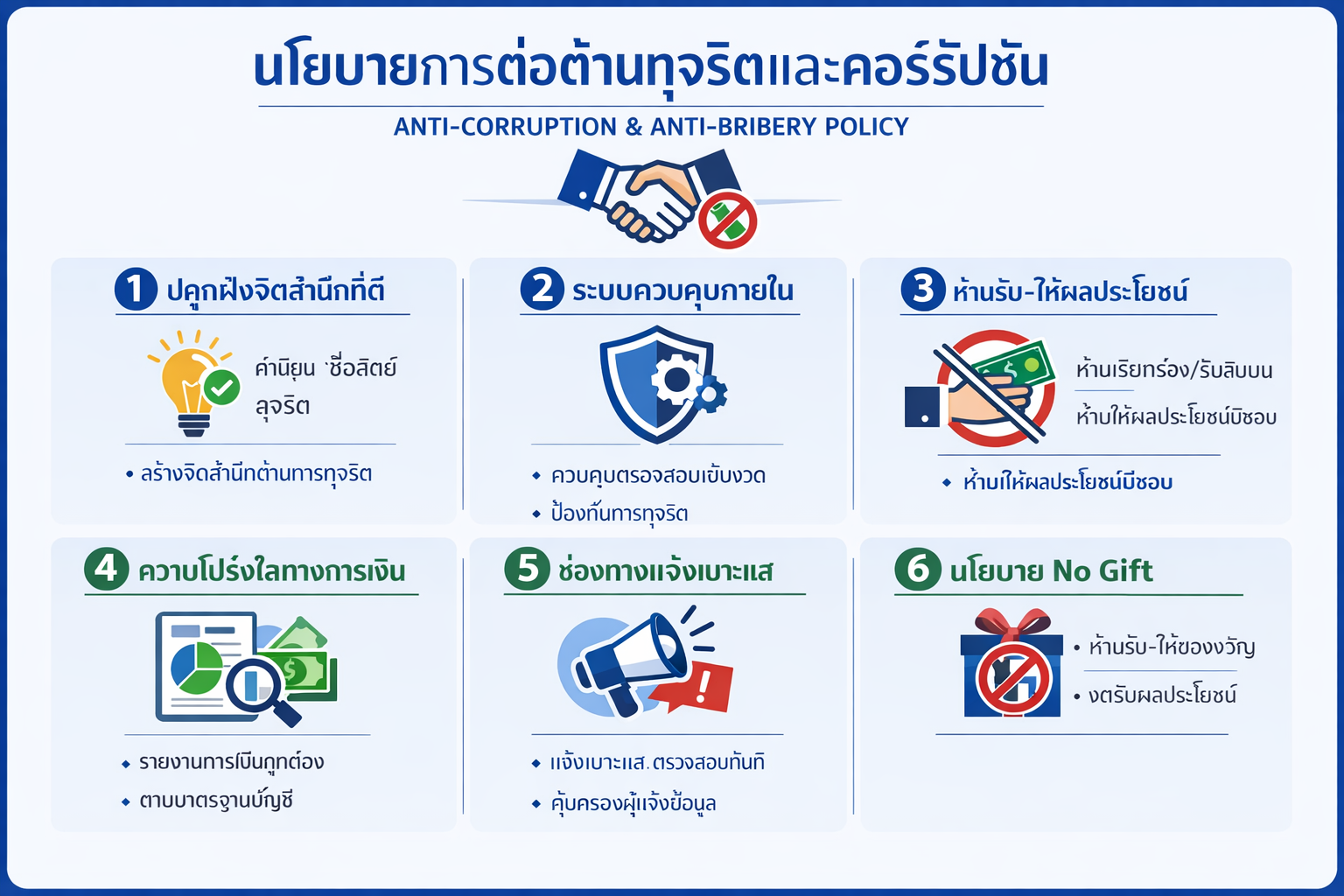
| Anti-corruption | Anti-Corruption & Anti-Bribery Policy and Guidelines The Board of Directors has a policy to comply with anti-corruption and anti-bribery laws, by establishing the following guidelines: The company prioritizes conducting business transparently, lawfully, and responsibly towards all stakeholders. The Board of Directors has established the following key policies and guidelines: 1. Instilling Awareness and Values (Awareness & Ethical Culture)
2. Internal Control System
3. Prohibition for Directors, Executives, and Employees (Prohibition on Receiving Benefits)
4. Financial Transparency
5. Communication and Whistleblowing Channels (Whistleblowing Mechanism)
6. No Gift Policy
| |||||||||||||||||||||||||||||||||||||||||||||||||||||||||||||||||||
| Whistleblowing and Protection of Whistleblowers | Whistleblowing Policy and Complainant Protection. 1. Policy and Principles.The company is committed to conducting business with transparency, adhering to good governance principles, and combating corruption. It has established a Whistleblowing system to provide all employees and stakeholders with a safe, transparent, and fair channel to report inappropriate conduct. 2. Scope of Complaints.The company defines the scope of reportable matters as follows:
3. Eligible Whistleblowers.Accepts complaints from all sectors, including:
4. Whistleblowing Channels.The company has established channels for receiving complaints through the Internal Audit Department, where complainants can contact via the following channels: Email: account@newcity.co.th Telephone: 02-294-6999 ext. 137, 157. Mail: Internal Audit Department, New City (Bangkok) Public Company Limited.
Email: laws@newcity.co.th The information received will be forwarded to the Internal Audit Department and the Audit Committee for consideration and action according to established procedures. Procedures upon receiving a complaint.Upon receiving a complaint or tip-off, the company will proceed systematically and transparently as follows: 4.1 Fact Gathering.
4.2 Fact-finding Investigation.
4.3 Consideration and Remedial Actions.
4.4 Reporting Results.
If the investigation reveals actual wrongdoing, the company will take disciplinary and/or legal action as appropriate. Complainant Protection Measures.The company places great importance on protecting complainants by implementing the following measures:
5. Criteria for Accepting Cases.Complaints should have the following characteristics:
6. Procedures and Timelines.
7. Complainant Protection Measures.The company has strictly defined protection measures, including:
8. Data Retention.The company systematically stores complaint data and outcomes, setting appropriate retention periods and complying with personal data protection laws (PDPA). 9. Penalties.
10. Reporting and Oversight.
11. Monitoring and Development.The company continuously monitors and evaluates the system's effectiveness, as well as developing it, for example:
12. Key Performance Indicators (KPIs).
13. Whistleblowing Statistics Table. 1. Summary of Complaints by Type.
2. Complaint Processing Status.
3. Processing Time.
4. Channels for Receiving Complaints.
14. Annual Performance.In the past year, the company has not received any complaints regarding corruption, legal violations, or business ethics, reflecting the effectiveness of its internal control system and good corporate governance. | |||||||||||||||||||||||||||||||||||||||||||||||||||||||||||||||||||
| Giving or receiving gifts, entertainment, or business entertainment | Giving or receiving gifts, hospitality, and business entertainment 1. Policy and PrinciplesThe Board of Directors is committed to ensuring that business operations are transparent, fair, and free from undue exploitation, recognizing that giving or receiving gifts, hospitality, or business entertainment may be part of building good business relationships in accordance with customary practices. However, such actions must remain within appropriate boundaries, not influence business decisions, and not violate laws, regulations, or the company's code of conduct. 2. Operational GuidelinesThe company sets forth guidelines for directors, executives, and employees as follows:
Furthermore, such giving or receiving of gifts must comply with appropriate business practices, not be of a nature that could influence decisions, or create conflicts of interest. In cases where it is necessary to give or receive gifts exceeding the specified value, it must be reported to and approved by the hierarchical supervisor, and conducted transparently and verifiably. 2.1 Cases involving external agencies
2.2 Giving on behalf of the company
2.3 Expense Control
2.4 Supervision and ControlThe company mandates appropriate internal control systems, including monitoring and tracking compliance with said policies, with reports submitted to relevant executives and committees to ensure transparent operations in line with good corporate governance principles. 2.5 ObjectivesThe company aims to foster an organizational culture committed to honesty, transparency, and fair business practices to prevent corruption risks and promote long-term stakeholder confidence. | |||||||||||||||||||||||||||||||||||||||||||||||||||||||||||||||||||
| Use and maintenance of data and assets | Use and Maintenance of Company Information and Assets 1. Policy and PrinciplesThe company prioritizes efficient, transparent, and secure management of its assets and information. Directors, executives, and employees at all levels are assigned duties and responsibilities to properly care for, maintain, and utilize company assets, including assets under the company's custody, to prevent loss, damage, misuse, and to safeguard the company's best interests. 2. Guidelines for PracticeThe company has established guidelines for the use and care of its assets and information as follows: 2.1 Appropriate Use of Assets
2.2 Asset Care and Protection
2.3 Asset Risk Management
2.4 Appropriate Use of Information Technology
2.5 Use of Email and Internet
2.6 Data Security (Access Control)
2.7 Protection of Intellectual Property
2.8 Reporting Violations
2.9 Document Retention and Destruction
3. Governance and ControlThe company shall establish appropriate internal control systems and oversight measures to ensure efficient use and maintenance of assets and information, including regular audits by relevant departments, such as Internal Audit, and consistent reporting to management or relevant committees. 4. Monitoring and DevelopmentThe company continuously monitors, evaluates, and improves its asset and information management practices to align with changes in business, technology, and relevant laws. | |||||||||||||||||||||||||||||||||||||||||||||||||||||||||||||||||||
| Environmental management | Environmental management 1. Policy and PrinciplesThe Board of Directors recognizes the importance of conducting business in conjunction with environmental stewardship, focusing on reducing impacts on natural resources and the environment, as well as promoting efficient and sustainable resource use. Therefore, the company has established environmental management policies and guidelines in accordance with relevant laws, standards, and international best practices to support the organization's sustainable growth. 2. Operational GuidelinesThe company has established environmental management guidelines as follows:
3. Governance and MonitoringThe company mandates continuous monitoring, inspection, and evaluation of environmental performance, with reports submitted to relevant executives and committees to ensure operations align with established policies and goals. 4. GoalsThe company is committed to sustainable organizational growth, considering the balance between business operations, economy, society, and environment to create long-term value for all stakeholders. 5. Quantitative Key Performance Indicators (KPIs)
6. Short-term – Long-term Goals (Target)
7. Greenhouse Gas Management (Carbon / Climate)
8. Waste Management
9. Water Management
10. Energy Management
11. Packaging
12. ESG in Supply Chain (Supplier ESG)
Environmental Management Table
| |||||||||||||||||||||||||||||||||||||||||||||||||||||||||||||||||||
| Human rights | The Board of Directors respects human rights by establishing policies and guidelines as follows: 1. Not to commit any acts or support any activities that violate human rights. 2. To provide employees with knowledge and understanding of human rights principles, to integrate them into their work practices. 3. Not to restrict freedom or differences in thought, gender, race, religion, politics, or any other matter. However, expressing opinions that may cause conflict or division should be avoided. 4. To establish communication channels so that employees or individuals who believe their rights have been violated or they have been treated unfairly can file complaints with the company, and such complaints should be given due attention and handled fairly. In the past year, no complaints regarding human rights violations in the company's business operations were found. | |||||||||||||||||||||||||||||||||||||||||||||||||||||||||||||||||||
| Occupational health and safety | The Board of Directors prioritizes safety and occupational health by establishing the following guidelines: 1. Conduct business in compliance with laws, regulations, and policies concerning safety, occupational health, and working environment, with consideration for the safety of life and property and the health impacts on employees, partners, and stakeholders, and regularly monitor and evaluate safety performance. 2. Promote workplace safety by establishing regulations, practices, and safe work standards commensurate with risks, as well as improving working conditions, environment, and safe work methods, including providing tools and safety equipment to employees. 3. Maintain preparedness for emergency situations by continuously developing, practicing, and improving emergency plans to prevent and reduce loss of life and property for the company, employees, partners, and relevant parties. 4. Foster a safety culture throughout the organization, which will contribute to sustainable workplace safety. In the past year, no employees suffered illness, injury, or death from work-related incidents. |
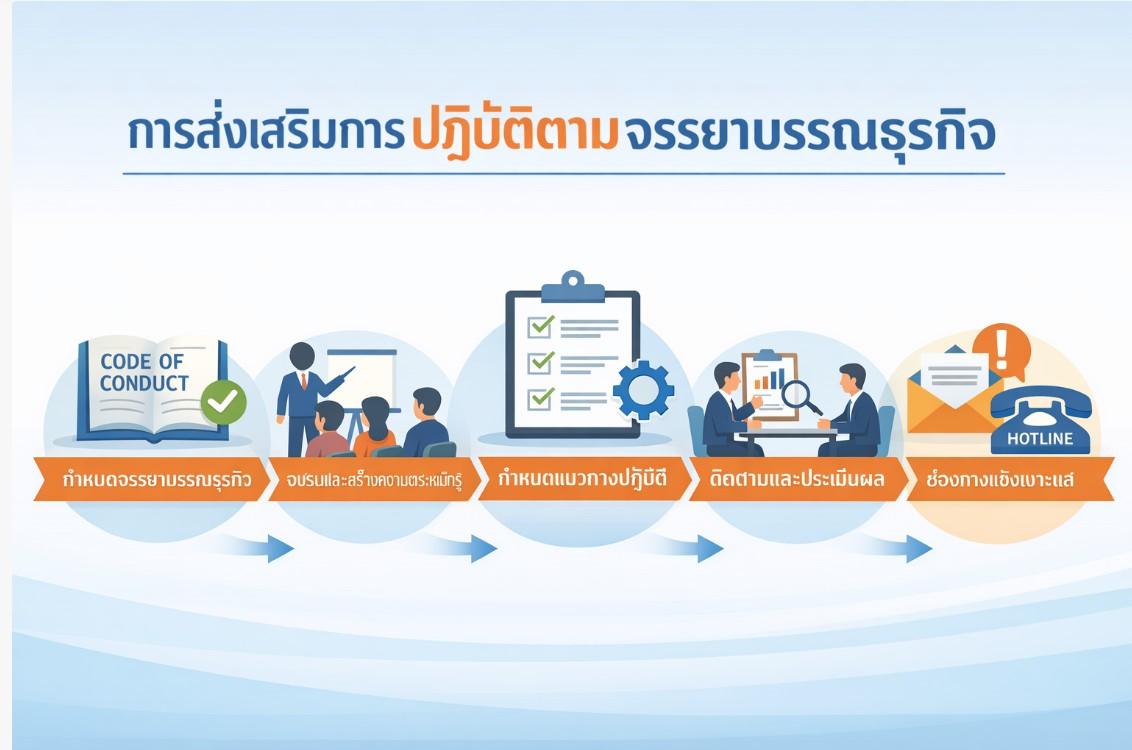
Promoting Compliance with the Code of Conduct
Promotes Compliance by Directors, Executives and Employees
Yes
Description
Process for Promoting Compliance with the Code of Business Conduct
The Board of Directors places importance on Good Corporate Governance and has measures in place to ensure that directors, executives, and employees consistently adhere to the Code of Business Conduct, under the core principles of honesty, integrity, and the best interests of the company and all stakeholders. The promotion and monitoring processes are as follows:
-
Establish a Code of Business Conduct for all directors, executives, and employees to acknowledge.
-
Organize training and meetings to build Awareness of honesty, integrity, and responsibility towards the company and stakeholders.
-
Establish Clear Code of Conduct For directors, executives, and employees to ensure consistent practice.
-
Continuously monitor and evaluate compliance with the Code of Business Conduct.
-
Establish a reporting system and communication channels to report clues or suspicions regarding ethical violations.
Code of Conduct for the Board of Directors and Executives
-
Perform duties with responsibility, care, honesty, integrity, and comply with laws, company regulations, and relevant announcements.
-
Perform duties to the best of one's ability to maximize benefits for the company and attend all meetings, except in necessary cases.
-
Act with impartiality, refraining from voting on matters in which one has a conflict of interest.
-
Prudently manage conflicts of interest, prioritizing the company's benefits.
-
Comply with the company's securities trading regulations, including those for spouses and minor children.
-
Do not buy or sell the company's securities within 1 month prior to the disclosure of financial statements.
-
Report one's own interests and those of related parties according to established criteria.
-
Evaluate the performance of the Board of Directors annually.
Code of Conduct for Employees
-
Support and cooperate in business operations and perform duties to the best of one's ability.
-
Comply with relevant laws, policies, regulations, rules, and announcements.
-
Treat visitors with good manners, hospitality, and excellent service.
-
Maintain trade secrets and internal company information.
-
Do not borrow money from customers, related parties, or business partners of the company, except from banks/financial institutions.
-
Comply with lawful orders from supervisors.
-
Uphold teamwork, provide assistance, and respect each other's rights.
-
Treat colleagues with kindness and good human relations, do not speak ill of others, or claim others' work as one's own.
-
Perform duties diligently, honestly, and without seeking undue personal gain.
-
Be responsible, careful, and not negligent to prevent damage to the company.
-
Act as a good citizen in accordance with laws and the Constitution, and do not engage in illegal activities or those contrary to
Recognizing the importance of good corporate governance, continuous efforts have been made to ensure that directors, executives, and employees are aware of and adhere to the Code of Conduct, maintaining honesty, integrity, prudence, and carefulness for the utmost benefit of the company and all stakeholders. Therefore, the Code of Conduct is established as follows:
Directors and Executives
1. Perform duties with responsibility, care, honesty, and integrity, complying with laws, company regulations, and relevant announcements.
2. Perform duties to the best of one's ability to maximize benefits for the company, including attending all meetings, except in necessary cases.
3. Perform duties with impartiality. Directors and executives have no right to vote on matters in which they have a conflict of interest during board meetings.
4. Perform duties by prudently and reasonably addressing conflicts of interest, prioritizing the company's benefits to ensure transparent management.
5. In the acquisition or disposal of the company's securities, directors and executives, including their spouses and minor children, must comply with relevant regulations and report to the Board of Directors at the next meeting.
6. Directors and executives are prohibited from buying or selling the company's securities within 1 month prior to the public disclosure of financial statements.
7. Directors and executives must report their interests and those of related parties, according to established criteria.
8. The performance of the Board of Directors is evaluated annually.
Employees
1. Consistently support and cooperate in the company's operations and perform assigned duties to the best of one's ability to achieve positive results and progress for the company and its employees.
2. Comply with relevant laws, policies, work regulations, rules, and announcements.
3. Treat visitors with good manners, hospitality, and excellent service, maintaining the company's image and reputation.
4. Maintain trade secrets and do not disclose internal company information to external parties.
5. Do not borrow money from customers, parties related to customers, or business partners of the company, except for borrowing from banks or financial institutions.
6. Comply with lawful orders from supervisors.
7. Uphold teamwork, provide assistance, foster unity, and respect each other's rights for the benefit of the company and its employees.
8. Treat colleagues with kindness and good human relations, do not speak ill of others without factual basis, and do not claim others' work as one's own.
9. Perform duties diligently, honestly, and with integrity, not seeking undue personal gain for oneself or others by leveraging one's position within the company.
10. Perform duties with responsibility, care, and without negligence, to prevent damage to the company's work or assets.
11. Act as a good citizen in accordance with constitutional law and relevant laws, exercising political rights appropriately, and avoiding involvement in illegal activities or those contrary to public order and good morals.
Anti-Corruption Networks & Projects
Joined or Declared Intent to Join Anti-Corruption Networks
No
Networks & Projects Joined
| Network / Project |
|---|
| Thai Private Sector Collective Action Against Corruption: CAC |
| United Nations Global Compact (UNGC) |
| Participation of anti-Corruption networks and initiatives |
Material Changes & Developments in CG
Reviewed the CG Policy or Board Charter in the Past Year
Yes
Material Changes or Developments in the Past Year
Yes
Policy Review — Description
The company has reviewed but has not yet changed its Corporate Governance Practices or Board Charters.
Implements the CG Code for Listed Companies
No
CG Code — Description
The Board of Directors has reviewed and adapted the principles of good corporate governance (CG Code) to suit the company's business context. In this process, it was found that there are some points that the company is not yet able to comply with the good corporate governance principles, with details as follows:
1. The Chairman of the Board should be an independent director.
Reason: The Chairman of the Board is not an independent director because the company has clearly defined the powers, duties, and responsibilities of the Chairman, which aligns with good corporate governance principles. The Chairman's tenure must be conducted with transparency and fairness to ensure that executive-level decisions are as independent and impartial as possible.
2. The Board of Directors should clearly specify the term of office for independent directors in the company's corporate governance policy, which should not exceed 9 years without exception.
Reason: The company believes that a long tenure does not affect the independence of performance, but rather enhances experience, knowledge, and a deeper understanding of the company's business, which will benefit the company's decision-making and operations in the long term.
Other CG Performance & Outcomes
Performance and Outcomes of Good Corporate Governance
1. Corporate Governance Assessment Results
In the past year, the company received a "Very Good (4-star)" assessment for corporate governance among listed companies, reflecting the commitment of the Board of Directors, management, and employees to conduct business efficiently, transparently, and verifiably in accordance with the principles of Good Corporate Governance (CG).
2. Outcomes of Corporate Governance Operations
The company's key corporate governance performance is as follows:
-
Governance and Internal Control
The company has an appropriate, comprehensive, and business-aligned governance and internal control system, with regular monitoring and evaluation, including audits by the internal audit department and reporting to relevant committees. -
Risk Management
The company has systematically managed risks by identifying, assessing, and defining key risk management approaches, as well as continuously monitoring results to ensure that risks are controlled at an acceptable level. -
Transparency and Information Disclosure
The company prioritizes accurate, complete, and timely disclosure of information, as well as equitable communication with shareholders and stakeholders, to build trust and transparency in its operations. -
Compliance with Laws and Business Ethics
The company conducts its business in strict adherence to laws, regulations, and business ethics, with no significant violations found in the past year. -
Anti-Corruption
The company has clear anti-corruption policies and measures, along with channels for reporting misconduct and whistleblower protection measures, resulting in no corruption-related complaints in the past year.
3. Projects and Activities Supporting Corporate Governance
The company has continuously implemented projects and activities to promote good corporate governance, such as:
-
Training and communication on business ethics and anti-corruption policies for employees.
-
Review and improvement of corporate governance policies in line with best practices.
-
Promoting stakeholder engagement in providing feedback.
4. Development Goals
Although the company received a "Very Good (4-star)" assessment, it is committed to continuous development, aiming to elevate its corporate governance to an "Excellent (5-star)" level through concrete development of its governance system, transparency, and sustainability operations.