

Board Performance · 2025
In this section15 topics
- Compliance Monitoring — Overview2 items
- Prevention of Conflicts of Interest3 items
- Prevention of the Use of Inside Information3 items
- Anti-Corruption3 items
- Whistleblowing3 items
- Selection of Directors & Chief Executives6 items
- Selection of Independent Directors2 items
- Director Development1 item
- Evaluation of Board & Subcommittee Performance2 items
- Subcommittees1 item
- Meeting Attendance & Remuneration5 items
- Supervision of Subsidiaries & Associated Companies5 items
- Board Duty Performance — Overview1 item
- Audit Committee Duty Performance1 item
- Executive Committee Duty Performance1 item
Compliance Monitoring — Overview
Compliance Monitoring — Introduction
Monitoring compliance with corporate governance policies and guidelines.
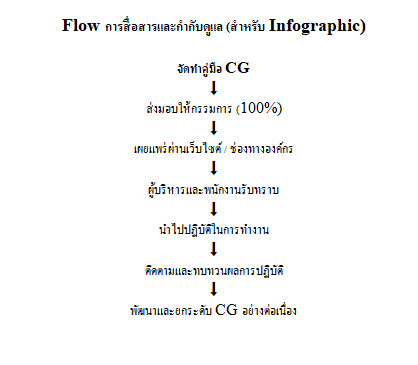
The company places importance on continuously promoting and monitoring compliance with corporate governance policies and guidelines. It has prepared and disseminated the "Good Corporate Governance Manual," which covers key policies such as the corporate governance policy, business ethics, and the code of conduct for directors, executives, and employees, to serve as a standardized guideline for operations across the entire organization.
The company has delivered the aforementioned manual to all directors, representing 100%, to ensure that directors are aware of and adhere to it as a guideline for performing their duties. Additionally, these policies and guidelines have been communicated to executives and employees through various company channels, particularly via the company's website, to ensure comprehensive, convenient, and transparent access to information.
Furthermore, the company encourages executives and employees at all levels to recognize the importance of good corporate governance and to strictly apply these principles in their daily operations, ensuring that business operations are ethical, transparent, verifiable, and in line with good corporate governance principles.
The company regularly monitors and reviews policy compliance to ensure that personnel at all levels understand and can implement them correctly, which will lead to the continuous elevation of the company's corporate governance standards.
Summary of Corporate Governance Policy Communication and Monitoring
|
Topic |
Details |
|---|---|
|
Document/Policy |
Good Corporate Governance Manual (comprising CG Policy, Business Ethics, Code of Conduct for Directors, Executives, and Employees) |
|
Target audience |
Company Directors / Executives / Employees |
|
Communication to directors |
Deliver the manual to all directors (100%). |
|
Communication to executives and employees |
Published via the company website and internal channels. |
|
Objective |
To ensure personnel are informed, aware, and use it as a guideline for operations. |
|
Implementation |
Promote adherence to ethical, transparent, and verifiable business conduct standards. |
|
Follow-up |
Regular monitoring and review of practices. |
|
Outcome |
Personnel understand and comply with the policy appropriately, in line with CG principles. |
Monitoring of Compliance with Other CG Policies & Guidelines
Summary of Monitoring Corporate Governance Policy and Practice Compliance
The company prioritizes good corporate governance by establishing clear policies and practices in relevant documents, such as the Corporate Governance Policy and Business Ethics, and communicating them to directors, executives, and employees at all levels for strict adherence, thereby building trust among all stakeholder groups.
The company continuously monitors and evaluates compliance with the said policies, covering the following key issues:
1) Employee care and non-discrimination
The company promotes equal and fair treatment of employees, without discrimination based on race, gender, religion, or social opinion, and supports appropriate opportunities for professional development and advancement.
In the past year, the company has consistently monitored and reviewed human resource practices, and no complaints regarding discrimination were found.
2) Anti-unfair competition
The company conducts business based on principles of fair competition, transparency, and compliance with relevant laws, continuously communicating and educating employees about trade competition regulations.
In the past year, no actions constituting unfair competition were found.
3) Environmental, health, and safety care
The company prioritizes conducting business responsibly towards the environment and considers employee health and safety, regularly inspecting workplace safety and improving the working environment as appropriate.
No serious accidents or significant safety incidents were found in the past year.
The company has established appropriate measures for information security, covering access control, data leakage prevention, and compliance with personal data protection laws.
In the past year, no data breaches or unauthorized data access incidents were found.
5) Anti-corruption
The company strictly adheres to its anti-corruption policy, continuously communicating and monitoring its implementation, and providing channels for whistleblowing and protection for complainants.
In the past year, no cases of corruption were found.
6) Prevention of conflicts of interest
The company has established measures to prevent conflicts of interest and to oversee related party transactions transparently, ensuring that directors and executives with vested interests do not participate in the consideration process.
In the past year, operations were in accordance with criteria, and no significant issues were found.
7) Oversight of inside information usage
The company has strict measures to control the use of inside information, including setting a Blackout Period for securities trading and reporting securities holdings in accordance with the law.
In the past year, no violations of the said policy were found.
From monitoring the operational results over the past year, the company observes that the adherence to corporate governance policies and practices has been efficient, appropriate, and consistent with good corporate governance principles, with no significant violations identified.
The company will continue to develop and improve its practices to elevate corporate governance standards and build long-term trust among stakeholders.
Summary of Corporate Governance Performance (CG Summary)
|
Category |
Policy / Practice |
Operations in the past year |
Performance results |
|---|---|---|---|
|
Employee care and non-discrimination |
Treat employees equally and fairly. |
Review HR policies and monitor implementation. |
No complaints found. |
|
Fair competition |
Conduct business in accordance with trade competition laws. |
Train and communicate practices to employees |
No violations found. |
|
Environment and safety |
Promote safety and reduce environmental impact. |
Inspect workplaces and continuously improve. |
No serious incidents found. |
|
Data security |
Control access and prevent data leakage. |
Utilize IT and PDPA measures. |
No data breaches found. |
|
Anti-corruption |
Anti-Corruption Policy and CAC Guidelines |
Communicate policies and monitor results. |
No corruption cases found. |
|
Whistleblowing |
Channels for complaints and protection for whistleblowers are available. |
Systematically receive and follow up on matters. |
No significant complaints found. |
|
Conflicts of interest |
Oversee related party transactions. |
Directors with vested interests abstain from voting. |
Correct practice |
|
Use of inside information |
Set Blackout Period and report shares. |
Monitored through the system and company secretary. |
No violations found. |
|
Internal control system |
Assessed according to COSO (5 Components, 17 Principles). |
Audit Committee's annual assessment. |
Sufficient and efficient system. |
Prevention of Conflicts of Interest
Has the Company Acted to Prevent Conflicts of Interest?
Yes
Operations in the Past Year
8.1.4 4 Monitoring compliance with corporate governance policies and guidelines
The Company prioritizes the prevention of conflicts of interest and the misuse of inside information by clearly establishing policies, guidelines, and control measures to ensure that business operations are transparent, fair, and in compliance with laws and good corporate governance principles.
1) Prevention of Conflicts of Interest
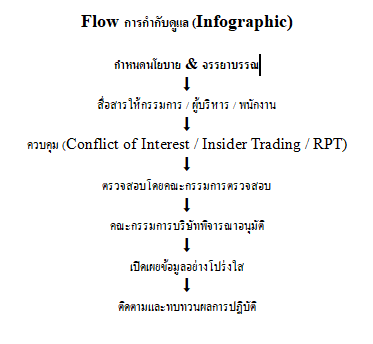
The Board of Directors strictly adheres to the regulations of the Securities and Exchange Commission. In cases of transactions that may lead to conflicts of interest, the Company requires the Audit Committee to provide an opinion on the necessity and appropriateness of such transactions before proposing them to the Board of Directors for approval.
If the Board of Directors' opinion differs from that of the Audit Committee, the Company will transparently disclose such differing opinions. Furthermore, if any director has an interest in the agenda item under consideration, that director shall not have voting rights and shall not participate in the deliberation of that agenda item, to ensure that decisions are made for the overall best interest of the Company.
2) Prevention of Using Inside Information for Personal Gain
The Company has systematically established measures to prevent the use of inside information, covering directors, executives, and employees who may have access to inside information, as well as their spouses and minor children. It is prohibited to use inside information for personal gain or for trading the Company's securities, especially during the one-month period before the public disclosure of financial statements, which is clearly stipulated in the Company's code of ethics.
The Company requires directors and executives to report changes in their securities holdings to the Securities and Exchange Commission and the Stock Exchange of Thailand, in accordance with Section 59 of the Securities and Exchange Act. This also includes reporting the interests of directors, executives, or related persons, enabling the Company to monitor and supervise effectively.
Furthermore, the Company has established written guidelines for the retention and control of access to inside information, limiting access only to those with relevant duties who need to use such information. Information will be disclosed to executives or related persons simultaneously with public disclosure to prevent unfair use of information.
3) Supervision of Connected Transactions
The Company has measures for carefully considering and approving connected transactions, requiring the disclosure of important information such as the nature of the relationship, transaction value, opinions of independent directors, and other necessary information, to enable the Board of Directors and/or shareholders to make transparent and fair decisions.
The Company stipulates that any director or executive with a conflict of interest or involvement in such a transaction must not participate in the consideration or voting on that matter.
4) Monitoring and Performance Results
The Company regularly monitors and reviews compliance with these policies and measures to ensure strict adherence by personnel at all levels.
In the past year, the Company found no instances of directors, executives, or employees trading the Company's securities during the designated blackout period.
Summary of Measures for Preventing Conflicts of Interest and Use of Inside Information
|
Topic |
Measures / Guidelines |
Responsible Party |
Control Mechanism |
Performance Results |
|---|---|---|---|---|
|
Conflict of Interest |
The Audit Committee shall consider transactions that may involve conflicts of interest before proposing them to the Board of Directors. |
Audit Committee / Board of Directors |
Disclose reasons, necessity, and differing opinions (if any) |
No significant issues found |
|
Directors with conflicts of interest do not have voting rights and do not participate in deliberations |
Board of Directors |
Meeting Minutes and Abstentions |
Fully complied |
|
|
Use of Inside Information |
Prohibit the use of inside information for personal gain |
Directors / Executives / Employees |
Stated in the code of ethics and company policy |
No violations found |
|
Blackout Period defined (1 month before financial statement announcement) |
Company |
Control and monitor securities trading |
No trading found during the blackout period |
|
|
Legal Securities Holding Report (Section 59) |
Directors / Executives |
Report to the SEC and the Stock Exchange |
Fully complied |
|
|
Disclosure of Information and Connected Transactions |
Fully disclose information on connected transactions |
Company |
Independent Director's Opinion / Information Disclosure |
Transparent, verifiable |
|
Directors/executives with conflicts of interest do not participate in deliberations |
Board of Directors |
Abstention Mechanism |
Fully complied |
|
|
Control of Inside Information |
Restricting access to information to relevant parties only |
Company |
Written Information Control Policy |
Appropriately controlled |
|
Disclose information to relevant parties simultaneously with the public |
Company |
Reduce information asymmetry |
Consistent practice |
|
|
Follow-up |
Monitor and review policy compliance |
Company |
Reporting and Internal Supervision |
No misconduct found |
3) Anti-Corruption
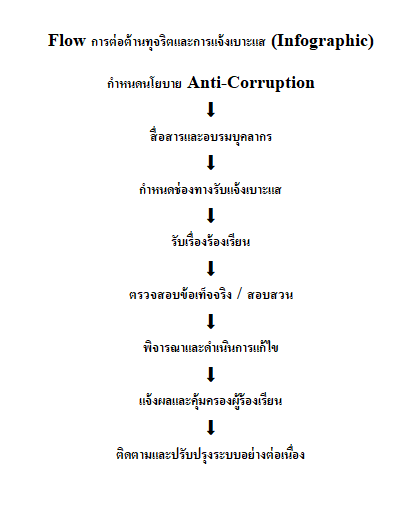
The Company is committed to conducting business in accordance with good corporate governance principles, upholding honesty, transparency, and accountability, as approved by the Board of Directors. The Company has clearly established a written anti-corruption policy within its business ethics section and communicates it to directors, executives, and employees at all levels for their awareness and collective adherence.
Furthermore, the Company has adopted the guidelines and measures of the Collective Action Coalition (CAC) project for the Thai private sector in combating corruption as a framework for its operations, to elevate anti-corruption standards in line with best practices.
The Company emphasizes building knowledge and understanding of anti-corruption, with executives and employees continuously participating in relevant activities and training to foster an organizational culture that does not tolerate any form of corruption.
Throughout the past period, the Company has no history of involvement in or prosecution for corruption. In the past year, no such issues were found, nor were there any labor or human rights disputes. The Company is committed to continuously operating its business free from corruption.
4) Whistleblowing and Whistleblower Protection
The Company is committed to promoting transparency and stakeholder engagement by establishing policies and measures for receiving complaints or tips regarding illegal acts, breaches of ethics, or corruption by personnel within the organization.
Whistleblowing Channels
The Company has provided various channels for submitting complaints through the Internal Audit Department and the Audit Committee, as follows:
Email: account@newcity.co.th
Phone: 02-2946999 ext. 137, 157
-
Mail: Internal Audit Department, New City (Bangkok) Public Company Limited
666 Rama 3 Road, Bang Phong Phang Subdistrict, Yannawa District, Bangkok 10120 -
Or report through the Audit Committee
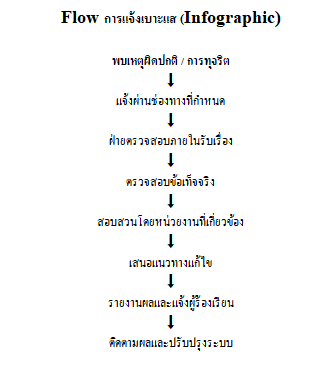
Process for Handling Complaints
Upon receiving a complaint, the Internal Audit Department will systematically proceed according to the established steps, as follows:
-
Gather and verify facts
-
Propose the matter to independent directors for investigation
-
Propose solutions to the relevant committee within the specified timeframe
-
Inform the complainant of the outcome
If a violation is found, the Company will consider disciplinary and/or legal action as appropriate.
Whistleblower Protection Measures
The Company prioritizes whistleblower protection by establishing the following measures:
-
Complainants can choose to remain anonymous.
-
All information will be kept strictly confidential.
-
Complainants will be protected from retaliation or unfair treatment.
Monitoring and Performance Results
The Company continuously monitors the outcomes to ensure that complaints are considered and resolved transparently, fairly, and efficiently.
In the past year, the Company received no complaints related to illegal acts, breaches of ethics, or corruption, which reflects the effectiveness of the Company's governance system, internal controls, and whistleblower protection.
Summary of Anti-Corruption and Whistleblowing Policy
|
Topic |
Details |
|---|
|
Anti-Corruption Policy |
Documented in the Corporate Governance and Business Ethics Handbook |
|
Guidelines |
Adhere to principles of honesty, transparency, accountability, and zero tolerance for all forms of corruption. |
|
Reference Standards |
CAC Guidelines (Collective Action Coalition) |
|
Communication |
Communicate to directors, executives, and employees for their awareness and compliance |
|
Training/Activities |
Promote participation in anti-corruption activities and training |
|
Whistleblowing Channels |
Email / Phone / Mail / Audit Committee |
|
Responsible Department |
Internal Audit Department / Audit Committee |
|
Operational Process |
Receive complaint, verify facts, investigate, propose solutions, report results |
|
Protection Measures |
Anonymity / Confidentiality / Protection from retaliation |
|
Follow-up |
Continuous monitoring, inspection, and reporting of results |
|
Latest Annual Performance |
No complaints of corruption or ethical misconduct found |
Number of Conflict-of-Interest Cases
| Metric | Current Year | Previous Year | Two Years Ago |
|---|---|---|---|
| Total number of cases or issues related to conflicts of interest (cases) | 0 | 0 | 0 |
Prevention of the Use of Inside Information
Has the Company Acted to Prevent the Use of Inside Information?
No
Operations in the Past Year
Oversight of Insider Information Usage
The company prioritizes the oversight of insider information usage by establishing clear policies, guidelines, and control measures to prevent directors, executives, and employees from using inside information for personal gain, particularly in trading the company's securities, which could impact investor confidence and business transparency.
1) Monitoring of Securities Trading Reports
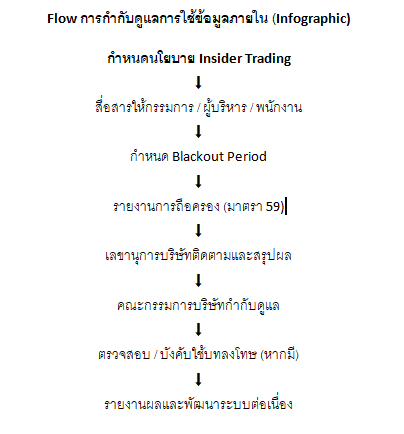
The company requires directors and executives to report changes in their holdings of the company's securities in accordance with Section 59 of the Securities and Exchange Act B.E. 2535, by reporting to the Office of the Securities and Exchange Commission within 3 business days from the date of change.
Furthermore, directors and executives must inform the Company Secretary so that the company can record changes and report a summary of securities holdings to the Board of Directors at the next meeting, ensuring transparency and auditability.
2) Prohibition of Using Inside Information for Personal Gain
The company has established measures prohibiting directors and executives from using inside information that is material to the securities' price for trading. A blackout period of one month is set before the disclosure of financial statements or significant information to the public, and trading is prohibited until at least 24 hours after such information has been disclosed.
In the event of a violation, the company has disciplinary measures commensurate with the severity, including warnings, salary deductions, unpaid suspension, or termination of employment, as well as legal action.
3) Policy Compliance in the Past Year
In the past year, the company found no instances of securities trading by directors and executives during the prohibited trading period as stipulated by the company's policy, which reflects strict and effective compliance with the policy.
In addition, the company has begun implementing an electronic system for reporting and monitoring securities holdings to enhance the efficiency, accuracy, and speed of oversight.
4) Oversight and Certification
These measures and guidelines have been reviewed and approved by the Board of Directors to ensure compliance with good corporate governance principles, laws, and relevant regulatory requirements.
The company is committed to continuously overseeing the use of inside information to prevent its misuse and to enhance transparency, credibility, and long-term investor confidence.
Summary of Measures for Oversight of Insider Information Usage
|
Topic |
Details |
|---|---|
|
Policy |
Establish a policy prohibiting the use of inside information for personal gain, especially for securities trading. |
|
Relevant Parties |
Directors, executives, and employees with access to inside information |
|
Reporting of Securities Holdings |
Report to the SEC under Section 59 within 3 business days and inform the Company Secretary. |
|
Monitoring |
The Company Secretary prepares a summary report of changes in holdings for submission to the Board of Directors. |
|
Blackout Period |
Prohibited trading 1 month before financial statement disclosure, and at least 24 hours after information disclosure. |
|
Data Control |
Restrict data access to relevant personnel only, and disclose information simultaneously with the public. |
|
Penalties |
Warning / Salary Deduction / Suspension / Termination of Employment and Legal Action. |
|
Supporting Tools |
Utilize an electronic system for reporting and monitoring. |
|
Oversight |
The Board of Directors certifies the policy and monitors its implementation. |
|
Latest Annual Performance |
No securities trading found during the Blackout Period. |
Number of Inside-Information Cases
| Metric | Current Year | Previous Year | Two Years Ago |
|---|---|---|---|
| Total number of cases or issues related to the use of inside information to seek benefits (cases) | 0 | 0 | 0 |
Anti-Corruption
Has the Company Acted on Anti-Corruption?
No
Operations in the Past Year
Anti-Corruption Operations
The company prioritizes anti-corruption by establishing clear written policies and guidelines, and communicating them to directors, executives, and employees at all levels for strict adherence, to ensure business operations are transparent, fair, and auditable.
The company has established internal control measures that cover the prevention of corruption in all key processes, such as appropriate authorization limits, segregation of duties, control over data access, guidelines for related party transactions, and the provision of whistleblowing channels and whistleblower protection, to promote scrutiny and prevent inappropriate actions.
At the Audit Committee Meeting No. 1/2569 on February 27, 2569, attended by all three independent Audit Committee members, the Audit Committee assessed the adequacy of the company's internal control system using an evaluation form based on the guidelines of the Securities and Exchange Commission, covering 5 components and 17 principles in accordance with international standard internal control frameworks, namely:
(1) Control Environment
(2) Risk Assessment
(3) Control Activities
(4) Information and Communication
(5) Monitoring and Evaluation
Based on the aforementioned evaluation results, the Audit Committee is of the opinion that the company possesses an internal control system that is adequate, appropriate, and effective, consistent with the nature and size of the business, capable of supporting operations to achieve objectives, and appropriately preventing and mitigating risks from corruption.
Furthermore, the company continuously monitors and reviews its anti-corruption operations to ensure that the established measures remain appropriate and consistent with changing circumstances, and to foster an organizational culture that does not tolerate any form of corruption.
Anti-Corruption Measures and Internal Control System
|
Internal Control Components |
Anti-Corruption Measures |
Guidelines / Tools |
Operating Results |
|---|
|
1. Control Environment |
Establish anti-corruption policy and business ethics |
CG Manual / Code of Conduct / Tone at the Top |
Personnel are aware and comply |
|
2. Risk Assessment |
Identify and assess corruption risks |
Risk Assessment / Fraud Risk |
Regular risk assessment is conducted |
|
3. Control Activities |
Prevent corruption in key processes |
Segregation of Duties (SoD) / Approval / RPT Control |
Reduce opportunities for corruption |
|
4. Information & Communication |
Communicate policies and whistleblowing channels |
Website / Training / Whistleblowing Channel |
Comprehensive data access |
|
5. Monitoring Activities |
Review and monitor compliance |
Internal Audit / Audit Committee Review |
System is continuously effective |
Summary of Evaluation Results
The Audit Committee evaluated the internal control system based on the framework of 5 components and 17 principles.
-
Deemed the system to be adequate, appropriate, and effective
-
Can appropriately prevent and mitigate corruption risks
-
Consistent with the nature of the business and supports the company's operations
Number of Corruption Cases
| Metric | Current Year | Previous Year | Two Years Ago |
|---|---|---|---|
| Total number of cases or issues related to corruption (cases) | 0 | 0 | 0 |
Whistleblowing
Has the Company Implemented Whistleblowing Procedures?
Yes
Operations in the Past Year
Whistleblowing and Complaint Reception
The company prioritizes promoting transparency and stakeholder participation by providing opportunities for employees and stakeholders to report information or complaints regarding actions that may constitute illegal acts, corruption, misconduct, or behavior that could cause damage to the company, including cases of rights violations or unfair treatment, through clearly defined channels and processes.
The company has established various channels for whistleblowing and complaints to facilitate and build confidence among whistleblowers, who can report directly to the responsible departments or individuals as follows:
-
Internal Audit Department
Email: account@newcity.co.th
Phone: 02-294-6999 ext. 137
-
Mail: New City (Bangkok) Public Company Limited
666 Rama 3 Road, Bang Phong Phang Subdistrict, Yannawa District, Bangkok 101202. Secretary of the Audit Committee / Company Secretary
-
Contact: Ms. Sam-ang Chantrima (Secretary of the Audit Committee) or Mr. Adul Srimadee (Company Secretary)
-
Phone: 02-294-6999 ext. 137, 157
-
Fax: 02-294-3801
Email: laws@newcity.co.th
-
Audit Committee
-
Mail: New City (Bangkok) Public Company Limited
666 Rama 3 Road, Bang Phong Phang Subdistrict, Yannawa District, Bangkok 10120
The company mandates that complaint information and the identity of whistleblowers be kept strictly confidential, and has measures in place to protect complainants from retaliation or unfair treatment.
All received complaints will be considered and processed according to established procedures, with fair, transparent, and independent fact-finding, and the results of the actions will be reported to relevant parties as appropriate.
The company is committed to continuously developing its complaint handling system to enhance governance efficiency and foster an organizational culture that upholds integrity, transparency, and accountability.
Summary of Whistleblowing System
|
Topic |
Details |
|---|---|
|
Objective |
Provide opportunities for employees and stakeholders to report information or complaints regarding illegal acts, corruption, misconduct, or unfair treatment. |
|
Eligible Whistleblowers |
Employees, executives, stakeholders, and external parties |
|
Reporting Channels |
Email / Phone / Fax / Mail / Via Internal Audit Department / Audit Committee |
|
Responsible Department |
Internal Audit Department / Secretary of the Audit Committee / Company Secretary / Audit Committee |
|
Procedure |
Receive complaint, verify facts, investigate, propose solutions, report results |
|
Confidentiality |
Strictly maintain the confidentiality of complainant information and identity. |
|
Protection Measures |
Protection of complainants from retaliation or unfair treatment |
|
Reporting Results |
Inform the complainant of the results as appropriate |
|
Follow-up |
Monitoring and verification are conducted to ensure effective resolution. |
|
Latest Annual Performance |
No significant complaints found |
Number of Whistleblowing Cases
| Metric | Current Year | Previous Year | Two Years Ago |
|---|---|---|---|
| Total number of cases or issues received through whistleblowing channels (cases) | 0 | 0 | 0 |
Selection of Directors & Chief Executives
Selection, Development & Evaluation — Introduction
The selection or appointment of the company's directors involved a resolution to appoint a Nomination Committee on December 13, 2022, to receive policies from the Board of Directors in early 2022 and to consider the criteria for the process of nominating suitable individuals for director positions, whereby the Nomination Committee shall consider and select individuals according to the established criteria for submission to the Board of Directors for consideration in presenting to the shareholders' meeting in accordance with applicable regulations.
Are Directors Selected Through the Nomination Committee?
Yes
Are Chief Executives Selected Through the Nomination Committee?
Yes
Number of Directors from Major Shareholders
9
Rights of Minority Shareholders on Director Appointment
1. Right to Elect Directors Minority shareholders can elect directors at the Annual General Meeting (AGM) or Extraordinary General Meeting (EGM) in proportion to their shareholding. The nomination of directors typically comes from both management and major shareholder groups, and minority shareholders can also nominate directors if they have the right to do so.
2. Nomination of Directors Minority shareholders can nominate directors at the meeting if they hold a sufficient number of voting shares (as per company regulations) and if nominations from shareholders are permitted.
3. Exercise of Rights at Meetings If minority shareholders hold an appropriate number of shares in the company (as per laws or company regulations), they can exercise their voting rights to elect directors at the shareholders' meeting. Furthermore, if there are relevant director nominations, they can vote for or against them.
Method of Director Appointment
| Method |
|---|
| Method whereby each director requires approval votes more than half of the votes of attending shareholders with voting rights |
| Method by which shareholders can divide their votes among candidates in accordance with the Public Limited Companies Act (Cumulative voting) |
Selection of Independent Directors
Criteria for Selecting Independent Directors
1) Independent Directors
Qualifications of Independent Directors
Definition: "Independent Director" refers to a person who fully meets the qualifications and possesses independence as prescribed by the Stock Exchange of Thailand and the SEC.
The qualifications of the company's independent directors are in accordance with the requirements of the Capital Market Supervisory Board, as follows:
1.1. Hold shares not exceeding one percent of the total voting shares of the company, its parent company, subsidiaries, associated companies, or any entity that may have a conflict of interest. This includes shares held by related persons of that independent director.
1.2 Not be or have been a director involved in the management of employees, staff, salaried advisors, or a person with control over the company, its parent company, subsidiaries, associated companies, fellow subsidiaries, or any entity that may have a conflict of interest, unless such characteristics have ceased for at least two years prior to the date of appointment as an independent director.
1.3 Not be a person who has a blood relationship or a legal registration relationship as a father, mother, spouse, sibling, or child, including the spouse of a child, of an executive, major shareholder, controlling person, or a person proposed to be an executive or controlling person of the company or its subsidiary.
1.4 Not have or have had a business relationship with the company, its parent company, subsidiaries, associated companies, or any entity that may have a conflict of interest in a manner that could impede their independent judgment, and not be or have been a major shareholder, a non-independent director, or an executive of a person who has a
1.5 Not have or have had a business relationship with the company, its parent company, subsidiaries, associated companies, or any entity that may have a conflict of interest, unless such characteristics have ceased for at least two years prior to the date of appointment as an independent director. Business relationships as mentioned in the first paragraph include normal commercial transactions for business operations, leasing or subleasing of real estate, transactions related to assets or services, or the provision or receipt of financial assistance through lending or borrowing, guarantees, or providing assets as collateral for debts, as well as other similar circumstances that result in the applicant or counterparty having a debt obligation to the other party of at least three percent of the applicant's net tangible assets or twenty million baht, whichever is lower. The calculation of such debt obligations shall be in accordance with the method for calculating the value of connected transactions as stipulated in the Notification of the Stock Exchange of Thailand Board regarding the disclosure of information and operations of listed companies concerning connected transactions, by analogy. However, when considering such debt obligations, any debt obligations arising within one year prior to the date of the business relationship with the same person shall be included.
1.6 Not be or have been an auditor of the company, its parent company, subsidiaries, associated companies, or any entity that may have a conflict of interest, and not be a major shareholder, a non-independent director, an executive, or a managing partner of an audit firm to which an auditor of the company, its parent company, subsidiaries, associated companies, or any entity that may have a conflict of interest belongs, unless such characteristics have ceased for at least two years prior to the date of appointment as an independent director.
1.7 Not be or have been any professional service provider, including legal or financial advisors, who received service fees exceeding two million baht per year from the company, its parent company, subsidiaries, associated companies, or any entity that may have a conflict of interest. In the case where the professional service provider is a juristic person, this shall include being a major shareholder, a non-independent director, an executive, or a managing partner of that professional service provider, unless such characteristics have ceased for at least two years prior to the date of appointment as an independent director.
1.8 Not be a director appointed to represent the company's directors, major shareholders, or shareholders who are related to the company's major shareholders.
1.9 Not possess any other characteristics that would prevent them from providing independent opinions regarding the company's operations. After being appointed as an independent director with characteristics conforming to paragraphs 1 to 8, the independent director may be assigned by the Board of Directors to make decisions regarding the operations of the company, its parent company, subsidiaries, associated companies, fellow subsidiaries, or any entity that may have a conflict of interest, through a collective decision-making process.
2) Criteria for Selecting Independent Directors and the Nomination Process
The Nomination Committee shall consider and select independent directors according to the criteria and qualifications prescribed by the Stock Exchange of Thailand and the SEC, for submission to the Board of Directors and the Shareholders' Meeting.
Highest-ranking executives
The company has a succession plan for senior executives to replace the highest-ranking supervisors of all departments due for retirement and executives who are unable to perform their duties. The Executive Committee monitors and evaluates the performance of individuals to be promoted to executive positions according to the following criteria:
2.1. Select qualified individuals from within the group of developed personnel to fill positions.
2.2. Analyze individual qualifications to identify strengths and areas for further development to ensure compliance and suitability.
2.4. Possess leadership qualities and the ability to manage the company towards its established strategic goals.
2.5 Be honest, fair, ethical, and not possess any prohibited characteristics as stipulated by law.
2.6 Possess vision, knowledge, ability, experience, and a thorough understanding of the company's business, capable of providing effective advice on problem-solving and company management.
2.7 Be a person who is respected, trusted, and held in high regard by directors, executives, and employees, as well as individuals in the business sector and the general public.
Did Any Independent Director Have a Business or Professional Relationship?
No
Director Development
Development of Directors in the Past Year
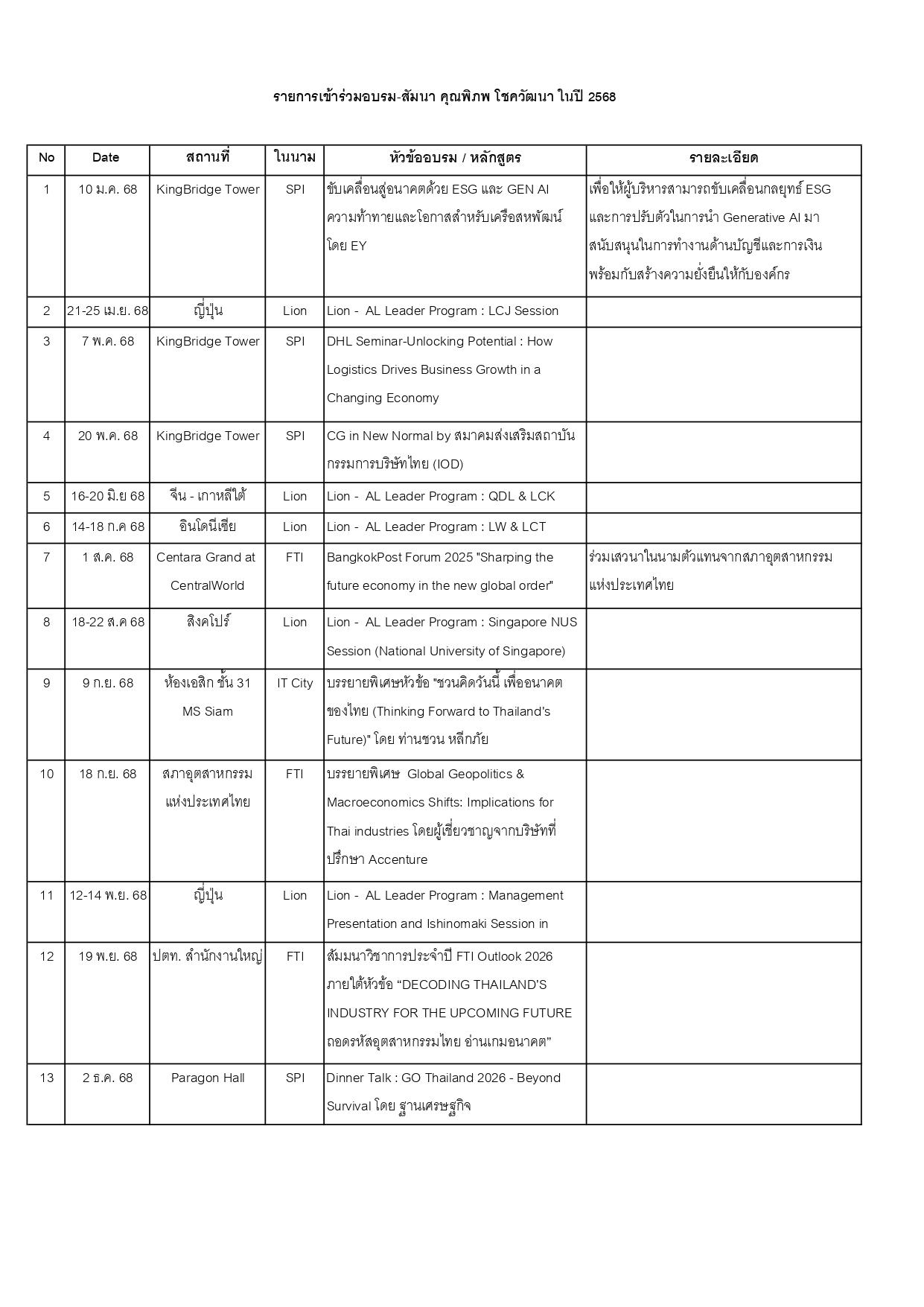
The company supports its directors and executives in continuously receiving training related to their duties as directors and knowledge pertinent to the company's business every year to enhance the capabilities of the company's board of directors and executives. In 2025, executive directors were sent to attend the following courses:
|
List of Directors |
Training attendance during the past fiscal year |
|
1. Mr. Boonpakorn Chokwatana |
Enhance sustainability disclosure in accordance with International Sustainability Standards Board (ISSB Standards) by the SEC, which organized a training on Friday, June 6, 2025. |
|
2. Mrs. Chamnian Chokwatana |
Enhance sustainability disclosure in accordance with International Sustainability Standards Board (ISSB Standards) by the SEC, which organized a training on Friday, June 6, 2025. |
|
3. Ms. Sam-ang Chantrima |
The Role of the Board of Directors Amidst Challenges in Governance to Create Sustainable Value for the Organization and Society (ESG and Sustainable Value Creating)” by Saha Group, which organized a training on Tuesday, February 4, 2025. |
|
4. Mr. Suksant Fuangrit |
Seminar “SET Carbon: Digital Solution for Sustainable Business” organized by the Stock Exchange of Thailand on January 16, 2025. |
|
5. Mr. Kaweepong Hirankasi |
Seminar “SET Carbon: Digital Solution for Sustainable Business” organized by the Stock Exchange of Thailand on January 16, 2025. |
|
6. Ms. Worawan Chokwatana |
CFO training course by the Thai Investors Association, 3 sessions, 6 hours.
|
|
7. Mr. Piratchai Prakobsap |
Seminar “SET Carbon: Digital Solution for Sustainable Business” organized by the Stock Exchange of Thailand on January 16, 2025. |
|
8. Mrs. Patcharin Treekulkittipan |
The Role of the Board of Directors Amidst Challenges in Governance to Create Sustainable Value for the Organization and Society (ESG and Sustainable Value Creating)” by Saha Group, which organized a training on Tuesday, February 4, 2025. |
9. Mr. Pipop Chokwatana
Evaluation of Board & Subcommittee Performance
Criteria for Evaluating Board Performance
Board of Directors' Self-Assessment
Performance Evaluation of the Board of Directors
The Company prioritizes the performance evaluation of the Board of Directors as a tool to enhance the efficiency of corporate governance in accordance with good corporate governance principles. It mandates annual self-assessments for both the entire Board and individual directors.
In 2025, nine members of the Board of Directors conducted self-assessments using the evaluation form prepared by the Company Secretary, which covered their roles, duties, responsibilities, and performance in accordance with good corporate governance principles. The assessment is conducted once a year, at the end of December each year. The Company Secretary then compiles and prepares a summary report of the scores to be presented to the Board of Directors' meeting in the following year.
The results of the 2025 annual self-assessment were presented at the Board of Directors' Meeting No. 1/2026 on February 27, 2026. The assessment results, both at the committee and individual levels, were good. The Company Secretary has retained these assessment results as evidence.
Sub-Committee Self-Assessment
The Company regularly conducts self-assessments for its sub-committees, namely the Audit Committee, the Nomination and Remuneration Committee, the Corporate Governance and Sustainability Committee, and the Risk Management Committee. These assessments adhere to the criteria and guidelines set by the Stock Exchange of Thailand, covering the structure, composition, qualifications, and performance efficiency of the sub-committees.
In practice, the Company Secretary distributes the assessment forms to the directors of each committee for self-assessment and compiles the results to be presented to the Board of Directors for acknowledgment, as well as to be used as information for improving and enhancing the performance of the sub-committees.
In 2025, the self-assessment results of all sub-committees, both at the committee and individual levels, were good. Recommendations for development included enhancing directors' digital knowledge and skills, and continuous training to develop knowledge and capabilities.
Summary Table of the Board of Directors' Performance Evaluation for 2025
|
Assessment Topic |
Scope of Assessment |
Assessment Method |
Frequency |
Assessment Results |
Development Guidelines |
|---|---|---|---|---|---|
|
Board of Directors (Overall Committee) |
Roles, Duties, Responsibilities, and Good Corporate Governance |
Self-Assessment |
Once a year |
Good |
Enhance digital skills and continuous knowledge development |
|
Board of Directors (Individual) |
Individual Performance, Participation, and Accountability |
Individual Self-Assessment |
Once a year |
Good |
Increase development of relevant specialized skills |
|
Audit Committee |
Structure, Composition, and Governance Efficiency |
Self-Assessment |
Once a year |
Good |
Enhance knowledge in regulations and governance |
|
Nomination and Remuneration Committee |
Suitability of Remuneration Structure and Personnel Recruitment |
Self-Assessment |
Once a year |
Good |
Develop Benchmark and Talent Management approaches |
|
Corporate Governance and Sustainability Committee |
Corporate Governance and ESG Drive |
Self-Assessment |
Once a year |
Good |
Increase knowledge in ESG and sustainability trends |
|
Risk Management Committee |
Identification and Monitoring of Organizational Risks |
Self-Assessment |
Once a year |
Good |
Enhance knowledge in Risk Analytics and new tools |
Evaluation of Board Performance in the Past Year
The Board of Directors has reviewed the corporate governance policy and found that the company already complies with most of the principles and that the current situation remains appropriate for the company's business context. Regarding the future implementation of the 8 principles of the CG Code, the company will review them annually, at least once a year, to ensure continuous improvement and appropriate benefits for the company.
In 2025, the company's 9 directors conducted self-assessments using the evaluation forms provided by the Company Secretary. This self-assessment of the Board of Directors was conducted in accordance with the corporate governance policy and the duties and responsibilities of the Board of Directors. The evaluation results are measured once a year, with the assessment process taking place in late December to prepare a summary report of the scores. The evaluation results were then presented at the Board of Directors meeting in the following year. The results of the Board of Directors' self-assessment for 2025 were presented at the Board of Directors Meeting No. 1/2569 on February 27, 2026. The self-assessment scores for both the entire Board and individual directors have been submitted to the Company Secretary for record-keeping.
Summary of the overall self-assessment scores for the entire Board of Directors for the year 2025 is as follows:
|
Evaluation Topic |
Full Score |
Score Obtained (Average) |
Equivalent to % |
|
1. Board Structure and Qualifications, 13 items |
1,300.00 |
1,300.00 |
100.00 |
|
2. Board Roles, Duties, and Responsibilities, 20 items |
2,000.00 |
2,000.00 |
100.00 |
|
3. Board Meetings, 9 items |
900.00 |
900.00 |
100.00 |
|
4. Performance of Directors' Duties, 7 items |
700.00 |
700.00 |
100.00 |
|
5. Relationships with Management, 5 items |
500.00 |
500.00 |
100.00 |
|
6. Director Self-Development and Executive Development, 6 items |
600.00 |
597.00 |
99.50 |
|
Total |
6,000.00 |
5,997.00 |
99.95 |
Summary of the self-assessment scores for all 9 individual directors for the year 2025 is as follows:
|
Evaluation Topic |
Full Score |
Score Obtained (Average) |
Equivalent to % |
|
1. Board Structure and Qualifications, 13 items |
1,300.00 |
1,300.00 |
100.00 |
|
2. Board Roles, Duties, and Responsibilities, 20 items |
2,000.00 |
1,991.00 |
99.55 |
|
3. Board Meetings, 9 items |
900.00 |
900.00 |
100.00 |
|
4. Performance of Directors' Duties, 7 items |
700.00 |
697.00 |
99.57 |
|
5. Relationships with Management, 5 items |
500.00 |
500.00 |
100.00 |
|
6. Director Self-Development and Executive Development, 6 items |
600.00 |
597.00 |
99.50 |
|
Total |
6,000.00 |
5,985.00 |
99.75 |
Summary of the self-assessment scores for all 9 individual directors for the year 2025 is as follows:
|
Evaluation Topic |
Full Score |
Score Obtained (Average) |
Equivalent to % |
|
1. Board Structure and Qualifications, 2 items |
200 |
200 |
100.00 |
|
2. Board Meetings, 4 items |
400 |
400 |
100.00 |
|
3. Board Roles, Duties, and Responsibilities, 5 items |
500 |
494 |
98.80 |
|
Total |
1,100 |
1,094 |
99.45 |
Summary of the CEO's performance evaluation scores by 3 independent directors for the year 2025 is as follows:
|
Item No. |
Evaluation Topic |
Full Score |
Achieved |
|
|
Score |
% |
|||
|
1 |
Leadership, 6 items |
600.00 |
600.00 |
100.00 |
|
2 |
Strategy Formulation, 6 items |
600.00 |
595.00 |
99.17 |
|
3 |
Strategy Implementation, 6 items |
600.00 |
590.00 |
98.33 |
|
4 |
Financial Planning and Performance, 6 items |
600.00 |
595.00 |
99.17 |
|
5 |
Relationships with the Board, 6 items |
600.00 |
600.00 |
100.00 |
|
6 |
External Relationships, 5 items |
500.00 |
495.00 |
99.00 |
|
7 |
Management and Personnel Relationships, 6 items |
600.00 |
595.00 |
99.17 |
|
8 |
Succession Planning, 3 items |
300.00 |
300.00 |
100.00 |
|
9 |
Knowledge of Products and Services, 4 items |
400.00 |
400.00 |
100.00 |
|
10 |
Personal Attributes, 6 items |
600.00 |
595.00 |
99.17 |
|
Total |
5,400.00 |
5,365.00 |
99.35 |
|
Self-Assessment of Sub-Committees
The Board of Directors has arranged for self-assessments of its sub-committees, namely the Audit Committee, the Nomination and Remuneration Committee, the Corporate Governance and Sustainability Committee, and the Risk Management Committee, using the evaluation guidelines of the Stock Exchange of Thailand, which include criteria.
(1) Board Structure and Qualifications
(2) Board Meetings
(3) Board Roles, Duties, and Responsibilities
For the aforementioned evaluation, the Company Secretary will send evaluation forms to each committee, and the committee members will conduct the evaluation and return the results to the company for compilation and reporting to the Board of Directors meeting for acknowledgment. The evaluation results will then be used to further develop the performance efficiency of the sub-committees. In 2025, the self-assessment results of all sub-committees were satisfactory.
Subcommittees
Subcommittees
| Results of the Subcommittee's Duty Performance | |||||||||||||||||||||||||||||||||||||||||||||||||||||||||||||||||||||||||||||||||||||||||||||||||||||||||||||||||||||||||||||||||||||||||||||||||||||||||||||||||||||||||||||||||||||||||||||||||||||||||||||||||||||||||||
|---|---|---|---|---|---|---|---|---|---|---|---|---|---|---|---|---|---|---|---|---|---|---|---|---|---|---|---|---|---|---|---|---|---|---|---|---|---|---|---|---|---|---|---|---|---|---|---|---|---|---|---|---|---|---|---|---|---|---|---|---|---|---|---|---|---|---|---|---|---|---|---|---|---|---|---|---|---|---|---|---|---|---|---|---|---|---|---|---|---|---|---|---|---|---|---|---|---|---|---|---|---|---|---|---|---|---|---|---|---|---|---|---|---|---|---|---|---|---|---|---|---|---|---|---|---|---|---|---|---|---|---|---|---|---|---|---|---|---|---|---|---|---|---|---|---|---|---|---|---|---|---|---|---|---|---|---|---|---|---|---|---|---|---|---|---|---|---|---|---|---|---|---|---|---|---|---|---|---|---|---|---|---|---|---|---|---|---|---|---|---|---|---|---|---|---|---|---|---|---|---|---|---|---|---|---|---|---|---|---|---|---|---|---|---|---|---|---|---|---|
Performance of the Nomination and Remuneration Committee The Nomination and Remuneration Committee of New City (Bangkok) Public Company Limited consists of 3 directors, with an independent director serving as Chairman, to ensure transparent, fair, and unbiased consideration free from any influence that may lead to conflicts of interest. The Committee has 1 Secretary, as follows:
In 2025, the Nomination and Remuneration Committee held a total of 2 meetings, with all directors attending (100% attendance). The Committee fully performed its duties, scope, authority, and responsibilities as stipulated in the charter. The results of its performance can be summarized as follows: 1) Nomination of Directors and Senior ExecutivesThe Committee has established clear, transparent, and systematic criteria and processes for nomination, considering qualifications, knowledge, abilities, experience, diversity of skills (Board Skill Matrix), and suitability for the Company's business nature. The nomination process covers from
This is to ensure that the Company can select qualified individuals in a transparent manner and in accordance with good corporate governance principles, for submission to the Board of Directors and/or the Shareholders' Meeting for further consideration and appointment. 2) Definition of Remuneration Policies and StructureThe Committee has established remuneration policies and structures for directors, executives, and employees, taking into account the suitability of responsibilities, the Company's performance, and individual performance. Key criteria include:
Remuneration comprises appropriate salaries, bonuses, and other benefits, with flexibility based on performance, to incentivize and retain high-potential personnel. The Committee has continuously monitored human resource performance and the remuneration system, considering:
Including incorporating suggestions from executives and employees to further improve policies and align them with the changing business environment. 4) Oversight of Transparency and FairnessThe Committee has performed its duties based on principles of independence, transparency, and fairness. Any director with a vested interest in a matter will not participate in its consideration, to prevent conflicts of interest. Furthermore, policies and criteria for determining remuneration have been appropriately disclosed to allow shareholders and stakeholders to review them. Overall Opinion of the Nomination and Remuneration CommitteeThe Nomination and Remuneration Committee is of the opinion that the Company has an appropriate, transparent, and fair nomination and remuneration system, which can effectively attract, retain, and develop talented personnel. The remuneration system is consistent with the Company's performance and supports long-term sustainable growth, with no significant issues regarding inappropriate remuneration found in the past year. 1) Structure and Meetings
2) Individual Attendance
3) KPI for Performance of Duties
4) Scope of Work- Nominate directors and senior executives
5) Key Performance Results
6) Overall OpinionThe Nomination and Remuneration Committee is of the opinion that the Company has an appropriate, transparent, and fair nomination and remuneration system, which can support the attraction and retention of qualified personnel, and is consistent with the Company's performance and sustainable growth objectives. | |||||||||||||||||||||||||||||||||||||||||||||||||||||||||||||||||||||||||||||||||||||||||||||||||||||||||||||||||||||||||||||||||||||||||||||||||||||||||||||||||||||||||||||||||||||||||||||||||||||||||||||||||||||||||||
Performance of the Risk Management CommitteeThe Board of Directors places importance on enterprise-level risk management by establishing a comprehensive risk management system and process across the organization to support business operations in achieving their goals and mitigating the impact of potential risk factors, in line with good corporate governance principles. The company has established a Risk Management Committee to define policies, guidelines, and oversee the organization's risk management. In 2025, the company's risk management covered 8 key risk areas, with continuous monitoring, evaluation, and plan adjustments. Risk Management Committee StructureThe Risk Management Committee consists of 3 directors and 1 secretary, as follows:
Attendance StatisticsIn 2025, the Risk Management Committee held a total of 2 meetings, with all directors attending, as follows:
Key Performance ResultsThe Risk Management Committee has performed its duties according to the charter, covering systematic risk management processes (Enterprise Risk Management: ERM) as follows: 1) Risk Identification The company has identified risks that may affect business operations, covering 8 areas:
2) Risk Assessment The company uses both quantitative and qualitative assessments, namely:
(Risk Exposure) by assigning scores from 1–5 (Very Low to Very High) and calculating the Risk Level (Risk Exposure / Risk Score) according to the formula: Risk Score = Probability x Impact The results will be used to categorize risk levels, such as:
The company defines Risk Appetite and Risk Tolerance to serve as criteria for determining which level of risk is acceptable and which level requires urgent management.
The company uses tools Risk Matrix or Heat Map In analyzing and prioritizing risks, considering the relationship between likelihood and overall impact. Risk levels are categorized into 5 levels:
The assessment results will be presented in a Heat Map to provide an overview of all organizational risks and enable management to prioritize resource allocation appropriately. -Utilization of assessment results (Risk Utilization) The company uses the risk assessment results to define risk management approaches, including:
Along with defining a Risk Mitigation Plan and continuously monitoring its performance, with reports submitted to the Risk Management Committee and the Board of Directors quarterly or when significant events occur. - Review and update of risk assessment The company reviews its risk assessment at least once a year or when significant changes occur, such as economic conditions, consumer behavior, technology, or relevant regulations, to ensure that risk management is up-to-date and aligned with the situation. Risk Assessment Criteria
Risk Score Interpretation Criteria
Summary of the company's significant risks (Risk Register) for the apparel business.
3) Risk Control and Mitigation The company has established appropriate risk control measures, such as improving work processes, defining internal control measures, and purchasing insurance, to reduce impacts to an acceptable level (Risk Appetite). 4) Monitoring and Review Performance of the risk management plan is regularly monitored, and the plan is reviewed to align with changing situations. 5) Risk Reporting Risk management results are reported to the Board of Directors and executives for decision-making and strategic planning. Summary of 2025 Risk Assessment ResultsFrom the assessment of all 8 risk areas, it was found that:
The company has no critical risks and can control risks to an acceptable level. To demonstrate the continuous development of the company's risk management, the company has conducted a 3-year retrospective risk trend analysis to support the consideration of the risk management system, as follows:
Risk Key Performance Indicator (Risk KPI)
Risk Control Measures
Summary of Committee's Opinion
The company prioritizes enterprise-level risk management by establishing policies and guidelines for comprehensive risk management across all aspects of business operations to support the achievement of objectives and goals, and to appropriately adapt to changes in the business environment. The company has adopted an Enterprise Risk Management (ERM) framework for risk management, covering systematic identification, assessment, control, monitoring, and reporting of risks, along with defining acceptable risk levels (Risk Appetite) to guide decision-making and risk management. Summary of Risk Management Committee for 2025
Overall Opinion of the Risk Management CommitteeThe Risk Management Committee is of the opinion that the company has an appropriate, comprehensive, and effective risk management system, operating systematically according to the risk management framework, capable of identifying, assessing, and controlling significant risks appropriately. The company's risk management system effectively supports business operations in achieving their goals and adapting to changes in the business environment. No significant uncontrollable risk issues were found in the past year. The Risk Management Committee operates under its charter to define policies and guidelines for comprehensive risk management processes, aligning with changing situations to maintain an acceptable risk level, and supporting the company's business operations to achieve established goals and policies. | |||||||||||||||||||||||||||||||||||||||||||||||||||||||||||||||||||||||||||||||||||||||||||||||||||||||||||||||||||||||||||||||||||||||||||||||||||||||||||||||||||||||||||||||||||||||||||||||||||||||||||||||||||||||||||
Performance of the Corporate Governance and Sustainability Committee. The Corporate Governance and Sustainability Committee was established to support the Board of Directors' operations in good corporate governance and the company's sustainability initiatives, as well as to foster an organizational culture committed to ethics, transparency, and responsibility towards all stakeholder groups. The Committee plays a crucial role in driving the integration of sustainability issues into the organizational strategy to support business operations in achieving objectives, goals, and creating long-term sustainable value for the enterprise. Composition of the Corporate Governance and Sustainability Committee.The Corporate Governance and Sustainability Committee of New City (Bangkok) Public Company Limited consists of 3 directors and 1 secretary, as follows:
Meetings.In 2025, the Corporate Governance and Sustainability Committee held 2 meetings, with all directors attending every meeting, resulting in a 100% attendance rate. Meeting attendance statistics of the Corporate Governance and Sustainability Committee, 2025. In 2025, the Corporate Governance and Sustainability Committee held a total of 2 times, with all directors attending every meeting, resulting in a 100% attendance rate. Details are as follows:
Summary of Performance in 2025.1) Good Corporate Governance.The Committee reviewed and revised policies and practices related to good corporate governance, including business ethics, to align with the criteria of the Securities and Exchange Commission (SEC) and international best practices. Key actions included:
These actions contribute to building confidence among shareholders, investors, and all stakeholders. 2) Sustainability Operations.The Committee reviewed sustainability policies and guidelines, covering economic, social, and environmental (ESG) dimensions, to align with the company's business operations. Key initiatives included:
Furthermore, the Committee has supported the establishment of sustainability goals and key performance indicators (Sustainability KPIs) to continuously monitor performance. 3) Anti-Corruption.The Committee reviewed policies and practices related to anti-corruption to comply with laws and good corporate governance principles. Key actions included:
4) Knowledge and Organizational Culture Development.The Committee emphasizes the development of knowledge among directors, executives, and employees, promoting participation in relevant training and seminars, such as:
To elevate organizational management standards in line with best practices and international changes. Future direction.The Corporate Governance and Sustainability Committee remains committed to continuously developing and elevating corporate governance and sustainability operations, emphasizing adaptation to changes in the business environment, managing new risks, and balancing business growth with social and environmental responsibility to create sustainable value for shareholders and stakeholders in the long term. Summary of the Corporate Governance and Sustainability Committee's Performance (KPI & Outcome).
Committee composition.
Future direction.
The company has linked the results of its risk assessment with ESG issues, prioritizing them through a Risk Heat Map. This helps identify significant risks and formulate appropriate management strategies.
|
 Very high risk: Business trends / High ESG Impact.
 High risk: Energy / Compliance.
 Medium risk: Operations / IT.
 Low risk: General support tasks.
Meeting Attendance & Remuneration
Meeting Attendance — Introduction
Currently, the Board of Directors consists of 9 members, comprising 5 executive directors and 4 non-executive directors.
comprising three independent directors. In 2025, the Board of Directors held 5 meetings. Additionally, the non-executive directors convened a meeting without the presence of management once, on December 18, 2025, to discuss the self-development of directors and executives, aiming to enhance new and up-to-date knowledge and skills in technology and management. The outcome of this meeting was subsequently reported to the Chairman of the Executive Board.
Justification for Directors' Non-Attendance
Sick leave
Types of Remuneration of the Board of Directors
The remuneration of the Board of Directors for the year 2025 was approved by the Shareholders' Meeting as proposed by the Board of Directors, after comparison with reference data from the same industry, the company's performance, and the powers and responsibilities in performing the duties of the directors.
Other remuneration for executive directors and management.
The company provides a provident fund for employee members at a rate of 2%.
Remuneration of the Board of Directors
Remuneration or Benefits Payable to the Board
| Metric | Amount (Baht) |
|---|---|
| Remunerations or benefits pending payment to the board of directors over the past year (baht) | 0 |
Supervision of Subsidiaries & Associated Companies
Does the Company Have Subsidiaries or Associated Companies?
Yes
Is There a Mechanism for Overseeing Subsidiaries and Associated Companies?
Yes
Mechanism for Overseeing Management of Subsidiaries
Supervision of management and operational responsibilities in subsidiaries and associate companies
The company places importance on supervising the operations of its subsidiaries and associate companies in accordance with the principles of Good Corporate Governance, focusing on transparent, verifiable management systems that align with the company's business direction.
Currently, the company has one associate company, namely New Plus Knitting Public Company Limited. The Board of Directors has established mechanisms for supervising the management of the associate company to ensure its operations align with the company's direction, by approving important matters such as vision, strategies, business plans, and key policies, to be consistent with the operational goals of the group.
The company has assigned its management to represent it in supervising associate companies, by appointing or nominating individuals with appropriate knowledge, abilities, and experience to serve as directors or executives in the associate companies, in proportion to the company's shareholding or by mutual agreement, to oversee and monitor operations in accordance with established policies and plans.
The company has established key principles for supervising associate companies as follows:
-
Appointment of company representatives
The appointment of individuals to serve as directors or executives in associate companies shall be in proportion to the shareholding or by agreement among shareholders, subject to the approval of the Board of Directors. -
Defining roles, duties, and responsibilities
The company clearly defines the scope of authority, duties, and responsibilities of directors and executives representing the company in associate companies, to enable effective supervision and management, and alignment with the company's policies. -
Supervision of operations and disclosure of information
The company sets guidelines for associate companies to operate under the same principles as the company regarding important matters, including the preparation and disclosure of financial information and operating results, entering into related party transactions, acquisition or disposal of assets, and other significant transactions, which must strictly comply with laws, regulatory requirements, and company policies.
Furthermore, the company regularly monitors the performance of its associate companies through performance reports and joint meetings, to manage risks and support operations in achieving established goals.
Summary of the structure and mechanisms for supervising associate companies
|
Topic |
Details |
|---|---|
|
Name of associate company |
New Plus Knitting Public Company Limited |
|
Nature of relationship |
The company's associate companies |
|
Supervision guidelines |
Supervise in accordance with the principles of Good Corporate Governance and the company's business direction |
|
Setting key policies |
The Board of Directors approves the vision, strategies, business plans, and key policies of associate companies. |
|
Appointment of Directors/Executives |
Appoint or nominate individuals to serve as directors or executives in proportion to shareholding or by agreement, subject to the approval of the Board of Directors. |
|
Role of company representatives |
Directors/executives representing the company are responsible for supervising, monitoring, and reporting operational results in accordance with the company's policies. |
|
Scope of authority and duties |
Clearly define the powers, duties, and responsibilities of the company's representatives in associate companies |
|
Supervision of significant transactions |
Stipulate that significant transactions, such as related party transactions, acquisition or disposal of assets, shall follow the same principles as the company. |
|
Information disclosure |
Associate companies must prepare and disclose financial information and operating results fully, accurately, and timely, in accordance with relevant laws and regulations. |
|
Performance monitoring |
The company regularly monitors the performance of its associate companies through reports and meetings to ensure goal achievement. |
|
Risk management |
The risks of associate companies are monitored and assessed to align with the company's risk management policy. |
Oversight Mechanisms
| Mechanism |
|---|
| Disclosure of financial information and operating results |
| Transactions between the Company and related persons |
Agreements Between the Company and Shareholders in Managing Subsidiaries
None
Board Duty Performance — Overview
Board Duty Performance — Overall Description
The Board of Directors has reviewed the corporate governance policy and observed that the company has already complied with most of the principles, and in the current situation, it remains appropriate for the company's business context. Regarding the future implementation of the 8 principles of the CG Code, the company will conduct an annual review at least once a year to continuously improve and develop it for the appropriate benefit of the company.
Audit Committee Duty Performance
Results of the Audit Committee's Duty Performance in the Past Year
Performance Results of the Audit Committee
The Audit Committee of New City (Bangkok) Public Company Limited consists of 3 independent directors who fully meet the qualifications set by the Securities and Exchange Commission and the Stock Exchange of Thailand. They possess diverse knowledge, expertise, and experience in accounting, finance, economics, law, and business administration, including:
-
Mr. Piratchai Prakobsap, Chairman of the Audit Committee
-
Mr. Suksant Fuangrit, Audit Committee Member
-
Mr. Kaweepong Hirankasi, Audit Committee Member
Ms. Sam-ang Chantrima, Accounting Manager, serves as the Secretary to the Audit Committee.
The Audit Committee performed its duties within the scope, authority, and responsibilities as defined in its charter, approved by the Board of Directors. In 2025, the Audit Committee held a total of 5 meetings, and all Audit Committee members attended regularly, performing their duties independently and diligently. The key results of their performance can be summarized as follows:
1) Review of Financial Statements
The Audit Committee reviewed the company's quarterly and annual financial statements in conjunction with management and external auditors to ensure that the financial statements were prepared accurately, completely, and in accordance with relevant financial reporting standards, and that information was disclosed sufficiently, transparently, and reliably.
The external auditor issued an unqualified opinion on the company's financial statements for the year 2025, and the Audit Committee reviewed the financial statements before presenting them to the Board of Directors for approval.
2) Review of Related Party Transactions and Conflicts of Interest
The Audit Committee reviewed related party transactions and transactions that may have conflicts of interest, considering the reasonableness, necessity, and appropriateness of such transactions, as well as compliance with the regulations of the Stock Exchange of Thailand and the SEC.
The review found that these transactions were in the ordinary course of business, had fair commercial terms, and were fully disclosed.
3) Review of Internal Control System and Internal Audit Plan
The Audit Committee regularly reviewed the internal audit plan and the results of various departmental audits, and found that the company has adequate, appropriate, and effective internal control systems.
Furthermore, recommendations were provided to continuously develop the internal control system to be more robust and aligned with business changes.
4) Oversight of Legal and Regulatory Compliance
The Audit Committee reviewed the company's operations to ensure compliance with relevant laws, regulations, and requirements, including those of the SEC and the Stock Exchange of Thailand.
In the past year, no significant legal violations or legal disputes affecting the company's business operations were found.
5) Review of Risk Management System
The Audit Committee monitored and reviewed the company's risk management system and found that the company has established an appropriate risk management framework, systematically identified, assessed, and monitored risks, covering 8 key risk areas, namely:
-
Strategic Risk
-
Operational Risk
-
Financial Risk
-
Compliance Risk
-
Health Risk
-
Environmental Risk
-
Community Risk
-
Reputational Risk
The company has defined its acceptable risk level (Risk Appetite) and continuously monitors its performance.
6) Consideration of Auditor Appointment and Remuneration
The Audit Committee considered and selected the auditor for the year 2025, taking into account independence, expertise, experience, quality of work, and the appropriateness of remuneration.
It was resolved to propose the appointment of an auditor from Krin Audit Co., Ltd. to the Board of Directors, for further submission to the shareholders' meeting for approval.
Overall Opinion of the Audit Committee
The Audit Committee is of the opinion that in 2025, the company prepared financial reports that are accurate, complete, and reliable, disclosed sufficient material information, maintained appropriate internal control and risk management systems, and practiced good corporate governance in accordance with the criteria of relevant regulatory bodies.
The Audit Committee will continue to perform its duties independently, transparently, and continuously develop its oversight to support the company's sustainable business growth.
1) Structure and Meetings
|
Item |
Details |
|---|---|
|
Number of Audit Committee Members |
3 persons (all independent directors) |
|
Number of Meetings |
5 times |
|
Meeting Attendance |
All members attended |
|
Qualifications |
Possesses knowledge in accounting, finance, law, and business administration |
|
Secretary |
Accounting Manager |
2) Individual Attendance
|
Name of Audit Committee Member |
Position |
Number of attendances / Number of meetings |
% Attendance |
|---|---|---|---|
|
Mr. Piratchai Prakobsap |
Chairman of the Audit Committee |
5/5 |
100% |
|
Mr. Suksant Fuangrit |
Audit Committee Member |
5/5 |
100% |
|
Mr. Kaweepong Hirankasi |
Audit Committee Member |
5/5 |
100% |
3) Performance KPI
|
Oversight Aspect |
KPI |
Performance |
|---|---|---|
|
Financial Statements |
Accuracy and Completeness of Statements |
Auditor issued an “unqualified opinion” |
|
Related Party Transactions |
Transparency and Reasonableness |
In the ordinary course of business and fully disclosed |
|
Internal Control |
Sufficiency of the System |
Adequate and effective |
|
Risk Management |
Risk Coverage |
Covers 8 areas and has a Risk Appetite |
|
Legal Compliance |
No Violation of Regulations |
No significant issues found |
|
Auditor |
Independence and Quality |
Appropriate and nominated for appointment |
4) Scope of Duties
-
Review of Quarterly and Annual Financial Statements
-
Review of Related Party Transactions
-
Oversight of Internal Control and Internal Audit Systems
-
Monitoring Risk Management
-
Oversight of Legal Compliance
-
Consideration of Auditor Appointment
5) Overall Opinion
The Audit Committee is of the opinion that the company has
✔ Financial statements are accurate and reliable
✔ Internal control system is adequate and effective
✔ Risk management system is comprehensive and appropriate
✔ Corporate governance complies with relevant criteria
Executive Committee Duty Performance
Results of the Executive Committee's Duty Performance in the Past Year
In 2025, the Executive Board of New City (Bangkok) Co., Ltd., acting as management to perform the duties of managing the company's affairs as assigned by the Board of Directors, held a total of 12 meetings and conducted operations within the framework of the Executive Board's charter. The outcomes of these meetings can be summarized as follows:
1. Meetings to Determine Operational Direction and Strategy The Executive Board has continuously held meetings to define the annual business direction and strategies, focusing on market expansion and the development of new products that can meet the needs of customers and target markets.
2. Performance Monitoring and Evaluation, and Consideration for Approval of the Company's 2025 Operating Budget The Executive Board has placed importance on closely monitoring the company's performance, continuously evaluating the performance of all departments to ensure that the company achieves its set goals in all aspects, and considering the approval of the company's 2025 operating budget for submission to the Board of Directors for approval.
3. Risk Management and Internal Governance The company's Executive Board has prioritized managing risks that could impact the company's operations. Plans from the Risk Management Committee have been carefully considered and various risks analyzed to prevent adverse effects on the company's stability. Furthermore, solutions to these issues have been implemented to an acceptable level, ensuring no impact on the overall organization. Specifically, the Board of Directors focuses on developing transparent and highly efficient internal audit and control processes to strengthen long-term business stability and build trust among all stakeholders.
4. Stakeholder Relationship Development The Executive Board has prioritized fostering strong relationships with business partners, investors, and customers. Continuous meetings and discussions have been held to build trust and satisfaction among all stakeholder groups, aiming to establish effective and sustainable collaborations, while also strengthening the company's long-term resilience and stability.
5. Organizational Development and Investment in Human Resources The Executive Board has emphasized organizational development through investment in human resources, providing training and developing new skills for employees to enhance operational efficiency and long-term organizational growth.
6. Business Plan Development and Resource Management The Board's meetings continue to focus on developing business plans that align with the economic environment and market demands, with efficient management of various resources to ensure sustainable business operations.
7. Oversight of Financial Report Preparation for Quarterly and Annual Audits/Reviews The Board is responsible for overseeing and verifying the accurate and appropriate preparation of financial reports, enabling auditors to regularly conduct audits or reviews of these reports on both a quarterly and annual basis. The purpose of this oversight is to ensure that financial reports accurately and transparently reflect the organization's financial status and operating results, as well as strict adherence to relevant accounting standards.