

Risk Management · 2025
In this section3 topics
Risk Management Policy & Plan
Main Introduction
Risk Management Policy and Plan
New City (Bangkok) Public Company Limited (“the Company”) places importance on risk management at all organizational levels, aiming for business operations to be efficient, transparent, and in line with good corporate governance principles.
The company has appointed a Risk Management Committee to oversee and support the systematic implementation of organizational risk management, with the following key duties and responsibilities:
1. Duties and Responsibilities of the Risk Management Committee
-
Analyze and assess risks that may impact business operations, and develop risk management plans aligned with the company's strategies and objectives.
-
Establish appropriate measures, guidelines, and strategies for risk management to reduce potential occurrences and impacts.
-
Clearly define the roles, duties, and responsibilities of relevant departments in risk management.
-
Continuously monitor, review, and evaluate the performance of risk management plans.
-
Prepare risk management performance reports and present them to the Board of Directors periodically.
-
Adjust risk management plans to suit changing situations.
-
Perform other duties as assigned by the Board of Directors.
-
Other assigned duties.
2. Company's Risk Management Process
The company has established a systematic risk management process, covering the following key steps:
-
Risk Identification: Identify potential risk factors from both internal and external sources.
-
Risk Assessment: Consider risks in terms of “Likelihood” and “Impact”.
-
Risk Mitigation ) : Establish control measures and contingency plans to keep risks at an acceptable level.
-
Monitoring & Reporting : Monitor operational performance and report to management and the Board of Directors.
The company requires all relevant departments to regularly monitor, track, and report risks within their respective responsibilities.
3. Defining Acceptable Risk Level (Risk Appetite)
The company defines an acceptable risk level (Risk Appetite) to serve as a framework for risk management, aiming to keep risks at a level that does not significantly impact the company's operational performance, financial position, and reputation.
4. Reporting and Oversight
The company regularly prepares risk management performance reports for the Board of Directors' acknowledgment and use in strategic decision-making, in line with good corporate governance principles at a level that does not significantly impact the company's operational performance, financial position, and reputation.
5. Key Risk Categories
The company has categorized key risks for comprehensive management as follows:
-
Strategic Risk
Risks arising from setting directions, strategies, or business plans that are not aligned with market conditions. -
Operational Risk
Risks arising from work processes, systems, or personnel. -
Legal and Regulatory Compliance Risk
Risks from non-compliance with relevant laws, regulations, or requirements. -
Financial Risk
Risks related to liquidity, exchange rates, interest rates, and credit. -
Health and Safety Risk
Risks that may affect the health and safety of employees and stakeholders. -
Environmental Risk
Risks from environmental impacts of business operations. -
Community and Social Risk
Risks that may affect surrounding communities and society. -
Reputation Risk
Risks that may affect the confidence of customers, investors, and stakeholders
6. Objectives
The company recognizes the importance of risk management to ensure business stability for all stakeholders. Therefore, the company has established a risk management policy and plan to maximize benefits and minimize potential impacts on business operations, with the following objectives:
-
Prevent and reduce business losses from potential risks.
-
Establish an effective internal control system that complies with international standards.
-
Promote management decisions based on complete and accurate information.
-
Support business continuity and investor confidence.
7. Scope of Risk Management
Risk management covers all departments of the company, including:
-
Financial: Liquidity management, investments, debt management
-
Operational: Production processes, quality control, procurement
-
Legal and Regulatory: Compliance with laws, government regulations, business contracts
-
Technology and Data: Data security, data backup, IT system continuity
-
Reputation and Relationships: Stakeholder communication, crisis management
8. Risk Management Structure
The company has established the following risk management structure:
-
Risk Management Committee
-
Comprises the company's senior management.
-
Responsible for setting policies, acceptable risk levels, and monitoring performance.
-
-
Risk Management Office
-
Responsible for analyzing risks, developing risk management plans, and reporting results to the committee.
-
Ensure that controls and risk mitigation measures are implemented across all departments.
-
-
Department Heads
-
Responsible for assessing risks within their own department.
-
Implement risk mitigation measures and report to the Risk Management Department.
-
-
Risk Management Process The company employs a continuous Enterprise Risk Management process with the following steps: 1 Identify Risks (Risk Identification)
-
Analyze potential risks in each department.
-
Categorize risks by type, such as financial, operational, legal, technological, and reputational.
2 Assess Risks (Risk Assessment)
-
Assess the likelihood and impact of each risk.
-
Determine the severity level (Risk Level) to prioritize management.
3 Plan and Control Risks (Risk Response & Control)
-
Establish measures to reduce or control risks, such as insurance, internal audits, and employee training.
-
Choose risk treatment methods: accept, reduce, transfer, or avoid.
4 Monitor and Report (Monitoring & Reporting)
-
Monitor the implementation of measures and changing risks.
-
Prepare summary reports of risks and measures for the Executive Committee and senior management.
-
9. Risk Communication
-
Risk reports and risk management will be regularly communicated to senior management and the Board of Directors.
-
Provide channels for employees at all levels to report risks or potential incidents.
10. Review and Improvement
-
The risk management policy and plan will be reviewed annually or when events occur that affect the company's risks.
-
Improve measures and processes based on analysis results to enhance the efficiency of risk management.
11. Other Assigned Duties
In addition to their primary duties, employees/departments have the following additional responsibilities:
-
Support the company's special projects.
-
Participate in planning or implementing projects assigned by the committee.
-
e.g., work process improvement projects, sustainability projects.
-
-
Prepare reports or data for management.
-
Prepare performance reports, risk reports, or decision-making support data.
-
Update information and reports as assigned.
-
-
Participate in training and seminars.
-
To develop skills in risk management, internal control, or specialized knowledge.
-
-
Provide consultation and assistance to other departments.
-
e.g., providing operational recommendations related to internal control systems, legal compliance, or technology.
-
-
Perform other duties as assigned by supervisors.
-
Urgent tasks or emergencies related to risk management and business operations.
-
The company has established a risk management structure based on the Three Lines of Defense approach to ensure systematic oversight, control, and auditing of risks, with clear roles and responsibilities for each department, as well as appropriate checks and balances. This will support comprehensive risk management for the organization, aligning with the company's objectives and business plans.
Risk Management Structure (Three Lines of Defense)
|
Control Level |
Departments/Responsible Parties |
Roles and Responsibilities |
|---|---|---|
|
Third Line of Defense (Independent Audit) |
Internal Auditor |
1. Ensure that risk management plans are implemented.
|
|
Second Line of Defense (Oversight and Control) |
Board of Directors and Audit Committee |
1. Provide recommendations or approval for the risk management system.
|
|
Risk Management Committee |
1. Establish a risk management and oversight framework.
|
|
|
Executive Committee |
1. Consider and approve risk management plans and mitigation measures.
|
|
|
First Line of Defense (Operations) |
Risk Management Working Group |
1. Define the likelihood and impact of risks.
|
|
Departments/Risk Owners |
1. Identify and discover risks in work processes.
|
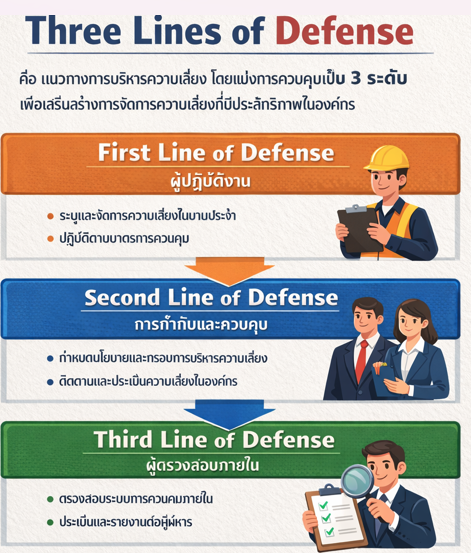
The risk management structure follows the Three Lines of Defense principle, clearly dividing responsibilities as follows:
1. First Line of Defense (Operational Personnel)
refers to departments or employees performing actual operations.
Key Roles:
-
Identify and discover risks in their own work.
-
Comply with procedures and control measures (SOP).
-
Manage and mitigate initial risks.
-
Report identified problems or risks.
Simple comparison: “Front-line worker = the first line of defense against risks”
2. Second Line of Defense (Oversight and Control Personnel)
is Management, Board of Directors, and Risk Management Department
Key Roles:
-
Establish risk management policies and framework.
-
Control, supervise, and monitor departmental operations.
-
Analyze and assess overall organizational risks.
-
Provide recommendations and improve control measures.
Comparison: “Game controller = ensures everything is done correctly”
3. Third Line of Defense (Independent Auditor)
is Internal Audit
Key Roles:
-
Verify the accuracy and effectiveness of all systems.
-
Assess whether controls and risk management are adequate.
-
Report directly to the Audit Committee.
Comparison: “Independent auditor = someone who re-checks if the system is truly good”
Top Level Governance
-
Board of Directors and Audit Committee
- Oversee the overall picture and provide approval.
-
Policy and Control Level (Second Line)
-
Risk Management Committee
-
Executive Committee
-
-
Operational Level (First Line)
-
Risk Management Working Group
-
Departments/Risk Owners
- Identify, analyze, and manage risks.
-
-
Independent Department (Third Line)
-
Internal Auditor
- Verify and report the accuracy and effectiveness of the system.
-
Policy & Plan Description
Risk Management Policy and Plan, New City (Bangkok) Public Company Limited
New City (Bangkok) Public Company Limited recognizes the importance of risk management to ensure business stability for all stakeholders. Therefore, the company has appointed Risk Management Committee established to oversee, monitor, and assess organizational risks, with details as follows:
1. Analyze risks and develop a risk management plan
-
The Risk Management Committee is responsible for Define and oversee risk management policies covering 8 main areas of organizational risk
-
create Risk Control Framework and define risk management measures according to severity levels, including:
-
Low level
-
Medium level
-
High level
-
2. Risk Assessment
The Committee divides risk assessment into 8 key areas as follows:
-
Strategic Risk – Risks from business planning and strategic decision-making
-
Operational Risk – Risks from work processes, production, service provision, or internal management
-
Financial Risk – Risks related to liquidity, investment, and debt management
-
Compliance Risk – Risks from non-compliance with laws, regulations, or government agency requirements
-
Health Risk – Risks affecting employee health and safety
-
Environmental Risk – Risks that may impact the environment
-
Community Risk – Risks affecting relationships and responsibilities towards the community
-
Image and Reputation Risk – Risks that may affect the company's image and credibility
3. Develop and monitor risk management strategies
-
In 2024, the company reduced its risk level from the previous year 12 items and further developed from the previous year 45 items
-
Focus on adjusting methods and defining events that can reduce risks
-
prepare Continuous monitoring process for risk control and reduction to ensure risks are at an acceptable level for the company
4. Review and evaluate operational performance
-
Monitor and evaluate operational performance according to the plan to improve strategies and risk management approaches for the next cycle
-
Analyze strengths and weaknesses of operations
-
Identify potential future risk factors to enable improvement of operational approaches and achievement of company goals
5. Other assigned tasks
In addition to general risk management, the Risk Management Committee has been assigned additional tasks as follows:
-
Monitor risks in energy-saving projects
-
Assess and manage potential risks in project implementation processes
-
Develop strategies to mitigate the impact of risks throughout the project duration
-
Consider external and internal factors that may affect project success
-
-
Support special or new projects of the company
-
Provide consultation and monitor risks in new business development projects
-
Prepare reports and recommendations to help ensure efficient operations
-
-
Prepare and update risk documents/reports
-
Report risk management results to executives and the board
-
Ensure that risk control measures are fully implemented
-
Risk Factors — Overview
Risk Factors — Introduction
Risks to the company's business operations
The company recognizes potential risks arising from both internal and external factors that may affect its business operations, financial position, operating results, and continued existence. Therefore, the company has established an Enterprise Risk Management system to systematically identify, analyze, and manage risks, covering both current risks and emerging risks over the next 3-5 years.
This risk disclosure is beneficial for investors in analyzing risks and building confidence in the company's management. The company has considered the following approaches:
-
Risk analysis must align with the company's goals, policies, strategies, and operational characteristics.
-
Consider risks that may affect stakeholders in the value chain, including customers, partners, employees, and communities.
-
Disclose significant and highly probable risk factors, specifying appropriate risk management measures consistent with the nature and context of business operations.
1. Corporate Level Risk Management
-
Align corporate-level strategies with Company's vision, mission, and goals
-
Report risk management progress to the Board of Directors periodically.
-
Covers risk assessment in anti-corruption, legal compliance, and good corporate governance.
-
Assess and monitor factors that may cause risks to change constantly.
2. Business Level Risk Management
-
Analyze the strengths, weaknesses, opportunities, and threats of the business.
-
Develop appropriate action plans for each business and department.
-
Assess the impact of risks on the operations and financial status of each business unit.
3. Functional / Operational Level Risk Management
-
Implement action plans in each department.
-
Evaluate and measure performance according to the Business Plan.
-
Covering 4 key dimensions:
-
Financial (Financial) – Monitoring expenses against budget.
-
Customer/Market – Seasonal services and promotions
-
Operations – Development of SOPs and standard operating manuals.
-
Capability – The use of analytical skills and data-driven planning (Data-Driven
-
From the operations of the Risk Management Working Group, the company has conducted an Enterprise Risk Assessment covering all aspects of risks related to business operations, considering the likelihood of occurrence and the level of impact, to prioritize risks and determine appropriate management approaches.
The results of the risk assessment for 2025 can be categorized by risk level as follows:
-
Low Risk These are risks at an acceptable level for the company, totaling 33 items, accounting for 41.77% of all risks. The company has sufficient internal control measures in place and continuously monitors them to prevent risks from escalating.
-
Medium Risk There are 23 items, accounting for 29.11%, which are risks that require close monitoring and follow-up. The company has established guidelines and measures to mitigate impacts, as well as to adjust operational processes to suit changing situations.
-
High Risk There are 23 items, accounting for 29.11%, which are risks that could significantly impact the company's business operations, financial position, and operating results if they occur. The company prioritizes establishing control measures and contingency plans, as well as closely and continuously monitoring and evaluating their effectiveness.
The company has utilized the results of this risk assessment as information for strategic planning and operations, to appropriately manage risks in alignment with the organization's goals and business direction, and to systematically accommodate potential future changes. This involves analyzing and managing risks across 8 key areas in 2025. with details as follows:
|
Risk aspects |
Number of topics |
Low Level (Low) |
Medium Level (Medium) |
High Level (High) |
Observations/Management Measures |
|---|---|---|---|---|---|
|
Strategy (Strategic Risk) |
47 |
24 |
10 |
13 |
Adjust strategies according to market and economic changes, plan business risk diversification. |
|
Operations (Operational Risk) |
12 |
2 |
4 |
6 |
Develop SOPs, quality control, employee training, performance tracking systems. |
|
Financial (Financial Risk) |
8 |
1 |
3 |
4 |
Analyze financial statements, check liquidity, assess the impact of interest rates and costs. |
|
Legal Compliance (Compliance Risk) |
4 |
3 |
1 |
0 |
Check compliance with laws and regulations, train employees. |
|
Health (Healthy Risk) |
3 |
0 |
3 |
0 |
Safety and health measures, health insurance programs. |
|
Environment (Environment Risk) |
1 |
0 |
1 |
0 |
Environmental impact management system, sustainable resource utilization. |
|
Community (Community Risk) |
2 |
2 |
0 |
Community engagement, social impact assessment |
|
|
Image & Reputation (Image & Reputation Risk) |
2 |
1 |
1 |
0 |
Corporate communication, crisis and PR management, social media monitoring. |
. Severity Level
-
Low (Low) – Insignificant impact on operations or finances.
-
Medium (Medium) – Has an impact on operations or performance at a level that requires monitoring.
-
High (High) – Severe impact on business and financial position. If it occurs, risk mitigation measures must be implemented immediately.
-
Acceptable Level (Risk Acceptance Level )
-
This is a level of risk that the company can accept under the specified control measures.
-
-
Management Measures
-
Including prevention, impact reduction, preparedness, and follow-up.
-
Such as strategic plan adjustments, SOP development, employee training, KPI tracking, and ESG impact assessment.
-
5. Environmental and Social (ESG) Risk Factors
-
Risks from climate change – may affect the operating cost structure and real estate development projects.
-
Occupational health and safety risks – affecting employee performance and safety standards.
-
Risks from disputes with communities – affecting project image and sustainability.
-
Risks from fraud/corruption – may affect the company's credibility and operations.
-
Risks from severe epidemics – affecting employees and operational activities.
Management measures:
-
Plan and implement environmental and safety projects.
-
Train and raise awareness on human rights and ESG.
-
Has anti-corruption policy and internal audit.
-
Assess the impact of epidemics and plan for backup operations.
6. Emerging Risk (New risks in the next 3-5 years)
The company recognizes emerging risks, which are mostly external factors beyond the company's control but are likely to impact business operations, financial position, and operating results in the medium to long term (3–5 years). The company continuously monitors and assesses the situation to prepare for these risks.
Key risks are as follows:
6.1 Risks from natural disasters such as earthquakes and floods
Changes in climate and natural uncertainties may lead to events such as earthquakes, floods, or other disasters, which could affect the supply chain, product transportation, and company operations, as well as potentially increase costs due to property damage or delays in product delivery.
Management approach:
The company has a Business Continuity Plan (BCP), diversifies sources of goods and raw materials, and assesses the risks of partners and service providers to accommodate unforeseen events.
6.2 Risks from geopolitical conflicts and wars
International conflicts or global political uncertainties may affect the overall economy, energy prices, production costs, and international transportation, which could increase the company's costs and impact consumer purchasing power.
Management approach:
The company closely monitors international economic and political situations, and adjusts procurement plans, cost management, and product pricing to suit the circumstances.
6.3. Risks from Climate Change / Global Warming
Climate change may affect business operations both directly and indirectly, such as changes in consumer behavior, government environmental measures, as well as potentially rising energy and raw material costs.
Management approach:
The company emphasizes sustainable business operations by promoting efficient resource utilization, reducing energy consumption, and improving operational processes to align with environmental guidelines.
6.4 Economic Fluctuations and the Real Estate Market Changes in overall economic conditions, including rising interest rate trends, may affect consumer purchasing power and access to credit, especially among middle-income customers, who are the primary target group for the real estate business. This could lead to a decrease in demand for housing and may slow down investment decisions in new projects. Furthermore, economic fluctuations may also impact the company's revenue levels, financial costs, and liquidity, which could affect overall operating performance.
Management approach:
The company closely monitors economic conditions and interest rate trends, while adjusting sales and marketing strategies to align with customer purchasing power. It also prudently manages costs and liquidity, and considers diversifying risks across various customer groups and products.
6.5 Technology Risk Rapid technological changes, including the adoption of information technology (IT) systems, data analytics, and artificial intelligence (AI) in business, may lead to risks in data security (Cybersecurity), leakage of critical information, and system discontinuity. Furthermore, if the company fails to adapt to technological changes, it may lose its competitive edge and be unable to adequately respond to evolving consumer behavior.
Management approach:
The company continuously emphasizes the development and improvement of information technology systems, implementing data security measures, data access controls, and regular data backups, as well as monitoring new technology trends and developing personnel capabilities to accommodate such changes.
6.6 Risks from changes in regulations and laws (Regulatory Risk) Changes in laws, regulations, and government agency requirements may affect the company's business operations, including operating costs, operational procedures, and the ability to expand the business. For example, changes in taxation, environmental control measures, or labor requirements may necessitate the company to revise its operational processes and increase compliance costs.
Management approach:
The company continuously monitors changes in laws and regulations, and updates its work processes to comply with relevant requirements. It also provides knowledge to employees and relevant departments to ensure business operations are conducted correctly and to reduce the risk of non-compliance. In summary, economic, technological, and legal risks are significant factors that may affect the company's future business operations. Although these are external factors that cannot be directly controlled, the company continuously monitors, analyzes, and prepares to adapt to accommodate changes and mitigate potential impacts appropriately. If desired, I can provide a "Summary in a 3-column table (Risk / Impact / Management Approach)" version for inclusion in the 56-1 form, making it look more professional.
Although these risks are external factors that cannot be directly controlled, the company continuously monitors, assesses, and prepares to adapt and mitigate potential impacts on business operations appropriately, as well as to enhance long-term business continuity.
Risks to the Company's Business Operations
Introduction
1. Strategic Risk from Sales Not Meeting Targets (Strategic Sales Risk)
The company sets sales targets as a key factor driving business growth. However, based on past performance, the company has identified strategic risks from sales not meeting set targets, particularly in department store sales channels, which show a significant downward trend.
In 2025, sales through department store channels decreased by 11.26 million Baht, or 9.36%. compared to the previous year, with potential influencing factors including changing consumer behavior towards increased online shopping, a slowing economy affecting purchasing power, and heightened competition from both existing and new operators.
A decrease in sales through these channels may affect the company's total revenue, its ability to achieve annual business targets, and its cost management efficiency, especially expenses related to department store operations, such as rent and management fees.
Risk management guidelines
The company has established the following guidelines for managing sales risks:
-
Adjustment of sales channel strategy (Channel Strategy)
The company focuses on diversifying its sales channels, especially online channels, to align with changing consumer behavior. -
Sales promotion and marketing
The company organizes sales promotion activities, visual merchandising, and attractive product presentations to attract customers and increase sales opportunities. -
Management of sales areas in department stores
The company assesses the efficiency of sales areas in each branch and improves product presentation formats as appropriate, including considering reducing or expanding areas based on the potential of each location. -
Product development to meet market needs
The company focuses on developing products that align with consumer needs in terms of quality, style, and price to enhance competitiveness. -
Monitoring and analysis of operational performance
<6U7ONRBs6klT>
2. Retail Space Management Risk in Department Stores
The company operates through sales channels in department stores, which have minimum sales requirements that must be met. If the company fails to achieve the specified sales targets, the department store may consider terminating the sales area or not renewing the lease agreement in the future.
This risk may arise from several factors, such as changing consumer behavior towards increased online shopping, heightened competition within department stores, and sales area locations that may not align with target customer groups, leading to a decrease in customer numbers and sales.
The impact of this risk may lead to the company losing significant sales channels, affecting its overall revenue, potentially harming the brand's image in leading department stores, and increasing unit costs due to the need to find alternative sales channels.
Risk Level Assessment
The company has assessed these risks by considering the likelihood of occurrence and the level of impact, with the assessment results being at a level of
-
Likelihood = 3 (Medium likelihood)
-
Impact = 3 (Medium impact)
thus having a Risk Score of 9, classified as Medium Risk.
Risk management guidelines
The company has established the following guidelines for managing these risks:
-
Monitoring and evaluation of sales performance per branch
The company closely monitors the performance of each branch, comparing sales with the department store's established criteria to enable timely corrective actions. -
Adjustment of sales and marketing strategies in sales areas
The company organizes sales promotion activities, visual merchandising, and attractive product presentations to attract customers and increase sales opportunities. -
Appropriate sales area management
The company assesses the potential of each location and considers adjusting the size of the sales area to align with performance, including relocating or changing locations if sales targets cannot be met. -
Diversification of sales channels
The company focuses on developing other sales channels, such as online channels and other retail stores, to reduce sole reliance on department store channels.
3. Strategic Risk of Product Portfolio Management in Each Branch )
The company emphasizes managing its product portfolio to align with the behavior and needs of customers in each department store branch, as customer characteristics and purchasing power vary significantly across locations. If the company fails to analyze and allocate products appropriately, some items may not meet customer demand, leading to reduced sales and accumulated inventory issues in certain branches.
This risk may arise from several factors, such as incomplete or untimely customer data analysis regarding changing consumer behavior, inappropriate product allocation planning for each location's potential, and limitations in inter-branch inventory management, which may lead to inventory imbalances, such as stock shortages in high-demand branches and stagnant stock in low-sales branches.
The impact of this risk may affect the revenue generation efficiency of each branch, inventory turnover rates, and inventory management costs. Furthermore, it may impact the brand's image if customers cannot find desired products in the branches they visit.
Risk Level Assessment
The company has assessed these risks by considering the likelihood of occurrence and the level of impact, with the following assessment results:
-
Likelihood = 4 (Relatively high likelihood)
-
Impact = 4 (High impact)
resulting in a Risk Score of 16, which is classified as High Risk and requires close monitoring and management.
Risk management guidelines
The company has established guidelines for managing product portfolio risks as follows:
-
Customer and sales data analysis (Data-Driven Analysis)
The company analyzes sales data and consumer behavior in each branch to plan product allocation appropriate for customer groups in each area. -
Localized Product Strategy
The company adjusts product styles and proportions in each branch to align with customer characteristics and location potential, aiming to increase sales opportunities and reduce stagnant inventory. -
Continuous monitoring and improvement d
The company regularly monitors sales performance in each branch and adjusts product allocation plans to align with changing situations. -
Inter-branch inventory management
The company manages product transfers between branches to balance inventory and reduce the risk of stagnant stock. -
Development of decision support systems
The company has developed information systems to support product analysis and planning, enhancing accuracy in portfolio management.
The risk of managing the product portfolio in each branch is high, which may affect the company's revenue and operational efficiency. However, the company has established continuous measures for analysis, planning, and monitoring to ensure appropriate product management and reduce the impact of risks to an acceptable level.
4 . Strategic risk from store issue management and corrective actions (Store Issue Management Risk)
The company prioritizes collecting store issues and promptly implementing corrective actions to enhance operational efficiency and customer experience. However, if problem collection, analysis, and resolution are ineffective or untimely, it may affect sales, brand image, and the company's competitiveness.
Problems found in stores can be categorized into 3 main issues: product issues, store display issues, and personnel issues, each with different risk levels as follows:
1. Product-Related Issues
Product issues, such as insufficient stock, products not matching customer needs, or substandard quality, may prevent customers from purchasing desired items and directly impact sales.
Risk Assessment:
-
Likelihood = 4 (Relatively high likelihood)
-
Impact = 4 (High impact)
-
Risk Score = 16 (High risk)
2. Store Display Issues (Visual Merchandising & Store Layout Issues)
Inappropriate product display and presentation within the store, or inability to attract customer attention, may affect the shopping experience and reduce purchasing decisions.
Risk Assessment:
-
Likelihood = 3 (Medium likelihood)
-
Impact = 4 (High impact)
-
Risk Score = 12 (Medium to high risk)
3. Sales Staff Lack of Product Knowledge (Sales Staff Product Knowledge Risk)
Sales staff lacking product knowledge and understanding may not be able to provide accurate information or advice to customers, leading to a lack of customer confidence and potential loss of sales opportunities.
Risk Assessment:
-
Likelihood = 1 (Low likelihood)
-
Impact = 3 (Medium impact)
-
Risk Score = 3 (Low risk)
Risk management guidelines
The company has established a systematic approach to managing and resolving store issues as follows:
-
Systematic problem collection and analysis
The company continuously collects problem data from each branch and analyzes it to identify root causes and appropriate solutions. -
Product improvement and stock management
The company adjusts product allocation plans to suit the needs of each branch and consistently controls product quality. -
Store display development (Visual Merchandising)
The company improves product display formats to be appealing, align with consumer behavior, and encourage purchasing decisions. -
Sales staff potential development
The company continuously provides training and product knowledge to employees to enhance service and sales efficiency. -
Continuous monitoring and evaluation
The company monitors operational performance and evaluates the effectiveness of problem-solving to further improve operational processes.
The risk from store issue management is a significant factor that may affect the company's sales and image, especially product-related issues, which carry a high level of risk. However, the company has established continuous monitoring, analysis, and corrective action guidelines to mitigate the impact of risks and enhance overall business operational efficiency.
5. New Product Development Risk
5.1 Products: New product under the SANREMO INNERWEAR brand (shorts category)
The company prioritizes new product development to expand its customer base and enhance market competitiveness. However, developing new products, especially in the highly competitive apparel sector with rapidly changing consumer behavior, may lead to multi-dimensional risks such as misalignment with market needs, inappropriate pricing, inaccurate sales forecasts, and inventory management risks.
For new shorts products under the SANREMO INNERWEAR brand, the company has assessed the risk as very high, with details as follows:
-
Likelihood of Risk: Level 5 (Frequent or continuous occurrence)
-
Impact: Level 5 (Significant impact on revenue, profit, and overall business operations)
-
Overall Risk Level (Risk Score): 25 (Very high level)
Key Risk Factors
-
Uncertainty of market demand As the product is new, consumer demand may not be accurately predicted, leading to sales not meeting targets.
-
High market competition There are numerous domestic and international manufacturers of shorts, leading to intense price and quality competition.
-
Unclear product positioning If products cannot clearly communicate their strengths or differentiation, they may fail to reach target groups.
-
Cost and inventory management risk Mass production to support sales may lead to overstock if products cannot be sold as planned, affecting cash flow and storage costs.
-
Market response not as expected May result from product style, size, or fabric not matching consumer needs.
Risk management measures
To control and mitigate the impact of these risks, the company has established the following guidelines:
-
Thoroughly study and analyze consumer insights and market trends before product development.
-
Conduct limited market testing before mass production to reduce sales and inventory risks.
-
Develop products with clear strengths and differentiation in terms of design, quality, and functionality.
-
Carefully manage production volume using a Demand Planning system.
-
Define pricing and distribution channel strategies appropriate for the target audience.
-
Closely monitor sales performance and adjust marketing or production strategies promptly.
-
Develop an Inventory Clearance Plan in case sales targets are not met.
The company assesses the new product development risk for SANREMO INNERWEAR (shorts) as very high, requiring close and systematic management. The company has established appropriate risk control measures to limit the impact to an acceptable level and increase the commercial success potential of the product.
5.2 Products: New product under the CHERILON INTIMATE brand (camisole category)
The company recognizes the importance of new product development to enhance competitiveness and respond to ever-changing consumer demands. However, developing new products may involve various risks, such as misalignment with market needs, product design that does not match consumer behavior, or inappropriate product launch timing.
For new camisole products under the CHERILON INTIMATE brand, the company has assessed the risk as low, with details as follows:
-
Likelihood of Risk: Level 1 (Very rare occurrence / less than once a year)
-
Impact: Level 1 (Very low impact on business operations)
-
Overall Risk Level (Risk Score): 1 (Very low level)
This is because the company has experience and expertise in developing apparel products, especially women's intimate wear, along with an existing consumer behavior database and market testing before actual sales, thereby reducing the likelihood and impact of such risks to a low level.
Risk management measures
To control and mitigate risks, the company has established the following guidelines:
-
Continuously study and analyze consumer demand data, including monitoring market trends.
-
Conduct product testing and gather feedback from target customer groups before commercial production.
-
Control product quality (Quality Control) at every stage of production to meet specified standards.
-
Plan production and product launches to align with seasons and consumer purchasing behavior.
-
Closely monitor sales performance and customer feedback to continuously improve products.
From the assessment, the company views the new product development risk for CHERILON INTIMATE (camisole) as very low and under appropriate control. However, the company will continue to monitor and assess risks to ensure effective management in line with changing market conditions.
6. Consumer Behavior Change Risk
The company recognizes that consumer behavior is constantly changing as a result of rapidly evolving technological, economic, social, and lifestyle trends, particularly the growth of online sales channels, the emphasis on product quality, value for money, and the shopping experience, which may impact product demand and consumer purchasing decisions.
Therefore, the company assesses the risk from changing consumer behavior as relatively high, with details as follows:
-
Likelihood of Risk: Level 4 (Relatively frequent occurrence / monthly)
-
Impact: Level 4 (Significant impact on revenue, market share, and competitiveness)
-
Overall Risk Level (Risk Score): 16 (High level)
Key Risk Factors
-
Changes in purchasing channels Consumers are increasingly using online channels and e-commerce platforms, which may affect sales in traditional channels.
-
Increased expectations for quality and value for money Consumers can easily compare various brands, leading to a demand for high-quality products at reasonable prices.
-
Rapidly changing popularity trends (Fast-changing Trends) especially fashion products with short life cycles, which may lead to products not aligning with demand at certain times.
-
Influence of digital media and social media Affects brand perception and purchasing decisions. If the company cannot communicate effectively, it may lose market opportunities.
-
Diversity of consumer needs Consumers increasingly demand niche market products, requiring flexible product development that precisely meets specific group needs.
Potential Impact
-
Product sales not meeting targets
-
Products not matching market demand, leading to excess inventory.
-
Loss of market share to faster-adapting competitors.
-
Brand image is not modern or does not align with consumer needs.
Risk management measures
The company has established the following risk management guidelines:
-
Continuously study and analyze consumer insights and market trends.
-
Develop efficient online sales channels and digital platforms that cover target groups.
-
Adjust marketing strategies to be flexible and responsive to rapid changes (Agile Marketing).
-
Develop diverse products that appropriately meet the needs of each consumer group.
-
Monitor and analyze sales data, as well as customer feedback, to continuously improve products and services.
-
Strengthen brand image through digital media and consistent marketing communications.
The company assesses the risk from changing consumer behavior as high, which may affect various aspects of its business. However, the company has established appropriate and continuous risk management measures to adapt promptly to changes and maintain long-term competitiveness.
7. Operational Risk
Risk Issue: 12 identified operational deficiencies/issues
The company prioritizes controlling and overseeing operations to ensure efficiency, transparency, and compliance with established policies and regulations. However, internal monitoring and audits revealed 12 operational observations, reflecting opportunities for improving certain work processes, such as document completeness, adherence to specified procedures, and internal controls in some activities.
The company has assessed the operational risk level as follows:
-
Likelihood of Risk: Level 3 (Occasional occurrence / quarterly)
-
Impact: Level 3 (Medium impact on operational efficiency and may affect the accuracy of some internal data)
-
Overall Risk Level (Risk Level): 9 (Medium level)
Nature of identified risks
The identified risk issues can be summarized as follows:
-
Incompleteness or inaccuracies in some operational supporting documents.
-
Operations not consistently adhering to established procedures or regulations
-
Incomplete or untimely data recording in the system
-
Lack of continuous internal monitoring and auditing in some processes.
-
Inconsistent understanding of operational procedures among employees
Potential Impact
-
Decreased operational efficiency
-
Inaccuracies in accounting or business data
-
Delays in operations or data reporting
-
Risk of non-compliance with relevant requirements or standards
Risk management measures
To control and mitigate these risks, the company has established the following guidelines:
-
Define a Corrective Action Plan for all 12 identified issues, with clear timelines and responsible parties.
-
Improve and review Standard Operating Procedures (SOP) to be clearer and more appropriate.
-
Continuously enhance employee knowledge and understanding through training and internal communication.
-
Develop internal control and audit systems to be more efficient.
-
Continuously monitor the results of corrective actions and report progress to management.
-
Utilize information technology systems to control and verify data, reducing operational errors.
The company assesses the operational risk from the 12 identified issues as medium, which is still manageable and controllable. However, the company prioritizes continuous improvement of work processes and internal control systems to enhance operational efficiency and reduce the likelihood of future risks.
8 . Financial Risk )
Issue: Trade Receivables and Other Current Receivables Risk
The company recognizes the importance of managing trade receivables and other current receivables, which are crucial components of current assets and directly impact the company's financial liquidity and cash flow. Ineffective debtor management may lead to delays in debt collection or the risk of bad debts.
From the risk assessment, the company has determined the risk level for this issue to be low, with details as follows:
-
Likelihood of Risk: Level 2 (Infrequent occurrence / once a year)
-
Impact: Level 2 (Low impact on liquidity and operational performance)
-
Overall Risk Level (Risk Score): 4 (Low level)
Key Risk Factors
-
Customer's ability to pay debt Customers may experience liquidity problems, leading to an inability to pay debts on time.
-
Trade credit provision Setting inappropriate credit limits or credit periods may increase collection risk.
-
Inconsistent debt collection follow-up May result in longer debt collection periods.
-
Inaccuracies in debtor data such as incorrect data recording or incomplete documents, which may affect debt monitoring and collection.
-
Risk from other current receivables such as advances or miscellaneous receivables, which may not have clear payment terms.
Potential Impact
-
Delayed cash receipts, affecting the company's liquidity.
-
May result in overdue debts or bad debts.
-
Increased cost burden for debtor monitoring and management.
-
Affects the accuracy of financial statements if the allowance for doubtful accounts is inappropriate.
Risk management measures
The company has established guidelines for controlling and mitigating risks as follows:
-
Establish a stringent trade credit policy, considering customers' payment history and creditworthiness.
-
Set appropriate credit limits and payment terms for each customer.
-
Prepare an aging report and consistently follow up on debt collection.
-
Establish an allowance for doubtful accounts in accordance with prudence principles and financial reporting standards.
-
Continuously improve the accuracy and completeness of debtor information in the accounting system.
-
<9XlbZ2gapvcl>
-
Periodically review debtor status and assess risks to adjust measures appropriately.
8. Risk from Changes in Raw Material Costs (Cost Risk)
Cost and Raw Material Price Risk
The company operates primarily in the distribution of textile products, which necessitates reliance on key raw materials for production, such as synthetic fibers like Nylon and Spandex, as well as transportation costs, which tend to fluctuate with global market conditions and economic factors.
Key factors that may lead to increased raw material and operating costs include fluctuations in global oil prices, which directly impact transportation and logistics costs, as well as foreign exchange rate volatility, particularly the depreciation of the Thai Baht, which may increase the cost of importing goods or raw materials from abroad.
The increase in these costs may affect the company's profit margins, especially if the company cannot adjust product selling prices in time to reflect cost changes due to competitive constraints and consumer purchasing power. Furthermore, if the company adjusts product prices to reflect increased costs, it may impact competitiveness and potentially lead to reduced sales.
Risk Situation
-
Rising global oil prices lead to increased domestic and international shipping costs.
-
The depreciation of the Thai Baht against major currencies leads to increased costs for imported goods and raw materials.
-
Manufacturers raise product prices in line with increased raw material costs.
Risk management guidelines
-
Price negotiation with manufacturers
The company regularly negotiates prices with manufacturers to achieve appropriate product costs, including entering into price agreements for a certain period to reduce cost volatility. -
Systematic cost management
The company controls and monitors costs at every stage of operations, while also improving work processes to reduce unnecessary expenses and enhance operational efficiency. -
Appropriate selling price determination
The company considers adjusting product prices to align with costs and market conditions, prioritizing competitiveness and consumer purchasing power. -
Exchange rate risk management
The company closely monitors exchange rate situations and considers appropriate risk management approaches to mitigate the impact of currency fluctuations. -
Purchasing planning and inventory management a
The company plans product procurement and manages inventory to align with market demand trends, aiming to reduce the impact of short-term cost fluctuations.
Cost and raw material price risks are significant factors that may affect the company's profitability. However, the company has planned and implemented various management measures to mitigate the impact of cost fluctuations and maintain long-term competitiveness.
9 . Risk of Operating Loss
Factors and coping strategies
The company's core business is the distribution of textile and apparel products, an industry characterized by high competition and sensitivity to economic conditions and consumer behavior. This exposes the company to the risk of operating losses if it cannot effectively manage costs and maintain competitiveness.
Risk Level
-
Likelihood of Risk (Likelihood) : Level 4 (Relatively frequent occurrence)
-
Impact: Level 5 (Significant impact on operational performance and profitability)
-
Overall Risk Level (Risk Score): 20 (High level)
Key Risk Factors
-
Price Competition
The textile and apparel industry faces high price competition, especially for easily imitable products, forcing operators to reduce product prices to maintain market share, resulting in a significant decrease in gross profit. -
Competition from imported products
Foreign products, especially those from China with lower production costs, have entered the market at lower prices, affecting the company's sales and profitability. -
Economic conditions and consumer purchasing power
Economic fluctuations, such as inflation, rising interest rates, and increased cost of living, lead to a decrease in consumer purchasing power, especially for apparel products which may not be essential goods, directly impacting sales. -
Increased operating costs
Raw material costs, labor costs, transportation costs, and operating expenses tend to increase, affecting the company's profit margins. -
Adaptability to market trends
If the company fails to adapt promptly to market trends and consumer behavior, it may lose sales opportunities and market share.
Impacts in the past year
In 2025, the company was affected by intense competition in the women's underwear market, especially from low-priced imported products, resulting in
-
Sales decreased by 1.60%.
-
Profit decreased by 63.16%.
which reflects significant price and cost pressures affecting the company's operational performance.
Strategies and measures for risk management
To address the risk of operating losses, the company has established the following Master Plan:
-
Efficient cost management (Cost Optimization)
-
Control operating expenses and enhance supply chain efficiency.
-
Product development and differentiation (Product Differentiation)
-
Develop products with quality, functions, and designs that meet consumer needs.
-
Create brand identity to reduce price competition.
-
Expansion of sales channels (Channel Diversification)
-
Develop distribution channels to be more comprehensive and accessible to target customer groups.
-
Appropriate price and promotion management (Pricing Strategy)
-
Set product prices in line with quality and target audience.
-
Utilize effective sales promotion strategies to stimulate sales.
-
Business data monitoring and analysis (Data-Driven Decision Making)
-
Continuously analyze sales data, costs, and consumer behavior.
-
Adjust operational strategies to align with changing situations.
-
Efficient inventory management (Inventory Management)
-
Plan production and procurement to match market demand.
-
Reduce risks from inventory and product write-offs.
The risk of operating losses is a significant risk to the company's business, as it is affected by both internal and external factors. However, the company has established systematic strategic plans and risk management measures to enhance competitiveness, control costs, and maintain long-term profitability amidst fluctuating economic and competitive conditions.
Risk Register
| Risk Name | Risk Characteristics | Consequences | Management Measures | Related Risk Factors |
|---|---|---|---|---|
| Strategic and Business Operational Risks | Strategic and Business Operation Risks The company recognizes the importance of managing strategic and business operation risks, which are critical factors that could impact its competitiveness, sustainable growth, as well as its financial position and operating performance in both the short and long term. In conducting business, the company faces uncertainties from both internal and external factors, such as changes in consumer behavior, competitive conditions in the industry, reliance on partners and business alliances, as well as economic fluctuations and uncontrollable situations like infectious disease outbreaks or other emergencies. These factors may affect the supply chain, production, product distribution, and consumer purchasing power. Additionally, setting business strategies that are not aligned with market conditions or failing to adapt to changes promptly may cause the company to lose business opportunities and affect its ability to generate future revenue and profits. Therefore, the company places importance on continuously monitoring, analyzing, and assessing risk factors. It has established appropriate risk management approaches covering strategic planning, product development, customer and partner relationship management, as well as improving operational processes to be flexible and responsive to changing situations in a timely manner. The company aims to mitigate the impact of these risks to an acceptable level and strengthen business stability, thereby creating sustainable long-term value for stakeholders. The company faces risks that may impact its business operations, financial position, and operating performance, with the following key factors: 1. Risks from customer/consumer behavior or demand Risk Factors:
At the same time, current consumers place greater importance on factors such as product quality, price, value for money, convenience, as well as brand image and social and environmental responsibility. If the company fails to monitor and adapt to these trends promptly, its products may not meet market demands. Impact:
Risk Management Approaches:
Furthermore, the company has developed distribution channels covering both online and offline platforms to enhance product accessibility, and has adjusted its marketing strategies, brand communication, and pricing to suit ever-changing market conditions, thereby maintaining competitiveness and continuously building customer satisfaction. 2. Risks from business operations of partners and supply chainRisk Factors:
These partners may face risks from various factors such as production issues, raw material shortages, increased production costs, product quality problems, delayed transportation, as well as economic uncertainties or emergency situations like natural disasters or infectious disease outbreaks, which could prevent partners from operating normally. Moreover, reliance on only a few key partners may increase risks should these partners encounter business difficulties or unexpectedly cease operations. Impact:
Additionally, it may lead to increased operating costs due to the urgent need to procure raw materials or services from alternative sources, and could also affect the company's image and the trust of customers and business partners in the long term. Risk Management Approaches:
The company has a manufacturing plant, which is an associated company, New Plus Knitting Public Company Limited. Production planning is systematically coordinated to align with market demand and efficient product distribution plans. Furthermore, the company selects other partners based on reliability, product quality, and the ability to deliver products consistently. It also regularly evaluates and monitors the performance of its partners to ensure that they meet the company's specified standards. The company has established a policy to diversify procurement sources to reduce excessive reliance on any single partner, and has also developed contingency plans for sourcing raw materials and services from alternative sources to prepare for emergencies or situations that may affect the supply chain. The company places importance on appropriate product quality control, procurement planning, and inventory management, as well as close coordination with partners, to efficiently manage the supply chain and mitigate the impact of potential business risks. 3. Risks from reliance on major or a small number of customers Risk Factors:
Furthermore, the purchasing behavior of these customer groups may fluctuate due to economic conditions, financial liquidity, or changes in the customers' own business policies. If the company fails to maintain business relationships with key customers or continuously meet their demands, it may lead to customers reducing or canceling orders, or switching to other service providers. Impact:
Additionally, the company may require time to find replacement customers and incur increased marketing and sales expenses. This could also affect production planning and inventory management, leading to reduced operational efficiency and impacting long-term profitability. Risk Management Approaches:
The company emphasizes building and maintaining good relationships with existing customers by continuously focusing on improving product and service quality to meet customer needs, and by offering a diverse range of products and sales models to enhance customer satisfaction. Furthermore, the company regularly monitors and analyzes the proportion of revenue from each customer to assess risk levels and determine appropriate management approaches, which will help enhance revenue stability and reduce the impact of reliance on major customers in the long term. 4. Risks from economic uncertaintyRisk Factors:
For consumer goods businesses, especially non-essential items, consumers may delay or reduce spending during economic slowdowns, leading to fluctuations in product demand and the company's sales. Additionally, the company's operating costs may increase due to inflation, transportation costs, and rising raw material costs in line with economic conditions. Impact:
Furthermore, exchange rate fluctuations may impact the cost of imported goods and price competitiveness, while increased interest burdens from rising interest rates may affect the company's liquidity and financial costs. Risk Management Approaches:
The company prioritizes efficient cost management, expense control, and adjusting product pricing structures to suit market conditions, as well as developing a diverse range of products in terms of price and style to meet the purchasing power of consumers in each segment. Furthermore, the company prudently manages its liquidity and considers using appropriate financial instruments to mitigate the impact of exchange rate and interest rate fluctuations, thereby ensuring continuous and stable business operations in the long term. 5. Risks from infectious disease outbreaksRisk Factors:
Additionally, the outbreak may affect the supply chain, such as production disruptions, raw material shortages, delayed transportation, as well as changes in consumer behavior that may lead to reduced spending or a shift towards online purchasing channels. Regarding internal operations, there may be risks of labor shortages, temporary work stoppages, or operational limitations, which could affect business efficiency. Impact:
Additionally, it may lead to decreased sales due to reduced consumer purchasing power, as well as increased operating costs from hygiene measures, workplace safety management, and operational adjustments. In the long term, this could affect the company's operating results, cash flow, and ability to continue business operations. Risk Management Approaches:
The company prioritizes employee health and safety measures, such as providing protective equipment, establishing work guidelines, and closely monitoring the situation to prevent and reduce the risk of internal outbreaks. Furthermore, the company has adapted its business model by increasing online sales channels and developing flexible work processes to effectively accommodate changes in consumer behavior and uncertain situations. | Management and Operational Risks
The company's business operations involve resource management, policy formulation, internal controls, and operational processes at all levels, which may give rise to risks affecting operational efficiency, data accuracy, and the ability to achieve organizational objectives. Key risks can be categorized as follows: 1. Risk of product obsolescence In 2025, the company established An allowance for inventory write-down of 715,484 Baht to clear slow-moving and obsolete inventory, as the company operates in a rapidly changing industry, particularly concerning consumer behavior, fashion trends, and product usage patterns. This may lead to the company's products becoming obsolete and not aligning with market demand at certain times. If the company cannot adapt or develop products in line with these changes, it could impact sales, inventory levels, and the company's overall performance. Key Risk Factors 1.1 Changes in market trends and consumer behavior
1.2 Product development unable to keep pace with competition
1.3 Inadequate production planning and inventory management
1.4 Product Development Time (Time to Market)
1.5 Impact of Changing Distribution Channels
Potential Impacts
The company has established guidelines for managing the risk of product obsolescence as follows:
2. Data or computer system security risks and cyberattacksThe company extensively utilizes information technology systems in its business operations, covering data management, operations, accounting, sales, and online distribution channels. Reliance on such systems may pose risks related to data security and cyberattacks. Without proper management, this could impact the company's business operations, credibility, and financial standing. Key Risk Factors
2.2 Data Breach Risk
2.3 System Downtime Risk
2.4 Risk from Data Access Rights Management
2.5 Personnel Risk (Human Error and Insider Threat)
2.6 Third-Party Service Provider Risk (Third-Party Risk)
Potential Impacts
Risk Management Guidelines The company has established measures for managing data and computer system security risks as follows:
3. Risks from Climate Change and Disasters Climate change and the increasing severity and frequency of natural disasters such as floods, droughts, storms, or heatwaves may directly and indirectly impact the company's business operations, including production, procurement, transportation, and product distribution, as well as operational costs and business continuity. Key Risk Factors 3.1 Risk from Natural Disasters
3.2 Supply Chain Disruption Risk
3.3 Increased Operational Cost Risk
3.4 Risk from Changes in Environmental Regulations
3.5 Risk of Changing Consumer Behavior
3.6 Business Interruption Risk
Potential Impacts
Risk Management Guidelines The company has established guidelines for managing risks from climate change and disasters as follows:
4. Inventory RisksInventory is a crucial component of the company's business operations, especially in businesses involved in the distribution of goods and textile products. Inefficient inventory management may impact financial liquidity, operational costs, and the ability to meet customer demand. Key Risk Factors 4.1 Risk of excessive inventory (Overstock)
As of year-end 2025, the company had total inventory of 346.23 million Baht, representing 73.42% of current assets, highlighting the importance of inventory management in the business. The risk of excessive inventory arises from production planning or purchasing that does not align with market demand, leading to large inventory volumes. This results in high storage costs and increases the risk of obsolescence. If products cannot be sold in time, they may have to be sold below cost, impacting the company's performance and financial liquidity. 4.2 Risk of insufficient inventory (Stock-out)
4.3 Risk of obsolete or deteriorated goods
4.4 Risk of inventory data inaccuracies
4.5 Risk of loss or damage to goods
4.6 Risk of inefficient warehouse management
Potential Impacts
Risk Management Guidelines The company has established guidelines for managing inventory risks as follows:
| Regulatory and legal risks.The company operates under laws and regulations related to industry, trade, finance, consumer protection, environment, and internal organizational management. Changes in laws or government regulations, as well as delays in compliance, may affect the company's operations, performance, and reputation. Key risk factors. 1. Risk from changes in laws and regulations. The company operates under various relevant laws and regulations, such as business law, tax law, labor law, consumer protection law, personal data protection law (PDPA), and environmental regulations. Rapid and unexpected changes in laws or regulations may require the company to adjust its operational processes, internal control systems, or business documentation. Failure to adapt in a timely manner could impact performance, credibility, and business continuity. Key risk factors.
Potential impacts.
Risk management guidelines. The company has established measures to manage risks arising from changes in laws and regulations, as follows:
2. Risk from regulations and laws unfavorable to business operations.The company operates under the framework of laws and regulations from both domestic and international government agencies. However, some laws or regulations may be unfavorable to business operations, such as imposing strict restrictions, enacting new laws immediately, or legal standards that are inconsistent with the company's operational capabilities, which may affect the company's business processes, competitiveness, and performance. Key risk factors.
Potential impacts.
Risk management guidelines. The company has established measures to manage risks arising from regulations and laws unfavorable to business operations, as follows:
Relationship management with regulatory bodies and partners.
The company's financial risk management. The company operates in a constantly changing economic and market environment. Inadequate financial management or financial risks may affect the company's liquidity, performance, investment capacity, and financial stability. 1. Risk from changes in financial and investment policies of financial institutions. The company has financial relationships with several financial institutions, including capital borrowing, credit line utilization, liquidity management, and investments in various assets. Changes in financial policies, interest rates, or investment requirements of financial institutions may affect the company's operations, investments, and performance. Key risk factors. 1. Changes in interest rate policy. Adjustments to loan interest rates and credit lines, whether upward or downward, affect the company's financial cost burden, especially for variable-rate debt. If interest rates rise, financial expenses may increase, and net profit may decrease. 2. Changes in loan terms and conditions. Financial institutions may adjust loan terms, such as credit limits, duration, interest rates, and collateral. Stricter requirements may limit the company's ability to secure funding. 3. Changes in investment policies of financial institutions. Adjustments to investment approaches, such as reducing investments in assets related to the company's business, may affect the ability to access funding sources or opportunities for co-investment with financial institutions. 4. Risk from policy decisions of financial institutions affecting the market. Changes in macroeconomic monetary policy, such as tightening credit or adjusting interest rates to control inflation, may affect the company's ability to raise funds or its liquidity. 5. Business Continuity Risk. If the company cannot access funding sources or obtain funds under appropriate conditions, it may affect operations, investments, or debt repayment, which could impact the confidence of shareholders and partners. Potential impacts.
Risk management guidelines. The company has established measures to manage risks arising from changes in financial and investment policies of financial institutions, as follows: <8y0jALfx8hH4_espace> 2. Financial and liquidity planning. The company meticulously plans cash flow and liquidity to accommodate fluctuations in financial costs and new requirements from financial institutions. 3. Diversification of funding sources. The company employs a strategy of diversifying funding sources, including loans, credit, and other capital sources, to reduce the risk of relying on a single financial institution. 4. Assessment of debt repayment capacity and financial costs. The company assesses debt obligations, interest rates, and repayment capacity to manage financial cost risks. 5. Building good relationships and communicating with financial institutions. The company communicates and collaborates with banks and financial institutions to appropriately adjust loan terms or respond to new requirements. 2. Risk from fluctuations in exchange rates, interest rates, and inflation rates. The company operates in a volatile economic environment, both domestically and internationally. Changes in exchange rates, interest rates, and inflation rates can significantly impact the company's revenue, costs, profits, and liquidity. Key risk factors. 2.1 Foreign Exchange Risk. For businesses involved in importing-exporting goods or making payments in foreign currencies, exchange rate fluctuations may lead to higher product costs or reduced revenue, affecting performance and profit margins. 2.2 Interest Rate Risk. Changes in loan interest rates or other financial instruments may increase financial expenses, especially if the company has variable-rate debt, which will affect net profit and liquidity. 2.3 Inflation Risk. An increase in the inflation rate may lead to higher raw material costs, labor wages, and operating expenses. If sales prices cannot be adjusted or costs managed in a timely manner, it may affect profitability and competitiveness. 2.4 Interconnectedness of macroeconomic factors. Fluctuations in exchange rates, interest rates, and inflation are often interrelated. A change in one factor may affect another, leading to increased overall risk. Potential impacts.
Risk Management Guidelines. The company has established risk management measures for fluctuations in exchange rates, interest rates, and inflation rates as follows: 1. Monitoring and analyzing economic trends and exchange rates. The company continuously monitors macroeconomic data and exchange rates to adjust its trading and foreign currency payment strategies. 2. Interest rate and exchange rate risk management (Hedging). The company uses financial instruments such as Forward Contracts or Currency Swaps to reduce cost and revenue volatility. 3. Cost planning and product pricing. The company assesses the impact of inflation and raw material costs to adjust prices, procurement, or production plans accordingly. 4. Liquidity and Funding Management. The company plans cash flow and secures loans at fixed interest rates, or diversifies funding sources to reduce volatility risk. 5. Regular assessment and monitoring. The company assesses the financial impact of economic fluctuations and continuously adjusts its management measures. 3. Risk of liquidity shortage in business operations. Financial liquidity is a crucial factor supporting the company's operations. If the company cannot manage liquidity adequately, it may be unable to repay debts on time, procure raw materials, or conduct business activities continuously, affecting its performance, reputation, and the confidence of shareholders, partners, and financial institutions. Key risk factors. 3.1 Insufficient working capital. If the company lacks sufficient cash or current assets for daily operations, debt repayment, raw material procurement, and investments may be delayed. 3.2 Delays in customer payments. Customers failing to pay on time or having high outstanding debts can strain the company's working capital and potentially lead to liquidity shortages. 3.3 Volatility of costs and financial expenses. Increases in raw material costs, labor wages, transportation costs, or loan interest rates may require more cash than anticipated, affecting liquidity. 3.4 Reliance on limited funding sources. Relying on only a few financial institutions or funding sources may expose the company to high risk if those sources limit credit lines or adjust loan terms. 3.5 Emergency event risk. Unexpected events such as natural disasters, disease outbreaks, or production problems may require cash to be used urgently to resolve issues. Potential impacts.
Risk management guidelines. The company has established comprehensive measures to manage liquidity risk as follows: 1. Cash Flow Management. The company regularly plans and monitors cash flow to ensure sufficient funds for operations and debt repayment. 2. Diversification of funding sources. The company obtains funds from various sources, such as bank loans, short-term credit lines, and internal working capital, to reduce the risk of relying on a single funding source. 3. Credit and debt management. The company establishes appropriate credit policies for customers, monitors payments, and manages debt in line with available cash. 4. Emergency cash reserves. The company maintains emergency reserves for unexpected events to respond immediately to liquidity issues. 5. Cost and expense restructuring. The company rigorously manages costs and expenses to ensure sufficient working capital for operations. | 756 · Description: Change in laws and regulations · Info category: COMPLIANCE_RISK · 729 · Description: Behavior or needs of customers / consumers · Info category: STRATEGIC_RISK · 757 · Description: Laws and regulations is not favorable for doing business · Info category: COMPLIANCE_RISK · 762 · Description: Change in financial and investment policies of financial institutions that affect business operations · Info category: FINANCIAL_RISK · 764 · Description: Fluctuation in exchange rates, interest rates, or the inflation rate · Info category: FINANCIAL_RISK · 743 · Description: Product obsolescence · Info category: OPERATIONAL_RISK · 733 · Description: Business operations of partners in the supply chain · Info category: STRATEGIC_RISK · 734 · Description: Reliance on large customers or few customers · Info category: STRATEGIC_RISK · 744 · Description: Information security and cyber-attack · Info category: OPERATIONAL_RISK · 1724 · Description: Liquidity risk · Info category: FINANCIAL_RISK · 1715 · Description: Economic risk · Info category: STRATEGIC_RISK · 750 · Description: Climate change and disasters · Info category: OPERATIONAL_RISK · 1718 · Description: Pandemic risk · Info category: STRATEGIC_RISK · 1721 · Description: Inventory risk · Info category: OPERATIONAL_RISK |
| Sustainability Risk | Sustainability Risk The company operates as a textile product distributor and has a joint venture manufacturing plant that produces goods for both the company itself and external customers. The company's business carries specific sustainability risks that may impact its operations, financial performance, reputation, and stakeholder confidence. The company's sustainability risks can be categorized into three main areas: Environmental, Social, and Governance (ESG), as follows: 1. Environmental Risks 1.1 Natural Resource Consumption: Textile and apparel production often consumes significant resources such as water, energy, and raw materials (e.g., cotton, polyester). Unsustainable use of these resources may lead to future resource scarcity. 1.2 Pollution: The use of chemicals in textile production, such as dyes or bleaches, can create environmental pollution in the air, water, and soil. 1.3 Transportation Emissions: The process of transporting textiles from manufacturers to distributors may generate pollution from the use of fossil fuels (e.g., oil and natural gas) in transportation. Mitigation Measures: The company has policies for efficient resource utilization, waste management, greenhouse gas emission reduction, and strict compliance with environmental laws. 2. Social Risks 2.1 Labor Rights and Unfair Labor Practices: Textile production may involve unfair labor practices, such as child labor, employing workers in unsafe environments, or under inappropriate working conditions. 2.2 Employment Inequality: Employment practices that do not provide opportunities for disadvantaged groups, such as discrimination against workers based on gender, race, or nationality. 2.3 Impact on Communities: Establishing textile production facilities in certain areas may lead to community displacement or affect local resource use, such as water scarcity or land loss. Mitigation Measures: The company focuses on creating a safe and equitable working environment, providing employee training, communicating with communities, and maintaining good relationships with all stakeholder groups. 3. Governance Risks 3.1 Corruption and Lack of Transparency: Lack of transparency in operations, such as selecting suppliers without considering environmental and social standards, or engaging in corrupt transactions during the procurement process. 3.2 Non-compliance with Laws and Regulations: Violation of environmental laws or labor laws related to textile production, such as non-compliance with emission standards or violation of labor rights. 3.3 Lack of Transparency in Reporting: Failure to disclose operational information, such as not reporting environmental or social impacts resulting from textile production processes. Mitigation Measures: The company has a strict risk oversight committee and internal control systems, with policies on transparency, internal and external audits, and regular ESG risk assessments. 4. Economic RisksThe company's business operations as a textile product distributor, with a joint venture manufacturing plant, are directly linked to both domestic and international economic conditions. These conditions may impact the company's cost structure, competitiveness, and financial performance. Key risks can be categorized as follows: 4.1 Raw Material Price Fluctuations The prices of key raw materials for textile production, such as cotton and synthetic fibers (e.g., polyester), fluctuate due to external factors such as climate conditions, natural disasters, global market output, oil prices, and foreign exchange rates, all of which are beyond the company's control. Fluctuations in raw material prices may significantly increase production costs. If the company cannot adjust product prices or manage costs appropriately, it may affect profit margins and competitiveness. Risk Management Approach:
4.2 Risks from Reliance on Certain Manufacturers or Distributors The company procures goods and raw materials from manufacturers or suppliers both domestically and internationally. High reliance on a single manufacturer or a specific group of countries may lead to risks from uncontrollable events such as economic or political issues, natural disasters, supply chain disruptions, or international transportation restrictions. Such events may result in the company being unable to procure products as planned, leading to delays in product delivery or increased costs due to the need to find new manufacturers. Risk Management Approach:
The company has a policy of supplier diversification, emphasizing regular selection and evaluation of manufacturers to ensure product quality, supply continuity, and efficient cost management, alongside building long-term relationships with partners to enhance supply chain stability. Furthermore, the company has developed contingency plans to address potential supply chain disruptions caused by uncontrollable external factors. In 2025, the company expanded its customer base, with 32 stores outside the company's network purchasing products. This reflects the diversification of both revenue sources and customer base, enhancing business stability and reducing over-reliance on any single customer group. 4.3 Risks from Stricter Regulatory Changes The textile industry is increasingly subject to stricter laws and standards, covering environmental aspects, consumer safety, and the use of chemicals in production processes, such as regulations on limiting hazardous chemical use, controlling emissions, and product standards. Changes in such laws or regulations may require the company to adjust production processes, change raw material sources, or invest further in technology and quality control systems, which could increase costs and impact short-term operations. Risk Management Approach:
5. Reputation and Marketing RisksThe company's business operations in the textile industry are directly related to rapidly changing consumer behavior and social trends, particularly concerning sustainability, environmental issues, and social responsibility. Reputation and marketing risks may affect customer confidence, organizational reputation, and company sales, with details as follows: 5.1 Risks from Changing Consumer Demands Currently, consumers increasingly prioritize environmentally friendly products and services, transparency in production processes, and business ethics. If the company fails to adapt to these trends, such as developing eco-friendly products, using sustainable raw materials, or appropriately communicating ESG information, it may lose its competitiveness and market share. Risk Management Approach:
5.2 Risks from Environmental and Social Criticism The company may face reputational risks if it is accused or perceived by the public as operating inconsistently with sustainability principles, such as using unfair labor practices, violating human rights, or causing environmental impacts. Such events may affect the organization's image, the confidence of customers, investors, and partners, and may also impact sales and long-term business relationships. Risk Management Approach:
6. Waste and Recycling RisksThe production and distribution of textile products involve resource consumption and waste generation during the manufacturing process. Without proper management, this could lead to environmental and community impacts, as well as non-compliance with relevant laws, with details as follows: 6.1 Risks from Inadequate Waste Management Textile production processes can generate waste such as fabric scraps, wastewater, and chemicals from dyeing or processing. If the company or its joint ventures lack efficient waste management systems, it could lead to water, air, and soil pollution, as well as risks of non-compliance with environmental laws and regulations. Risk Management Approach:
6.2 Risks from Inability to Recycle or Use Sustainable Materials Failure to use recyclable raw materials or to utilize waste may lead to wasteful resource consumption and an increase in long-term waste volume, which could impact the environment and the company's image. Furthermore, current market trends and regulations increasingly emphasize the Circular Economy. If the company fails to adapt, it may affect its future competitiveness. Risk Management Approach:
The company has also processed waste materials, such as plastics, into fibers for use in producing various lace patterns under the concept "Made Earth Friendly for The Good of Tomorrow" for the CHERILON brand. This reflects its commitment to reducing environmental impact and adding value to used resources. Furthermore, the company develops products in the Innerwear category using natural cotton fabrics, alongside selecting easily biodegradable and environmentally friendly synthetic fibers. The production process adheres to ISO 14001 environmental management system standards and emphasizes reducing or avoiding the use of hazardous chemicals to ensure product safety for consumers and minimize long-term environmental impact. | The impacts of sustainability risks for a company, as a textile distributor, can be categorized into several aspects, each of which can have significant effects on finance, reputation, legal compliance, and society, with details as follows: 1. Financial Impact 1.1 Increased costs: If a company needs to adjust production processes to reduce environmental impact or use labor with standards, such as investing in eco-friendly technology or importing and utilizing sustainable materials (e.g., recycled materials), production costs may increase. 1.2 Reduced profits: Being forced to adjust production processes or change the supply chain (e.g., selecting suppliers with labor and environmental standards) may lead to a decrease in company profits, as additional costs may be incurred in production. 1.3 Loss of customers and revenue: If a company cannot meet the demands of consumers who prioritize sustainability, it may lose customers and experience a decrease in sales revenue. 1.4 Risk of lawsuits: If a company violates laws or makes errors in complying with labor or environmental standards, it may face fines or lawsuits, which will have financial implications. 2. Environmental Impact 2.1 Increased pollution: If a company fails to comply with standards for reducing pollution or managing waste from textile production processes, it will result in water, air, or soil pollution, which impacts ecosystems and surrounding communities. 2.2 Destruction of natural resources: Unsustainable use of natural resources in textile production, such as using cotton not grown according to good agricultural standards or using fossil fuels for product transportation, may lead to the destruction of natural resources in the area. 2.3 Impacts of climate change: Unsustainable textile production processes may increase greenhouse gas emissions (e.g., from energy use in production or transportation), leading to climate change and global environmental impacts. 3. Social Impact 3.1 Labor rights violations: If a company employs unfair labor practices, such as using child labor or workers in unsafe conditions, the impact of labor rights violations could damage the company's reputation in the eyes of consumers and stakeholders. 3.2 Impacts on communities: If a company establishes factories in areas where natural resources are overused or where production generates pollution, it will affect local communities, such as water scarcity, health issues from pollution, or loss of livelihoods. 3.3 Emergence of inequality issues: If a company fails to adhere to the principles of equality in employment, it may lead to social inequality issues, such as discrimination based on gender or ethnicity. 4. Reputation and Marketing Impact 4.1 Damage to reputation: If a company violates labor rights or harms the environment, such as using child labor or releasing hazardous chemicals from textile production processes, consumers may become dissatisfied and choose not to purchase products from the company. 4.2 Loss of customers or consumers: Currently, many consumers are beginning to prioritize selecting products manufactured with sustainability in mind. If a company cannot meet this demand, it will result in the loss of customers interested in products with sustainability standards. 4.3 Public criticism: Criticism in the media regarding unsustainable operations, such as unfair labor practices or environmentally destructive production, will have a long-term impact on the company's image. 5. Governance Impact 5.1 Legal penalties: If a company fails to comply with labor or environmental laws, such as using hazardous chemicals or paying unfair wages, it may face lawsuits or fines. 5.2 Lack of transparency and accountability: If a company fails to adhere to principles of operational transparency, such as not disclosing information about production or sourcing raw materials from unreliable sources, it will lose the trust of consumers and stakeholders. 5.3 Risk of losing investor confidence: If a company fails to demonstrate its commitment to managing sustainability risks or engages in unethical practices, investors may lose confidence and decide to withdraw their investments. 6. Legal and Regulatory Impact 6.1 Need for legal compliance adjustments: If environmental or labor laws change, such as the issuance of strict regulations regarding chemical use or employment, the company may need to invest in improving production processes. 6.2 Fines and legal penalties: If a company fails to comply with laws, such as violating labor rights or exceeding pollution standards, it may face substantial fines or lawsuits.
| Sustainability risk management for a textile distributor company can be achieved by implementing environmental, social, and governance measures to mitigate various risks and promote sustainable operations. These can be categorized into the following main measures: 1. Environmental Measures. 1.1 The company prioritizes social and environmental responsibility, committed to promoting and educating employees at all levels to foster understanding and adherence to clear guidelines for caring for and being responsible towards the community and environment in daily life. For example, establishing waste separation points before disposal according to various types and categories, enabling these wastes to be processed or recycled. Waste types separated include recyclable waste, plastic bags, glass bottles, aluminum cans, and paper boxes, among others. 1.2) Energy Conservation Projects. The company has a policy for energy conservation and saving, which involves the economical and efficient use of energy. This focuses on campaigning to foster values and awareness in energy consumption through planning and controlling energy use with maximum efficiency and benefit, including continuous monitoring and maintenance of electrical appliances and water usage. This is to promote sustainability and reduce environmental impact, with the following policies: 1.2.1 Setting operating hours for office lights and air conditioners. 1.2.2 Campaigning for employees to switch off electrical appliances every time after use. 1.2.3 Adjusting air conditioner temperature to 25 degrees Celsius to ensure normal operation and consistent room cooling. 1.2.4 Cleaning air conditioners twice a year. 1.2.5 Proposing a policy to switch to LED light bulbs. The company has replaced 35% of its deteriorated light bulbs with LED bulbs. 2. Social Measures. 2.1 The company fully protects labor rights and strictly adheres to labor laws, emphasizing fair and transparent employment. Furthermore, it ensures the highest safety standards in all areas of the office building, particularly through the installation of air purifiers to maintain clean and suitable working conditions for all employees. 2.2 Promoting Workplace Equality. The company has established transparent and fair policies for personnel recruitment, focusing on non-discrimination based on gender, race, or nationality. It emphasizes creating opportunities for all employees to develop their potential through performance evaluation processes and the establishment of Key Performance Indicators (KPIs) that cover all departments, to foster equal and sustainable career growth and advancement. 2.3 Community Engagement. The company is committed to creating positive change for society through continuous annual CSR (Corporate Social Responsibility) activities. It aims to provide sustainable assistance and create maximum benefits for the community, not only strengthening society but also encouraging employees and all involved parties to fully cooperate in this mission. Every CSR activity undertaken will inspire and motivate all sectors to work together for a better society and contribute to creating positive change in the future. 3. Governance Measures. 3.1 Establishment of a Sustainability Committee. The company established a Sustainability Committee on December 13, 2022, comprising 3 members. Their performance report to the Board of Directors can be summarized as follows: 3.1.1 Reviewing the good corporate governance policy, corporate governance principles, and business ethics for listed companies, as stipulated by the Securities and Exchange Commission, to build confidence among shareholders, stakeholders, and all relevant parties, free from conflicts of interest, in conducting the company's business efficiently. 3.1.2 Reviewing the responsibility policy in the sustainability action plan concerning economic, social, and environmental aspects to align and connect with the company's business operations. 3.1.3 Reviewing the anti-corruption policy for conducting business under the law and good corporate governance, demonstrating the commitment and determination to combat all forms of corruption. 3.2 Establishing a clear sustainability policy. The company has a sustainability management policy and goals based on good corporate governance principles, good governance, and business ethics. It prioritizes economic, social, and environmental aspects, and anti-corruption, considering the interests of all stakeholder groups. The company recognizes and believes that this development will genuinely enhance efficiency and effectiveness across all sectors, leading to stable and sustainable business success as follows: 3.2.1 Conducting business with fairness, transparency, and accountability. 3.2.2 Respect for human rights. 3.2.3 Responsibility towards consumers. 3.2.4 Fair labor responsibility. 3.2.5 Responsibility towards the community, society, environment, and stakeholders. 4. Financial Risk Management Measures. 4.1 Diversification of supplier sources: To reduce the risk of relying on a single manufacturer or supplier. The company is a distributor of hosiery and socks, which are produced by an affiliated company specializing in the comprehensive manufacturing of these products. The value of goods purchased amounts to 264.22 million Baht. For other products, the company has 32 supporting suppliers, with a purchase value of 111.30 million Baht, who are ready to supply a wide variety of products to the company as required. 4.2 Budget allocation for development and new innovations: The company develops personnel through training and the creation of action plans for performance monitoring. The product department focuses on enhancing the sourcing and use of sustainable, environmentally friendly materials, such as recycled nylon fibers, recycled polyester fibers, and plant-based fibers.
| 730 · Description: Government policy · Info category: STRATEGIC_RISK · 760 · Other name: - · Description: Other · Info category: COMPLIANCE_RISK · 767 · Other name: - · Description: Other · Info category: FINANCIAL_RISK · 1717 · Description: ESG risk · Info category: STRATEGIC_RISK · 751 · Description: Impact on the environment · Info category: OPERATIONAL_RISK · 755 · Other name: - · Description: Other · Info category: OPERATIONAL_RISK |
| Emerging Risks | Emerging risks Due to rapid changes in the business environment, technology, and consumer behavior, the company, as a distributor of textile products with an affiliated manufacturing company, may face emerging risks that could impact its operations, competitiveness, and long-term growth. These risks can be categorized as follows: 1. Risks from Market Changes and Consumer Trends
Risk Management Approach:
2. Risks from Technological Factors
Risk Management Approach:
3. Supply Chain Risks
Risk Management Approach:
4. Risks from Regulatory and Policy Changes
Risk Management Approach:
5. Risks from Economic Factors
Risk Management Approach:
6. Risks from Increased Competition
Risk Management Approach: The company focuses on developing product quality, creating brand differentiation, and enhancing both offline and online distribution channels.
International conflicts and natural disasters are external factors beyond the company's control, but they can significantly impact the supply chain, operations, and business costs. Details are as follows: 7.1 Risks from International Conflicts (Geopolitical Risks) Political conflicts or wars at regional or global levels may impact the global economy, energy prices, international transportation, and supply chain stability. Such events may lead to
All of which impact the company's operations and competitiveness. Risk Management Approach:
7.2 Risks from Natural Disasters (Natural Disaster Risks) Natural disasters such as floods, earthquakes, storms, or epidemics may affect the production process, transportation, and business operations of the company, as well as its affiliates and partners in the supply chain. Potential impacts include:
Risk Management Approach:
8. Pandemic RisksThe outbreak of infectious diseases at national or global levels may significantly impact the company's business operations, including production, distribution, and consumer behavior, as these are external factors beyond its control. Potential impacts include:
Risk Management Approach:
| Impacts of emerging risks for companies distributing textile products, which include: 1. Financial Impacts 1.1 Increased Costs: Shortages of raw materials or rising prices of textile materials will lead to higher production costs, which may reduce profits or necessitate price adjustments to maintain profitability. 1.2 Adaptation Costs: Investments in modernizing technology or production processes to respond to market changes may incur additional expenses and reduce short-term profits. 1.3 Losses from Obsolete Inventory: If the company fails to adapt to new trends or changing market demands, it may face the sale of unwanted or unprofitable inventory. 2. Operational Impacts 2.1 Production or Transportation Delays: Supply chain-related issues such as raw material shortages, transportation delays, or logistical constraints may prevent timely delivery of goods, leading to customer dissatisfaction and potential loss of customers. 2.2 Production Disruptions: Labor issues or resource shortages may delay or halt production processes, potentially leading to late deliveries or an inability to meet market demands promptly. 3. Impacts on Competitiveness 3.1 Loss of Market Share: Failure to meet consumer demands or adapt to trends may result in the company losing market share to competitors who can adapt more quickly. 3.2 Difficulty in Customer Retention: If the company cannot maintain product quality or adequately meet customer needs, customers may turn to other manufacturers or distributors who can better satisfy their requirements. 4. Image and Reputation Impacts 4.1 Damaged Reputation: The company's inability to provide quality products or environmentally friendly products as desired by consumers, or delays in goods, or non-compliance with standards, may lead to negative criticism and damage the company's reputation. 4.2 Customer Dissatisfaction: Dissatisfied customers may disseminate negative experiences through various channels, which can adversely affect the acquisition of new customers and the retention of existing ones. 5. Legal and Compliance Impacts 5.1 Costs of Complying with New Regulations: New regulations concerning environmental or labor aspects of production or distribution may require the company to modify its production processes, potentially incurring increased costs. 5.2 Fines or Lawsuits: Failure to comply with new laws or regulations may expose the company to fines or lawsuits, impacting its expenses and public image. 6. Impacts on International Market Expansion 6.1 Market Access Restrictions: Changes in international trade policies or increases in import/export tariffs and fees may hinder the company's ability to expand internationally or grow in domestic markets with high trade barriers or taxes. 6.2 Trade Uncertainty: Political or economic instability in certain countries may compel the company to reconsider market expansion or reduce investments in those markets. | Risk Management Measures The company systematically prioritizes managing risks arising from market changes and consumer behavior by establishing comprehensive risk management guidelines that include both risk avoidance and risk mitigation, as follows: 1.1 Risk Avoidance
The investment aims to preserve investment value, reduce risks from market volatility, and enhance the company's long-term financial stability.
The implementation of this technology enhances accuracy and speed in inventory counting, reduces errors from manual operations, and enables real-time tracking of product status. Furthermore, it systematizes the recording of product movement data, supporting more efficient warehouse management. 1.2 Risk Mitigation
2. Risk Reduction 2.1 Adjustment of the company's production process as a manufacturing plant: The introduction of modern machinery in the production of Seamless Bonding products, a seamless sewing technology, provides comfort during wear and enhances a seamless fit, thereby increasing customer confidence. 2.2 Employee Training and Skill Development: Training employees to acquire knowledge and skills in all areas. In 2025, training was conducted. Divided into two parts: training from the Department of Skill Development 13, Bangkok, with 4 sessions and 160 employees trained, and in-house training. The company conducted 4 training sessions with 99 employees participating. 2.3 Supply Chain Improvement: Careful supply chain planning to manage risks from raw material shortages or transportation issues, such as sourcing raw materials from 32 suppliers to prevent problems if one source encounters issues. 3. Risk Transfer 3.1 Insurance Purchase: Procuring insurance to protect the company from uncontrollable risks, ensuring business stability and continuity. The company has implemented comprehensive insurance coverage, including marine or air cargo insurance for international shipments, which mitigates risks from accidents or unforeseen events during transit; employee accident insurance for unexpected incidents during business travel; and company property insurance to protect all assets from various risks. The investment in insurance premiums for 2025, totaling 1.19 million baht, serves as preparation for potential situations, enabling the company to operate securely and stably in all circumstances. 3.2 Use of Clear Contracts: Entering into shipping contracts with 3 transportation service providers enhances confidence in the smooth and secure delivery process. These contracts are established to ensure the company's goods transportation is efficient in terms of time and safety, as well as to mitigate potential transportation risks. Selecting reliable transportation providers builds confidence for both customers and the company in maintaining the highest service standards. 4. Risk Acceptance The company recognizes that business operations inherently involve certain levels of unavoidable risks. Therefore, it has established a Risk Acceptance framework under a systematic risk management approach, considering acceptable risk levels alongside management capabilities and potential impacts, as follows: 4.1 Accepting risks at an appropriate level The company has appointed a Risk Management Committee to continuously oversee, assess, and monitor risks across all dimensions of the organization. In 2025, the company conducted an Enterprise Risk Assessment and categorized risks according to established criteria, finding that:
Such risk acceptance is subject to careful consideration, taking into account the likelihood and impact of the risk, as well as the company's ability to control and manage it, to ensure that the risk remains at a level that does not significantly affect business operations. 4.2 Preparation of contingency plans and risk response plans Although the company accepts certain risks, appropriate mitigation measures have been established, including the development of a Contingency Plan and a Business Continuity Plan (BCP) in alignment with the Action Plan of each department. The plan aims to accommodate unexpected situations, mitigate potential impacts, and support the company's operations to continue seamlessly and efficiently. 5. Risk Monitoring and ReviewThe company prioritizes continuous monitoring, inspection, and review of risk management to effectively respond to changes in both internal and external factors and maintain risk levels within acceptable criteria. The operational guidelines are as follows: 5.1 Continuous risk monitoring The company has appointed a department or team responsible for risk management to comprehensively monitor, assess, and analyze risk situations arising from both internal and external factors of the organization. This monitoring covers changes in economic conditions, market trends, technology, laws, and environmental and social factors, enabling the company to identify potential risks promptly and implement appropriate and effective mitigation measures. 5.2 Review and improvement of risk management plans The company has a Risk Management Committee responsible for overseeing and reviewing the organization's risk management. Meetings are held at least twice a year to evaluate the effectiveness of risk management measures and adjust operational plans to align with changing situations. The company has established a risk management framework covering 8 key risk areas, namely:
This review enables the company to improve its risk management processes to be appropriate, comprehensive, and aligned with current business operations, as well as to support long-term sustainable growth. | 732 · Description: Changes in technologies · Info category: STRATEGIC_RISK · 733 · Description: Business operations of partners in the supply chain · Info category: STRATEGIC_RISK · 1714 · Description: Competition risk · Info category: STRATEGIC_RISK · 1715 · Description: Economic risk · Info category: STRATEGIC_RISK |
| Customer/Consumer Behavior or Needs | Risk: Customer/Consumer Behavior or Demand The characteristics of behavioral risks or customer demands for businesses acting as textile distributors are as follows: 1. Changes in Customer Demand 1.1 Adaptation to Fashion and Market Trends: For products such as stockings or socks, a lack of modern design will impact Sales decreased. 10-20 % 1.2 Niche Product Demand: The company's main products include stockings and socks. Should the popularity of these product categories decline, it would directly impact sales volume and operating profit, consequently reducing the company's overall performance. 2. Risk from Customer Purchasing Behavior 2.1 Inconsistent Purchasing: At one point, customers placed large orders, which then decreased in the subsequent period, leading to uncertainty in planning product orders throughout 2025. The company's total product purchases amounted to 375.52 million baht, with risks arising from the uncertainty in customer orders impacting increased inventory and decreased cash. 2.2 Changes in Purchasing Behavior: For example, choosing to purchase products online or from other sources that offer lower prices or greater convenience, affecting offline sales. In 2025, offline sales amounted to 395.72 million baht, representing 80.02%. 2.3 Lower Price Expectations: Customers expect lower prices due to intense competition from multiple distributors, leading to a decrease in sales. In 2025, sales decreased by 8.05 million baht from 2024, representing 1.60%. 3. Risk from Quality Assurance 3.1 Higher Quality Demands: Customers have high expectations for product quality, which is a crucial factor driving the company to invest with manufacturing plants in adjusting production processes, incurring higher costs to meet customer-required standards. In the past year, the manufacturing plant, which is an associated company, has gradually started ordering new seamless bonding machinery to enhance production efficiency and quality to meet the demands of an increasingly competitive market. 3.2 Response to Dissatisfied Customers: If products have quality issues or do not meet customer expectations, it may affect the company's image and customer relationships, leading to a decrease in the popularity of the Cherilon brand. 4. Risk from Economic Changes 4.1 Impact of Economic Conditions: For example, a decrease in customer purchasing power during an economic downturn or financial problems that may prevent customers from making timely payments. Trade receivables outstanding at year-end 2025 amounted to 99.03 million baht, a decrease of 1.82 million baht from 2024. 4.2 Currency Fluctuations: Changes in currency exchange rates may affect the prices of raw materials used in production. 5. Risk from Logistics and Supply Chain Management 5.1 Material Shortages or Raw Material Procurement: If suppliers encounter problems or raw materials are not procured on time, it may lead to delays in product delivery, resulting in a decrease in customer orders. 5.2 Untimely Product Delivery: Delays or problems arising from product transportation lead to customer dissatisfaction and loss of confidence, resulting in decreased sales. 6. Marketing and Branding The company operates in a highly competitive and rapidly changing market environment, particularly in the textile and fashion product sectors, where consumer behavior and market trends are diverse and constantly evolving. Marketing and competitive risks may impact the company's ability to generate revenue and market share, with details as follows: 6.1 Risk from Misunderstanding Target Groups The company develops and offers products under multiple brands, with some brands targeting new-generation consumers. However, if marketing strategies, brand communication, or advertising do not align with the behavior, needs, and lifestyles of the target group, it may result in an inability to generate positive awareness and response from consumers. For example, brands like Cara, Goldenlegs, Dansmate, and Sanremo, which target new-generation customers, if they fail to communicate the product's value proposition and brand image in line with the target group's expectations, sales may not meet targets, leading to excess inventory in the system. Risk Management Approach:
6.2 Risk from Market Competition The textile and fashion product industries are highly competitive, both from domestic and international operators, as well as the growth of online channels, which makes it easier for consumers to access products and compare prices. If the company fails to develop and create product differentiation or adapt its marketing strategies to keep pace with competition, it may lead to a decrease in the brand's attractiveness and a loss of market share. For example, the reduction of product lines by some brands, such as Misasa, which has reduced its sales of cosmetic products and focused on specific product categories, may reflect competitive pressures and the necessity for business adaptation. Risk Management Approach:
| The impacts of risks arising in the textile distribution business can have both short-term and long-term effects on the business, as follows: 1. Impact of changes in customer demand 1.1 Financial Loss: If there is a risk of decreased customer demand or a reduction in overall demand (e.g., reduced product demand due to changing trends), the business may be unable to achieve its targeted profits. 1.2 Decreased sales lead to a reduction in the company's overall revenue, necessitating the company to scale back future investment plans or business expansion plans due to a lack of capital for development or new market expansion. 2. Impact on Inventory 2.1 Inconsistent product ordering directly impacts inventory, leading to both shortages and overstocking. This can affect the total order value of 346.23 million baht in 2025. If orders do not align with declining sales, unnecessary inventory accumulation will occur, resulting in reduced financial liquidity due to more purchases than sales. This creates a burden that could affect long-term business operations. 2.2 Consumer purchasing behavior through online channels significantly impacts the future offline sales system. In 2025, the company's offline sales amounted to 395.72 million baht, representing 80.02% of total sales. This poses a challenge for the company to maintain offline sales. The company's reliance on sales channels in leading department stores in Bangkok and other provinces, as well as wholesale trade through modern trade stores and traditional distributors, makes the reduction in sales volume through these channels inevitable, especially in an era where consumers increasingly rely on online purchases. This is a factor that requires the company to adjust its sales strategy to cope with these changes in consumer behavior in the future. 3. Impact of Product Quality Assurance 3.1 Impact of no product warranty on customer purchasing decisions: If a company does not offer a product warranty or a return policy, it may cause customers to lack confidence in the product's quality and reliability. This could lead customers to decide against purchasing or to choose products from competitors who offer warranty and return policies to build customer confidence and satisfaction. Therefore, the absence of a product warranty may hinder customer retention and reduce market competitiveness. 3.2 Loss of loyal customers: Failure to meet customer demands regarding product quality, price, and brand reputation may lead to a significant risk of losing customer trust. This could cause loyal customers to switch to competitors' products, resulting in the company losing opportunities to retain its customer base and potentially damaging the brand's image in the long run. 4. Impact on Image and Brand 4.1 Reduced market credibility: If a business cannot effectively manage emerging issues, such as delays in product delivery or product quality problems, customers may lose confidence and trust in that brand. 4.2 Damage to reputation: Poor after-sales service or inadequate response may tarnish the brand's reputation, leading to the loss of both new and existing customers. 5. Competitive Impact 5.1 Increased competition: If a business cannot adapt to market changes or effectively address emerging issues, competitors who manage risks more effectively may gain market share. 6. Impact on long-term growth 6.1 Reduced opportunities for business expansion: Unmanageable risks may prevent businesses from investing in new opportunities or expanding operations into new markets due to a lack of financial stability or resources. 6.2 Risk of lack of innovation: If a business cannot respond to new fashion trends or adapt to technological advancements, it may be unable to grow and compete in the market. | Risk management in the textile distribution business can be achieved through various methods to mitigate the impact of potential risks. The following measures can be implemented: 1. Advance Planning and Risk Forecasting The company prioritizes systematic advance planning and risk forecasting to accommodate uncertainties in the business environment. Analytical data and business planning are utilized as crucial tools to support decision-making and mitigate potential risks, as follows: 1.1 Market Trend Analysis and Forecasting The company utilizes data from its Enterprise Resource Planning (SAP) system to systematically analyze sales data for each Stock Keeping Unit (SKU). The top 100 best-selling products in each product category and customer group are selected for studying market demand trends and consumer behavior. This data is used for forecasting future sales, planning procurement, and managing inventory, as well as for developing marketing strategies such as creating advertising media, sales promotions, and product market positioning. Furthermore, the company benchmarks product data against competitors in the market to assess its competitiveness and appropriately adjust strategies in line with market conditions, thereby reducing risks associated with demand uncertainty and market changes. 1.2 Long-Term Business Plan Development The company develops a long-term business plan to define its operational direction and strategic goals, covering the following four key dimensions:
2.1 Multiple Suppliers: The company has an affiliated company that serves as a manufacturing plant for products under its own trademarks. Additionally, there are 32 external suppliers involved in distributing products to the company's customers. 2.2 Supplier Monitoring and Evaluation: Regularly assessing supplier performance and capabilities to ensure timely and quality material delivery. 2.3 Optimal Stock Management: Managing stock levels appropriate to market demand to reduce the risk of shortages or excessive inventory. 3. Quality Control 3.1 Product Testing and Quality Inspection: The company maintains a stringent quality inspection system at every stage of production to ensure that products meet standards and customer expectations. 3.2 Quality Guarantee: The company offers product warranties or refunds in cases of defective products to maintain customer satisfaction and prevent the risk of customer loss. 4. Financial Management 4.1 Capital Reserves: The company holds a total of 26.31 million Baht in cash and bank deposits, and has remaining overdraft facilities and loans from financial institutions totaling 344 million Baht. 4.2 Use of Financial Risk Hedging Instruments: The company conducts both import and export businesses. Payments for imported goods are made in US Dollars (USD), while export transactions are processed via Telegraphic Transfer (T/T) for convenience and security in international transactions. 5. Technology and Innovation Development 5.1 Technology Trend Monitoring. The company has adopted Seamless Bonding technology, a seamless sewing technology, and certain types of software for planning and analyzing consumer needs, as well as surveying data through various online platforms and advertising media to promptly monitor and capture market trends. 5.2 Investment in Product Innovation: Our company is committed to developing products that are not only high-quality but also consider environmental impact and sustainability. This involves selecting eco-friendly materials such as Recycled Nylon, which utilizes recycled fibers in production to reduce natural resource consumption and minimize environmental impact. Furthermore, the company has developed UV Protection innovation, a technology that helps block UV radiation within the fabric, providing users with sun protection and increased confidence for outdoor use. Our products are also certified with UPF 50+ standard, confirming maximum effectiveness in protecting skin from UV radiation, making them an excellent choice for consumers who prioritize sustainability and skin health. 6.1 Building Strong Customer Relationships: The company has over 60 years of experience in serving customers through all distribution channels, maintaining long-standing trade partnerships in wholesale (Yipua and Sapua) in both Bangkok and other provinces. This reflects the trust and confidence customers have placed in the company over several decades. 6.2 Diversification of Sales Channels. The company has sales channels covering all platforms, including leading department stores in Bangkok and other provinces, as well as large wholesale and retail stores in modern trade, including traditional wholesale and retail shops (Yipua, Sapua), and online sales channels covering all platforms, to fully reach all target customer groups. 7. Risk Insurance 7.1 Insurance Coverage: The company maintains comprehensive insurance coverage to protect against uncontrollable risks. In 2025, the company paid insurance premiums totaling 1.18 million Baht.
| 729 · Description: Behavior or needs of customers / consumers · Info category: STRATEGIC_RISK · 1715 · Description: Economic risk · Info category: STRATEGIC_RISK |
| Reliance on major or few customers | Over-reliance on major customers or a small number of customers in the textile distribution business can lead to several risks, as follows: 1. Risk of over-reliance on major customers 1. 1 Financial risk: If a business relies on revenue from only one or a few major customers, revenue from this group of customers could directly impact the financial stability of the business if major customers stop purchasing products or switch distributors. 1.2 Strong bargaining power: Major customers possess significant bargaining power over prices or terms, which may force the business to sell at lower prices or accept unfavorable conditions. 1.3 Risk from changes in customer demand: If major customers change the nature or volume of their orders, the business may not be able to adapt in time and could lose significant revenue. 1.4 Risk from changes in customer strategy: If major customers alter their business strategy or direction, the demand for products from the distributor may decrease. 2. Risk of over-reliance on a small number of customers 2.1 1. Revenue concentration risk: If a business has a small number of customers, revenue will be highly volatile due to changes in product demand or the decisions of any single customer. 2.1.2 Loss of customers or decline in sales: If key customers reduce orders or cease doing business with the distributor, the business may face financial difficulties or lose significant revenue. 2.1.3 1. Difficulty in acquiring new customers: If a business has a small number of customers, finding new customers can be challenging, and without support from key customers, expanding the customer base may be difficult. | The impacts of the risks associated with relying on a large client or a small number of customers in the textile distributor business can be multifaceted, as follows: 1. Financial impact 1.1 Reduced revenue: If a major client stops ordering products or switches to another supplier, the business may lose significant revenue, leading to decreased cash flow and potential financial difficulties. 1.2 Shortage of working capital: Relying on a small number of customers or large clients may prevent the business from accurately forecasting sales, leading to working capital issues or an inability to plan finances effectively. 2. Impact on negotiation capability and product pricing 2.1 Unfair price negotiation: When a major client has bargaining power, the business may have to accept lower prices or unfavorable terms, such as price reductions or the addition of disadvantageous conditions. 2.2 Lack of business flexibility: If relying on a large client, the business may have limitations in adjusting strategies or product prices due to the need to maintain customer relationships or meet customer demands. 3. Impact on customer base expansion 3.1 Lack of customer diversity: Relying on a small number of customers may prevent the business from effectively expanding its customer base, as the loss of key customers or a reduction in orders would significantly impact the business. 3.2 Difficulty in acquiring new customers: If the business cannot expand its customer base, the current customer group may be insufficient to support growth, potentially leading to high risks when problems arise or customers reduce orders. 4. Impact on inventory and production management 4.1 Production not meeting demand: Relying on a large client or a small number of customers may cause the business to have difficulty forecasting product demand, which could result in overproduction or underproduction. 4.2 Inventory control: Having a small number of customers may lead to excess inventory or product shortages at certain times if forecasting is inaccurate. 5. Impact on business risk and stability 5.1 Risk of customer loss: If a major client switches suppliers or other business problems arise, the business may suddenly lose significant revenue, leading to risks to its stability. 5.2 Lack of stability: The risk of relying on a single client or a small number of customers places the business at high risk of being unable to maintain financial and operational stability in the long term. | Managing risks associated with reliance on major customers or a small number of customers in the textile distribution business can be achieved through various methods to mitigate potential risks and ensure business stability. Here are examples of risk management measures that can be employed: 1. Customer DiversificationThe company prioritizes customer base diversification to mitigate risks associated with reliance on major customers and to foster sustainable growth opportunities. The operational guidelines are as follows: 1.1 Increasing and Diversifying Customer Groups The company distributes a wide range of products and has a wholesale customer base spread across various regions nationwide. Currently, the company has two major customers, whose combined sales account for 40.25% of total sales. To mitigate the risks associated with reliance on major customers and to enhance business expansion opportunities, the company implements a strategy of diversifying its wholesale customer base by segmenting customers according to their business characteristics, purchasing behavior, and similar needs (Customer Segmentation). This customer segmentation enables the company to deeply analyze the needs of each customer group, leading to the effective design of marketing strategies, product development, and service models that align with the specific requirements of each customer group. Furthermore, customer diversification helps reduce revenue risks, increases business flexibility, and enhances long-term competitiveness. 1.2 New Customer Development The company has a policy of continuously expanding its new customer base in both the short and long term, setting this as a key strategic objective for the organization to increase business growth opportunities and reduce the risk of reliance on existing customer groups. In its operations, the company focuses on developing new customer bases through proactive planning, setting monthly and annual targets for increasing new customer numbers in alignment with the established Business Plan, while continuously monitoring and evaluating performance. The company prioritizes market expansion to new potential customer groups by leveraging market data and consumer behavior analysis to identify business opportunities and develop sales and marketing strategies appropriate for each target group. Additionally, the company focuses on developing both offline and online distribution channels to increase opportunities for reaching new customers, as well as building strong relationships and long-term trust with customers, which will support repeat purchases and continuous growth of the customer base. 2. Building Strong Customer Relationships (Customer Relationship Management)The company prioritizes building and maintaining strong relationships with all customer groups, as this is a crucial factor in supporting sustainable business growth and mitigating the risk of customer churn. The operational guidelines are as follows: 2.1 Customer Retention The company has a policy of nurturing and maintaining good relationships with both major and minor customers, assigning sales staff to regularly visit and contact customers monthly to foster closeness and continuous understanding of customer needs. The company prioritizes listening to customer feedback and utilizes this information to efficiently improve products and services in line with customer needs. Communication is maintained through various channels such as telephone, email, and LINE application, as well as coordination through distributors, to ensure prompt and appropriate responses to customer requirements. This approach helps foster satisfaction, trust, and long-term relationships with customers, which are crucial factors in retaining the customer base and increasing revenue growth opportunities. 2.2 Offering Products and Services Tailored to Each Customer Group (Customer-Centric Offering) The company manages its product portfolio by classifying product types in accordance with customer characteristics and distribution channels (Customer Segmentation) to effectively offer products and services that meet the specific needs of each customer group. The company has defined distinct distribution models and product categories for wholesale customers, retail stores, and department stores, to align with the purchasing behavior and business characteristics of customers in each channel. These operations enhance the efficiency of responding to specific customer needs (Customized Offering), strengthen customer satisfaction, and increase the company's competitiveness in the market. 3. Long-term Contracts and Clear Terms 3.1 Long-term contracts with major customers. The company has entered into agreements with stores that place large-volume orders and primarily distributes products through major retailers. For trade with small retailers, the company has established trading terms through mutual agreements, primarily using payment documents for operations. 3.2 Clear Terms and Conditions. The company has policies regarding payment terms, product delivery, discounts, and product returns. 4. Improving and enhancing efficiency in production and inventory management 4.1 Improved Product Demand Forecasting. For wholesale stores, sales staff are responsible for managing product stock and processing customer orders, ensuring products are always checked and prepared for shipment. Other stores or affiliated companies manage their stock separately from wholesale stores for ease of product management and to respond to market demands in each segment. 4.2 Efficient Inventory Management. The company has established measures for compiling product data to accurately plan future purchase orders and align with demand. This involves collecting data from the SAP system, analyzing sales trends over various periods, and estimating the necessary inventory levels to enable proactive ordering and timely fulfillment of customer needs. 5. Diversification of Product Sourcing 5.1 Diverse Sourcing Channels. The company has an affiliated company that operates as a manufacturing plant for products under the company's own brand. Additionally, there are 32 external distributors who participate in distributing products to the company's customers. 5.2 Supplier Relationship Development. The company has maintained commercial relationships with its partners for over 60 years. Throughout this period, our joint business operations have been smooth, and there have been no defaults on debt payments or contractual obligations whatsoever. 6. Risk Insurance and Utilization of Financial Instruments 6.1 Business Risk Insurance. The company has arranged risk insurance contracts for product transportation. 6.2 Utilization of Financial Instruments. The company places advance orders for a period of 6-12 months to efficiently plan production and resource management, and to accommodate future customer demands. 7. Regular Risk Monitoring and Assessment 7.1 Regular Risk Assessment. The company maintains close relationships with stores through assigned staff who monitor the activities of wholesale stores. These employees regularly visit stores to maintain relationships and foster strong cooperation. 7.2 Use of Technology for Data Tracking and Analysis. The company has developed a system for controlling and tracking product purchases and returns using Google Forms, to facilitate data collection and ensure transparency and efficient verification of various processes. 8. Emergency Planning 8.1 Business Recovery Plan Development. The company has planned its operations under a comprehensive business plan covering four key management dimensions, each considered a crucial factor in supporting and driving the organization to achieve its set goals. These dimensions include: 8.1.1 Financial Dimension: Establishing sound financial strategies to strengthen financial stability and support long-term growth. 8.1.2 Customer/Market Dimension: Focusing on building strong customer relationships and developing appropriate marketing approaches to enhance customer satisfaction and expand the customer base. 8.1.3 Internal Operations Dimension: Optimizing internal organizational processes to maximize operational effectiveness. 8.1.4 Employee and System Capability Dimension: Developing and enhancing the potential of personnel, as well as developing work systems that support organizational growth and change. | 734 · Description: Reliance on large customers or few customers · Info category: STRATEGIC_RISK |
| Product obsolescence | The obsolescence of products for a company that distributes textile products can arise from several factors. These factors may cause products that were once popular to no longer be in demand or may involve market changes to which the company cannot adapt in time. The main characteristics and causes of textile product obsolescence are as follows: 1. Changes in fashion trends: The textile market changes very rapidly, especially in fashion. Clothing and textile products that were once popular may lose their popularity in a short period when designs or colors do not align with the prevailing fashion trends of that time. 2. New innovations and technologies: The development of innovations in materials or production processes can render existing textile products obsolete. Examples include clothing products with improved breathability or sustainable and environmentally friendly materials that meet the demands of current consumers. 3. Changes in consumer behavior: Consumer behavior can change very rapidly, such as an increased emphasis on sustainable or environmentally friendly products. Consumers may shift towards products made from recycled materials or those demonstrating greater social responsibility. 4. Increased competition: The textile business faces intense competition. Having products that cannot meet customer demands in a timely manner or adapt to new trends will render those products obsolete and outdated. 5. Lack of market analysis and customer needs: If a business does not continuously survey and analyze customer behavior or market trends, it may result in distributed products not meeting the true market demand, leading to obsolescence. | Obsolete textile products pose various impacts and risks to businesses, potentially harming profitability, customer relationships, and brand image. The following are the main potential impacts: 1. Financial Impact 1.1 Loss of revenue: When products become obsolete and cannot be sold as expected, the business will experience a loss of sales revenue, which may lead to Unsalable inventory accumulates, requiring price reductions or promotions to clear stock, which resulted in decreased revenue. In 2024, depreciated inventory amounted to 2.74 million baht. 1.2 Increased costs: Obsolete products require longer transportation or storage, leading to higher storage costs or additional expenses. In 2024, the cost of goods sold increased by 2.75%. 2. Impact on Brand Image 2.1 Decreased customer confidence: If customers perceive that the brand cannot adapt to trends or market changes, their confidence will diminish, and they may choose to purchase products from competitors offering more modern goods. 2.2 Diminished image: Obsolete products can make a business appear outdated and unresponsive to consumer demands, potentially leading to a lack of market appeal. 3. Impact on Customer Relationships 3.1 Loss of customers: When products offered do not align with market demands or trends, customers may choose to purchase from competitors who can better meet their needs, leading to a loss of customers and a shrinking customer base for the business. 3.2 Reduced customer satisfaction: Customers who were previously satisfied with the business's products will be disappointed if they cannot find modern products that meet their needs, which could lead to the business losing long-term customer relationships. 4. Impact on Market Competition 4.1 Competitive disadvantage: This impacts competitiveness, giving an advantage to competitors who can adapt quickly and offer products that better meet customer needs. 4.2 Reduced market share: When products become obsolete and unpopular, market share is lost to competitors who offer more modern and customer-responsive products. 5. Impact on Internal Operations 5.1 Loss of inventory management capability: Obsolete products can lead to excess stock, requiring the business to expend time and resources on inventory management and potentially resulting in damage. 5.2 Lack of foresight: Inability to accurately assess market trends and customer needs impacts the development of appropriate long-term operational strategies. 6. Impact on Product Development 6.1 Lack of development and innovation: Obsolete products reflect an inability to adapt and a lack of new product development that meets market demands, which prevents the business from creating innovations that maintain the appeal of its products. 6.2 Loss of market opportunities: Failure to develop products that meet customer needs in a timely manner will result in lost opportunities for market penetration and expansion of new customer bases. | Managing the company's obsolescence risk in the textile distribution business by implementing measures that mitigate impacts and enhance adaptability to market trends and demands. These are key measures businesses can employ to manage this risk: 1. Continuous monitoring and analysis of market trends 1.1 Market and consumer research. The company assigns the product department responsibility for monitoring news and trends on social media and various other media to keep pace with market changes. This also includes utilizing sales data for each ITEM GROUP from the SAP system to analyze the performance of best-selling and underperforming products, in order to refine strategies and develop products that align with market demands. 1.2 Utilizing insights. The company mandates that the sales and product departments jointly collect statistical data on customer order history to analyze and more effectively present new products that align with customer needs. 2. Product design based on trends and innovation 2.1 New product development. Focusing on developing ECOWEAR products that are friendly to both consumers and the environment is crucial, especially Innerwear products made from natural cotton blended with rayon. These products use fabric composed of 50% cotton and 50% rayon, carefully selected for its easily biodegradable and environmentally friendly synthetic fibers. All production is certified according to ISO 14001 standards, ensuring no harmful chemicals are used on the skin. The fabric is exceptionally soft, comfortable to wear, provides a cool sensation, and is highly breathable, with a gentle touch on the skin. As for lace, it is produced with environmental preservation in mind, by recycling waste materials such as plastic and transforming them into beautiful lace patterns under the concept "Made Earth Friendly for The Good of Tomorrow." This aligns with production guidelines aimed at reducing environmental impact by minimizing water and energy consumption, reducing waste pollution, and decreasing the use of new raw materials. Products in the Recycled Lace collection from the Cherilon Intimate brand therefore offer an option that supports environmental conservation and creates a better future for our planet. 2.2 Flexible design. The company offers seasonal products as follows: In winter, products include stockings, leggings, and bodysuits from the Cherilon brand. In summer, products include tamarind soap and shower cream from the Scruples brand. The company offers a diverse range of seasonal products. During winter, we present stockings, leggings, and bodysuits from the Cherilon brand, designed for warmth and comfort in cold weather. During summer, our products such as tamarind soap and shower cream from the Scruples brand will nourish and refresh your skin daily. Each of our product types is meticulously selected to suit the climate and consumer needs of each season. 3. Efficient inventory management 3.1 Inventory control. The company has ranked its best-selling products (TOP 100) to efficiently control product turnover and purchasing, reduce issues of long-standing stock, and enhance the efficiency of warehouse and inventory management. Products are grouped by product line and inventory types are clearly classified through the use of a computer system for managing disbursements and receipts, ensuring accuracy, precision, and timely execution of processes. Furthermore, old, stagnant stock is segregated to reduce inventory value, resulting in a stock reduction of 13.28 million baht from the previous year, or a decrease of 4.12%. 3.2 Efficient inventory management. The company has ranked its best-selling products (TOP 100) to precisely plan inventory control, ensuring optimal purchasing plans, preventing stock shortages, and maintaining balanced inventory levels. For newly imported products, the company plans purchases in line with sales targets and sets advance ordering schedules to enable suppliers to deliver on time, allowing the company to immediately dispatch new imports to customers, thereby reducing storage burden. In cases of slow-moving or long-standing stock, the company reduces prices from cost and sells products at a lower price, often showcasing them at public or private trade fairs aimed at assisting low-income consumers. Furthermore, the company generates product movement reports to monitor product age and expedite the clearance of stagnant stock, while also reducing unprofitable sales points in department stores and strengthening sales points in profitable areas to effectively increase sales. 4. Offering a diverse range of products 4.1 Offering a diverse range of products. The company presents products with various designs and styles to accommodate diverse customer needs. Having multiple product types can meet demands and expand the customer base more broadly, while also enhancing variety and satisfaction for all consumer groups. You can view our products at www.cherilon 4.2 Seasonal adaptation. The company offers a diverse and interesting range of seasonal and festive products, including fancy stockings for performances or special events, graduation stockings during graduation season, or stockings for men during Pride Month LGBTQ+ Pride Parades and other special occasions requiring modernity and distinctiveness. Additionally, there are various product types to choose from according to your needs and the occasions you wish to celebrate, or to meet specific demands during those times, ensuring all your activities and festivities are more complete. You can view our products at www.cherilon 5. Building customer relationships 5.1 Listening and responding to customer needs. The company dispatches sales representatives to visit and contact various stores monthly to record orders and collaboratively resolve any issues that arise, while also fostering good working relationships. Additionally, close contact is maintained through various online channels such as Line, email, and telephone to ensure efficient communication and timely responses to customer needs. 5.2 Building customer loyalty. Organizing sales promotion campaigns and offering discounts for bulk purchases are strategies that help stimulate sales and increase customer satisfaction. Valuable and attractive offers can be presented in an engaging format. 6. Internal communication 6.1 Internal coordination. The company rapidly develops new products and responds to market trends. Close coordination between the design and marketing departments is crucial. The creation of a Business Plan that integrates the collaboration between both departments will ensure that new product development proceeds smoothly and remains current, aligning with market demands. This will enable effective responses to market changes and trends. | 743 · Description: Product obsolescence · Info category: OPERATIONAL_RISK |